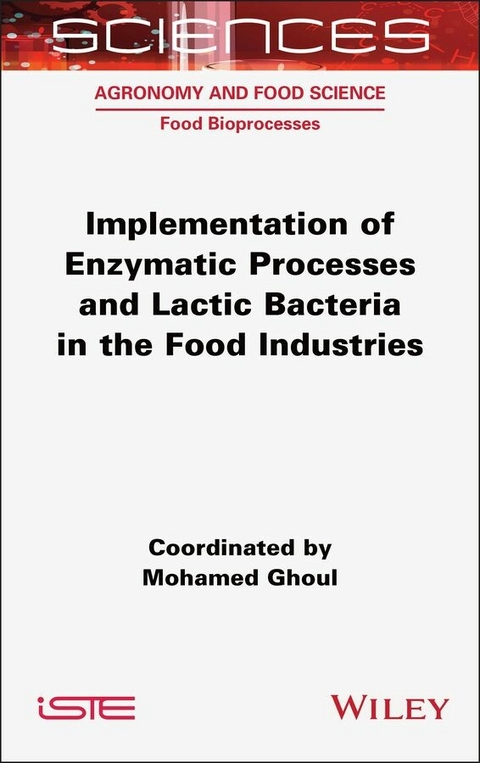
Implementation of Enzymatic Processes and Lactic Bacteria in the Food Industries (eBook)
436 Seiten
Wiley-Iste (Verlag)
9781394312320 (ISBN)
Consumers are demanding healthy, natural food products with no environmental impacts. The use of ingredients of plant origin and the implementation of bioprocesses using enzymes and micro-organisms as biocatalysts represent a promising alternative to satisfy this demand.
Implementation of Enzymatic Processes and Lactic Bacteria in the Food Industries focuses on describing the latest developments in the use of enzymatic biocatalysts and lactic acid bacteria in the food industry.
The first part of the book is devoted to the presentation of different classes of enzymes, production and application processes, ways of improving enzymes and the main industrial applications using biocatalysts.
The second part of the book describes a family of micro-organisms widely used in health food processing and formulation: lactic acid bacteria and bifidobacteria. Then, the most commonly used encapsulation matrices, encapsulation processes and the process of bacterial adhesion to these matrices are discussed. Finally, the best-known fermented foods and new approaches developed in this field are presented.
Mohamed Ghoul is a professor at the Université de Lorraine, France, and a researcher in process engineering, specializing in the implementation, modeling and optimization of bioprocesses.
Consumers are demanding healthy, natural food products with no environmental impacts. The use of ingredients of plant origin and the implementation of bioprocesses using enzymes and micro-organisms as biocatalysts represent a promising alternative to satisfy this demand. Implementation of Enzymatic Processes and Lactic Bacteria in the Food Industries focuses on describing the latest developments in the use of enzymatic biocatalysts and lactic acid bacteria in the food industry. The first part of the book is devoted to the presentation of different classes of enzymes, production and application processes, ways of improving enzymes and the main industrial applications using biocatalysts. The second part of the book describes a family of micro-organisms widely used in health food processing and formulation: lactic acid bacteria and bifidobacteria. Then, the most commonly used encapsulation matrices, encapsulation processes and the process of bacterial adhesion to these matrices are discussed. Finally, the best-known fermented foods and new approaches developed in this field are presented.
1
General Characteristics of Enzymes
Isabelle CHEVALOT1, Mohamed GHOUL1 and Seraphim PAPANIKOLAOU2
1 LRGP, CNRS, Université de Lorraine, Nancy, France
2 LFMB, Agricultural University of Athens, Greece
Enzymes are proteins that speed up chemical reactions. This acceleration process is called catalysis, and enzymes act as catalysts for chemical reactions. In enzymatic reactions, the molecules present at the start of the reaction are called “substrates”. Enzymes transform the substrates into different molecules called “products”. As with all catalysts, enzymes are not consumed by the reactions they catalyze and do not alter the equilibrium of these reactions. However, enzymes differ from most other catalysts by being much more specific. Numerous works detail the structure, functions, mechanisms, kinetics and technologies of enzyme catalysts (Pelmont 1997; Buchholz et al. 2005; Cornish-Bowden et al. 2005; Illanes 2008).
1.1. Notion of catalysis
Two factors are specifically involved in the rate laws for a chemical transformation: the pre-exponential factor (A) and the activation energy (Ea). The classical expression for the rate constant is:
This constant is only valid for a given system. From a set of reagents, through an appropriate reaction pathway, the system evolves toward the formation of products. Ea corresponds to the height of the potential barrier (Figure 1.1).
Unlike thermodynamics, which does not consider the path followed (the principle of initial and final states), chemical kinetics is largely dependent on it. By modifying this path, the potential barrier is altered. If Ea increases, the reaction-rate constant decreases and vice versa.
The principle of enzymatic catalysis is related to a reduction in the energy required for the reaction (Figure 1.1). The activation energy corresponds to the amount of energy absorbed by the substrate molecules required to move to an unstable transition or activated state, in which bonds are more fragile and easier to break. The transition state is located at the top of the energy barrier.
The enzyme reduces the activation energy by creating an environment in which the transition state is stabilized.
Figure 1.1. Schematic representation of the role of enzymes as biological catalysts, which act by lowering the activation energy of reactions, enabling the formation of reaction intermediates with lower activation energy.
1.2. Notion of specificity
One of the most remarkable properties of enzymes is their specificity. Some enzymes have a very strict specificity, only catalyzing one particular reaction. Other enzymes will be specific to a particular type of chemical bond or functional group.
This specificity is directly related to the structure of enzymatic proteins. Indeed, native proteins fold into a unique functional tertiary conformation that confers their biological activity, which may be that of a catalyst. This overall structure of the macromolecule enables a particular region to adopt a spatial structure, recognized by the protein’s specific ligand. In the case of enzymes, this particular region is known as the active site. Within the active site, a distinction is made between amino acids that constitute the binding site (these amino acids have no chemical functions involved in the reaction) and amino acids that constitute the catalytic site. The active site is made up of a small number of amino acids which, in most cases, are not contiguous in the polypeptide chain. These amino acids are characterized by side chains, whose chemical nature (ionizable groups) and structure (steric hindrance) are specifically adapted to substrate recognition. Enzyme specificity is determined by the complementary form, charge, hydrophilic/hydrophobic nature of the substrates and their three-dimensional structure.
Three types of specificity can be distinguished as follows:
- Chemo-specificity: it includes enzymes that are specific to certain functional groups, such as the amino, phosphate or methyl groups.
- Regio-specificity: it includes enzymes that are specific to a functional group, depending on its position within the structure of the molecule.
- Stereo-specificity: it includes stereospecific enzymes that only act on a steric or optical isomer and not on their homologous isomers.
1.3. Nomenclature
The International Commission on Enzymes, founded in 1955, has established an enzyme nomenclature system based on the type of reaction each enzyme catalyzes. Under this system, enzymes and coenzymes, their units of activity, standard assay methods and the symbols used to designate reaction kinetics are all grouped together in a single system. All enzymes are assigned a four-digit number according to the class, subclass and sub-subclass in which they have been classified. Each enzyme has been assigned a code number, consisting of four digits separated by dots. The first digit indicates the main class to which the enzymes belong:
- Oxidoreductases catalyze redox reactions in which hydrogen or oxygen atoms, or electrons are transferred between molecules. This extended class includes dehydrogenases (hydride transfer), oxidases (electron transfer to molecular oxygen), oxygenases (oxygen transfer from molecular oxygen) and peroxidases (electron transfer to peroxide). The second digit of the code indicates the reducing equivalent donor involved in the reaction. For example, glucose oxidase (EC 1.1.3.4 or β-D-glucose: oxygen 1-oxydoreductase), laccase (EC 1.14.18.1) and lipoxygenase (EC 1.13.11.12) are major enzymes of this class used in the food industry.
- Transferases catalyze the transfer of an atom, or group of atoms, between two molecules, apart from certain enzymes included in other groups (such as oxidoreductases and hydrolases). The International Commission recommends that the names of transferases end with X-transferase, where X is the transferring group. For example, glucanotransferase (EC 2.4.1.19) is used for the modification of starch into cyclodextrins. The second digit describes the transferred group.
- Hydrolases include enzymes catalyzing the hydrolytic cleavage of bonds, such as C – O, C – N, C – C, and a few others. They are classified according to the type of hydrolyzed bond. They are currently the most common class of enzymes used in enzyme technologies. In the food industry, the majority of enzymes classified as such include α-amylases (EC 3.2.1.1), β-amylases (EC 3.2.1.2), lactases (EC 3.2.1.23), lipases (EC 3.1.1.3) and proteases, including aminopeptidase (EC 3.4.11), trypsin (EC 3.4.21.4), subtilisin (EC 3.4.21.62), papain (EC 3.4.22.2), ficin (EC 3.4.22.3), pepsin (EC 3.4.23.1) and chymosin (EC 3.4.23.4).
- Lyases are involved in the non-hydrolytic elimination of certain groups by breaking various chemical bonds. This elimination often generates double bonds. The second digit in the classification indicates the broken bond. These include aldolases, decarboxylases and dehydratases. For example, acetolactate decarboxylase (EC 4.1.1.5) is used in the beer industry.
- Isomerases are enzymes that can catalyze various molecular isomerization reactions. These enzymes catalyze geometric or structural changes within a molecule. Depending on the type of isomerism involved, they may also be referred to as racemases, epimerases, cis-trans isomerases, isomerases, tautomerases, mutases or cycloisomerases, such as phosphoglucose isomerase (EC 5.3.1.9).
- Ligases, also known as synthetases, catalyze the synthesis of new bonds between two molecules. They link molecules by covalent bonds in biosynthetic reactions. These reactions require energy through hydrolysis of an ATP diphosphate bond or a similar triphosphate: this property justifies the difficulty of their application on an industrial scale. The second digit indicates the type of bond synthesized.
The second digit designates the enzyme sub-class, defined according to its mechanism of action. The third digit designates the nature of the molecule acting as acceptor in the case of electron transfer. The fourth digit is a sequence number within the group and sub-group. When an enzyme ends in 99, it is incompletely characterized.
Table 1.1 shows the six classes, the type of reaction catalyzed by the enzyme and an example for each class.
Table 1.1. Enzyme nomenclature
| No. | Classes | Reaction | Examples |
|---|
| 1 | Oxidoreductases | Oxidation-reduction reactions | Glucose oxidase (EC 1.1.3.4) |
| 2 | Transferases | Functional group transfer | Hexokinase (EC 2.7.1.2) |
| 3 | Hydrolases | Hydrolysis reactions | Carboxypeptidase A (EC 3.4.17.1) |
| 4 | Lyases | Addition of double bonds | Pyruvate decarboxylase (EC 4.1.1.1) |
| 5 | Isomerases | Isomerization reactions | Malate isomerase (EC 5.2.1.1) |
| 6 | Ligases | Bond formation (C–C, C–S, C–O and C–N) with ATP... |
| Erscheint lt. Verlag | 15.8.2024 |
|---|---|
| Reihe/Serie | ISTE Consignment |
| Sprache | englisch |
| Themenwelt | Naturwissenschaften |
| Wirtschaft | |
| Schlagworte | bifidobacteria • Biocatalysts • Bioprocesses • enzymes • fermented foods • food industry • Food Processing • Lactic acid |
| ISBN-13 | 9781394312320 / 9781394312320 |
| Informationen gemäß Produktsicherheitsverordnung (GPSR) | |
| Haben Sie eine Frage zum Produkt? |
 EPUB (Adobe DRM)
Kopierschutz: Adobe-DRM
Adobe-DRM ist ein Kopierschutz, der das eBook vor Mißbrauch schützen soll. Dabei wird das eBook bereits beim Download auf Ihre persönliche Adobe-ID autorisiert. Lesen können Sie das eBook dann nur auf den Geräten, welche ebenfalls auf Ihre Adobe-ID registriert sind.
Details zum Adobe-DRM
Dateiformat: EPUB (Electronic Publication)
EPUB ist ein offener Standard für eBooks und eignet sich besonders zur Darstellung von Belletristik und Sachbüchern. Der Fließtext wird dynamisch an die Display- und Schriftgröße angepasst. Auch für mobile Lesegeräte ist EPUB daher gut geeignet.
Systemvoraussetzungen:
PC/Mac: Mit einem PC oder Mac können Sie dieses eBook lesen. Sie benötigen eine
eReader: Dieses eBook kann mit (fast) allen eBook-Readern gelesen werden. Mit dem amazon-Kindle ist es aber nicht kompatibel.
Smartphone/Tablet: Egal ob Apple oder Android, dieses eBook können Sie lesen. Sie benötigen eine
Geräteliste und zusätzliche Hinweise
Buying eBooks from abroad
For tax law reasons we can sell eBooks just within Germany and Switzerland. Regrettably we cannot fulfill eBook-orders from other countries.
aus dem Bereich