


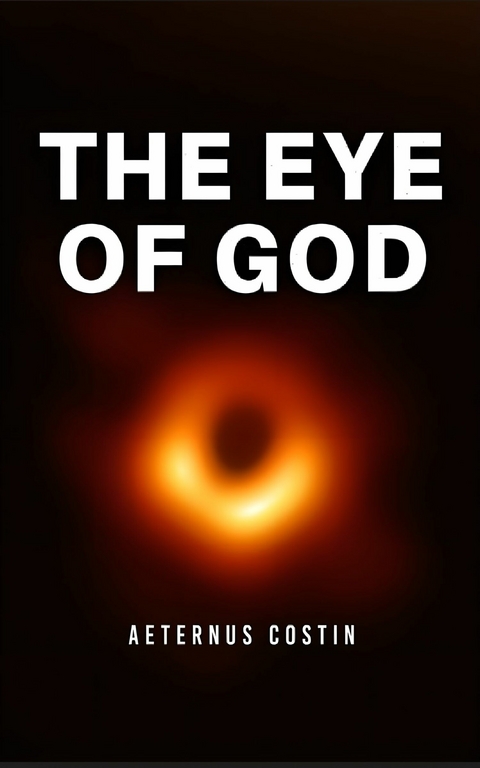
The Eye of God (eBook)
126 Seiten
Aeternus Costin Publications, LLC (Verlag)
9798989136018 (ISBN)
A profound journey through faith, reason, and the mysteries of existence
Born and raised in the heart of America's Bible Belt, Aeternus Costin's upbringing among devout Southern Baptists set the stage for a lifetime of spiritual exploration and philosophical inquiry.
From beginning to question his faith as a youth, to staunch atheism catalyzed by a deepening fascination with science and technology, Costin's voracious appetite for knowledge led him down the rabbit hole of scientific discovery.
Until one day, in a transformative moment during an ordinary drive, everything changed.
A chance encounter with a podcast on philosophy sparked an epiphany that shattered the author's atheistic convictions. This revelation transcended conventional beliefs and ignited a quest for understanding that would define the next chapter of his life.
The Eye of God is not just a memoir but a profound treatise on metaphysics and the nature of divinity itself. Through meticulous research and introspection, Costin unveils a startling hypothesis-that the key to comprehending the universe lies not in religious scripture but in the fundamental laws of nature. Drawing from the wisdom of philosophers ancient and modern, from Aristotle to Stephen Hawking, Costin weaves a compelling narrative that challenges the dichotomy between faith and science.
This book is a testament to the power of intellectual curiosity and the courage to challenge ingrained beliefs. It invites readers on a journey that spans centuries of human thought, offering a fresh perspective on the age-old question: What is the nature of God?
The Eye of God is a Literary Titan Book Award winner, and a must-read for anyone grappling with questions of faith, science, and the ultimate meaning of existence. It promises to provoke, inspire, and leave a lasting impression on all who dare to ponder the mysteries of the cosmos.
A profound journey through faith, reason, and the mysteries of existenceBorn and raised in the heart of America's Bible Belt, Aeternus Costin's upbringing among devout Southern Baptists set the stage for a lifetime of spiritual exploration and philosophical inquiry.From beginning to question his faith as a youth, to staunch atheism catalyzed by a deepening fascination with science and technology, Costin's voracious appetite for knowledge led him down the rabbit hole of scientific discovery.Until one day, in a transformative moment during an ordinary drive, everything changed.A chance encounter with a podcast on philosophy sparked an epiphany that shattered the author s atheistic convictions. This revelation transcended conventional beliefs and ignited a quest for understanding that would define the next chapter of his life.The Eye of God is not just a memoir but a profound treatise on metaphysics and the nature of divinity itself. Through meticulous research and introspection, Costin unveils a startling hypothesis that the key to comprehending the universe lies not in religious scripture but in the fundamental laws of nature. Drawing from the wisdom of philosophers ancient and modern, from Aristotle to Stephen Hawking, Costin weaves a compelling narrative that challenges the dichotomy between faith and science.This book is a testament to the power of intellectual curiosity and the courage to challenge ingrained beliefs. It invites readers on a journey that spans centuries of human thought, offering a fresh perspective on the age-old question: What is the nature of God?The Eye of God is a Literary Titan Book Award winner, and a must-read for anyone grappling with questions of faith, science, and the ultimate meaning of existence. It promises to provoke, inspire, and leave a lasting impression on all who dare to ponder the mysteries of the cosmos.
Chapter 1
I grew up and have lived my entire life in the southeastern United States, a region American journalist H. L. Mencken referred to as the Bible Belt in the 1920s.[1] The states that make up the region have less religious diversity than the rest of the nation, with Protestant Christianity being the majority faith by far. Only about half as many people in these states identify as nonreligious compared to the national average. And people in these states attend church more often than those who live in most other states.
My own family were Southern Baptists, although I occasionally attended Methodist churches with friends. My grandmother, who lived in the house next door, attended the First Baptist Church, which you could see one block from our home. She also taught Sunday school, played piano, and sang in church. My mother’s oldest sister was just as devout as my grandmother was. I remember my aunt singing the hymn, “I’ve got the joy, joy, joy, joy” to me when I was a child. My father’s parents traveled to churches as part of a gospel singing group, which is how my mother and father first met. Growing up, I wasn’t aware of anyone not believing in God.
At some point in junior high school, when I was between the ages of eleven and thirteen, I began to worry about the fate of the souls who had not accepted Jesus Christ as their Lord and Savior. I was a boy scout, and my scout master was also a Christian minister. I trusted him enough to share my doubts and concerns. I remember asking him what he believed happened to the souls of the Native Americans who had died before Christians colonized the country.
My trust in him was not misplaced. He agreed with me that it did not seem right for their souls to be damned and burn in hell for all eternity simply because they were not aware of Jesus Christ. He also agreed, though, that scripture implied that anyone who did not accept Jesus would suffer this horrible fate. He also acknowledged that I’d probably heard something during church service that implied this as well. But then he said it was his personal belief that even though that was what the Bible said, and what some preachers said as well, he did not believe God would do that. He believed instead that many Native Americans were as good as any Christian and had their own beliefs in their own way. He said he felt God would know and understand this and not punish them unjustly.
At the time I can remember feeling relieved. It made sense to me that God would know this. Also, it seemed possible to me that some people, like the Baptist preacher I had heard preaching hellfire and damnation for any nonbelievers, just simply had that wrong about God. But it wasn’t long before new doubts and concerns arose in my mind. I remember sitting alone in the woods while deer hunting as a young teenager wondering about God knowing all my thoughts. This was a strange feeling. Did I truly believe in God? Had I accepted Jesus Christ as my Lord and Savior? I felt like an imposter. I felt there was a God, and I felt he knew I was a fake Christian because I was having doubts. I felt God knew that I was saying I believed, while not truly allowing Jesus into my heart properly and walking the path of the righteous as I should.
I made up my mind to turn to the source of truth itself: I would read the Bible. I remember this felt like an incredibly important task. I told a religious friend I was going to read both the Old and New Testaments, cover to cover. I was surprised when she got angry and said that it could not be done. This seemed absurd to me. Of course it could be done. My aunt had read both several times. All one had to do was to start and read a little each night, not give up, and eventually the task would be complete. She then countered that even were I to do this, I would not understand what it said. Having not read both books before, I found the idea of understanding the scripture completely a task that I was less certain I could do, but I still believed in myself. In hindsight, I am amazed now by how many people who profess to be believers of any given religion have not actually ever read their religion’s doctrine.
But I believe that I know why, because I did not have to read far before I thought to myself, most of this is completely ridiculous! I can remember telling another friend, “It all just seems like the stories of the people at that time in those places.” He was confused by this, and he asked me, “Do you mean like stories that someone just made up?” At the time, I could not quite articulate what I meant, so I told him, “They seem like the stories people around here tell others about events. The people who are telling the stories seem to believe them, and they say that the stories are true, but you know that when you hear some of these stories that they are far-fetched.” He couldn’t accept this. Later when the topic of God came up in our friend group, he announced that I’d said that I believed the stories in the Bible were just that, only stories told by people long ago and not the word of God. Suddenly I felt as if it had been announced that I did not believe that Coach Paul “Bear” Bryant was a good football coach. Everyone laughed and turned to me smiling as if I were the most foolish person on earth. One exclaimed while laughing, “What?!”
I tried to explain myself. I asked the group, “What if, for instance, when Moses led the Jews out of Egypt, they came to a part of the Red Sea that usually had water, but for some reason like drought or something, it did not. They crossed that area, but later the Egyptians came along after them and they were not able to cross because there was water there now. And then the people who told the story believed that God protecting them was the reason this had happened?” They all just stared at me smiling, some shaking their heads. One person felt sorry for me I think, or perhaps wanted the awkwardness to end, so they tried to change the topic. Then one of them asked me, “So you don’t believe in God?” I answered, “That is not what I am saying. There is a God. But what if the Bible is just stories written a long time ago by people? I’m saying I don’t think all the stories happened exactly the way they are written, such as people living for hundreds of years, and Jonah being swallowed by a fish and surviving in its belly.”
Afterwards, I was offended that my belief in God had been questioned simply because I raised concerns about the outlandish stories I had read in the Bible. I searched within myself, and I did believe that there had to be a reason and a purpose for everything. I believed that the world and the people in it had to have been caused by something. Surely this was God, but it seemed more likely to me that people had just told all their own stories about this one God, which was how all the various religions and different beliefs had started.
In my early twenties, I joined the military as an enlisted member and left home for the first time. I don’t remember how, when, or even why I decided that I no longer believed in God, but at some point in my mid-twenties, I decided that the cause of the universe was the big bang, and the idea of a supernatural deity was an absurdity. Over the next decade I would oscillate between considering myself an atheist and considering myself agnostic.
Science was always my favorite subject in school. Perhaps that’s why I was always questioning everything. I was far from the best student in terms of attendance, doing homework, or getting good grades. If school had consisted just of science, history, and literature and I had been allowed to just read what I was curious about or conduct my own experiments all day, I believe I would have excelled. Instead, I was bored. Usually, I could be found in class staring out the window daydreaming. I always scored high on achievement tests and science tests in general, but I was an underachiever academically before I joined the military.
Once in the military I was trained in computer science. It was the mid-1990s just as personal computers and public access to the internet were taking off. I soaked up my training, finishing in the top of my class. I embraced every new technology, and I would spend countless hours reading, and testing and building networks and systems. After my active-duty tour ended, I made a career in Information Technology (IT). I quickly became a certified software engineer and a certified network and IT security specialist. In the late 1990s and early 2000s, I was on the internet night and day reading about new scientific discoveries and new technology.
Sometime during the fall of 2010, I read an article with a sensational headline. The article’s title proclaimed that famed English theoretical physicist Stephen Hawking had said that no God was necessary for the creation of the universe. Hawking claimed that the big bang was the result of natural laws of physics. The article included excerpts from a new book, The Grand Design, which Hawking had coauthored with US physicist Leonard Mlodinow. In the excerpt, Hawking wrote, “Because there is a law such as Gravity, the universe can and will create itself from nothing. Spontaneous creation is the reason there is something rather than nothing, why the universe exists, why we exist.” Hawking went on to say, “It is not necessary to invoke God to light the blue touch paper and set the universe going.”[2]
At the time, that seemed intuitive to me. I thought, of course the beginning of the universe was caused by some natural law like Gravity and not some conscious deity as we humans had believed before we created the scientific method...
| Erscheint lt. Verlag | 26.2.2024 |
|---|---|
| Sprache | englisch |
| Themenwelt | Geisteswissenschaften ► Philosophie ► Metaphysik / Ontologie |
| Geisteswissenschaften ► Religion / Theologie | |
| Naturwissenschaften ► Geowissenschaften ► Geophysik | |
| Schlagworte | Atheism • does god exist • God's existence • Gravity • History of Religion • Metaphysics • nature of God • philosophy books • Rational spirituality • Science and Philosophy • spiritual journey • The origin of christianity • the rise of Christianity |
| ISBN-13 | 9798989136018 / 9798989136018 |
| Informationen gemäß Produktsicherheitsverordnung (GPSR) | |
| Haben Sie eine Frage zum Produkt? |
 EPUB (Ohne DRM)
Digital Rights Management: ohne DRM
Dieses eBook enthält kein DRM oder Kopierschutz. Eine Weitergabe an Dritte ist jedoch rechtlich nicht zulässig, weil Sie beim Kauf nur die Rechte an der persönlichen Nutzung erwerben.
Dateiformat: EPUB (Electronic Publication)
EPUB ist ein offener Standard für eBooks und eignet sich besonders zur Darstellung von Belletristik und Sachbüchern. Der Fließtext wird dynamisch an die Display- und Schriftgröße angepasst. Auch für mobile Lesegeräte ist EPUB daher gut geeignet.
Systemvoraussetzungen:
PC/Mac: Mit einem PC oder Mac können Sie dieses eBook lesen. Sie benötigen dafür die kostenlose Software Adobe Digital Editions.
eReader: Dieses eBook kann mit (fast) allen eBook-Readern gelesen werden. Mit dem amazon-Kindle ist es aber nicht kompatibel.
Smartphone/Tablet: Egal ob Apple oder Android, dieses eBook können Sie lesen. Sie benötigen dafür eine kostenlose App.
Geräteliste und zusätzliche Hinweise
Buying eBooks from abroad
For tax law reasons we can sell eBooks just within Germany and Switzerland. Regrettably we cannot fulfill eBook-orders from other countries.
aus dem Bereich


