


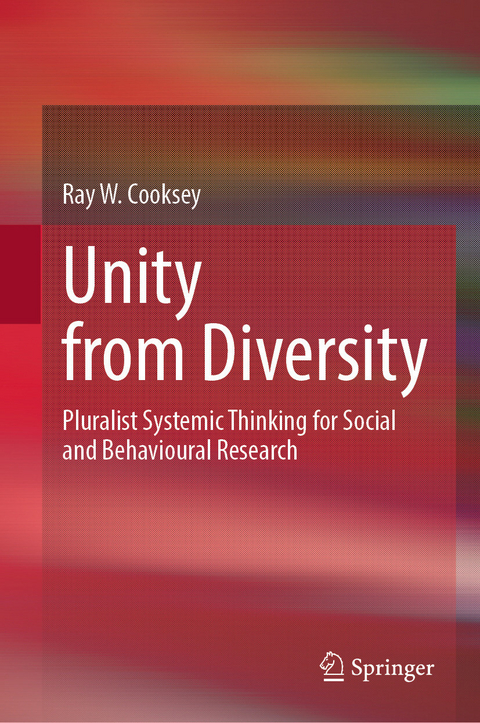
Unity from Diversity (eBook)
474 Seiten
Springer Nature Singapore (Verlag)
978-981-97-3462-7 (ISBN)
This book is about the choices that researchers can make when building knowledge in social and behavioural spaces. Knowledge is the unity we seek and, given that social and behavioural research is a human endeavour focusing on human lives and experiences, there are diverse and ever-evolving pathways towards achieving that unity. Any one pathway will only ever yield partial glimpses into human life and diversity of potential choices serves to enrich, expand, and enlarge those glimpses in pursuit of more complete understanding. The book shows that researchers and the researched are far more connected than disconnected in this world and those connections are spread out through a network of interlinked complex systems. The book argues that pluralist systemic thinking provides the means by which a researcher’s methodological choices for navigating the ‘Data Triangle’ (comprising data source, data gathering, and data analysis strategies) and the learning they provide can be fully and robustly contextualised with respect to those systems and the expectations and influences that emerge from them. Such contextualisations facilitate the refinement, augmentation, and/or narrowing of those choices during the researcher’s journey. Anticipating choices downstream may have implications for more immediate choices and more immediate choices may create a cascade of necessary downstream choices. An essential part of contextualisation involves making choices about patterns of guiding assumptions, modes of knowledge building, and research frames. Researchers must develop the capacity to be flexible and adapt to unanticipated emergent events, obstacles, and political influences, making trade-offs where necessary throughout their research journey, always with an eye on both feasibility and quality. Importantly, research has no meaning unless the researcher can ensure that it connects with intended audiences via specific research outcomes, especially since the ultimate judgments about the convincingness, meaningfulness, quality, and utility of the research are vested in those audiences. Throughout the book, special attention is devoted to the role(s) that stakeholders and gatekeepers play in shaping the researcher’s journey as well as to what can be learned from Indigenous/First Nations perspectives on social and behavioural research.
This book is about the choices that researchers can make when building knowledge in social and behavioural spaces. Knowledge is the unity we seek and, given that social and behavioural research is a human endeavour focusing on human lives and experiences, there are diverse and ever-evolving pathways towards achieving that unity. Any one pathway will only ever yield partial glimpses into human life and diversity of potential choices serves to enrich, expand, and enlarge those glimpses in pursuit of more complete understanding. The book shows that researchers and the researched are far more connected than disconnected in this world and those connections are spread out through a network of interlinked complex systems. The book argues that pluralist systemic thinking provides the means by which a researcher's methodological choices for navigating the 'Data Triangle' (comprising data source, data gathering, and data analysis strategies) and the learning they provide can be fully and robustly contextualised with respect to those systems and the expectations and influences that emerge from them. Such contextualisations facilitate the refinement, augmentation, and/or narrowing of those choices during the researcher's journey. Anticipating choices downstream may have implications for more immediate choices and more immediate choices may create a cascade of necessary downstream choices. An essential part of contextualisation involves making choices about patterns of guiding assumptions, modes of knowledge building, and research frames. Researchers must develop the capacity to be flexible and adapt to unanticipated emergent events, obstacles, and political influences, making trade-offs where necessary throughout their research journey, always with an eye on both feasibility and quality. Importantly, research has no meaning unless the researcher can ensure that it connects with intended audiences via specific research outcomes, especially since the ultimate judgments about the convincingness, meaningfulness, quality, and utility of the research are vested in those audiences. Throughout the book, special attention is devoted to the role(s) that stakeholders and gatekeepers play in shaping the researcher's journey as well as to what can be learned from Indigenous/First Nations perspectives on social and behavioural research.
| Erscheint lt. Verlag | 15.7.2024 |
|---|---|
| Zusatzinfo | XVII, 474 p. 53 illus., 51 illus. in color. |
| Sprache | englisch |
| Themenwelt | Mathematik / Informatik ► Informatik ► Datenbanken |
| Mathematik / Informatik ► Mathematik ► Statistik | |
| Naturwissenschaften | |
| Sozialwissenschaften ► Pädagogik ► Allgemeines / Lexika | |
| Sozialwissenschaften ► Pädagogik ► Erwachsenenbildung | |
| Sozialwissenschaften ► Soziologie ► Empirische Sozialforschung | |
| Schlagworte | behavioural research • meta-criteria for research quality • Mixed Methods • Multimethodology • multi-paradigm research • pluralist research methods • qualitative methods • Quantitative Methods • Social Research • systems thinking in research |
| ISBN-10 | 981-97-3462-2 / 9819734622 |
| ISBN-13 | 978-981-97-3462-7 / 9789819734627 |
| Informationen gemäß Produktsicherheitsverordnung (GPSR) | |
| Haben Sie eine Frage zum Produkt? |
 PDF (Wasserzeichen)
DRM: Digitales Wasserzeichen
Dieses eBook enthält ein digitales Wasserzeichen und ist damit für Sie personalisiert. Bei einer missbräuchlichen Weitergabe des eBooks an Dritte ist eine Rückverfolgung an die Quelle möglich.
Dateiformat: PDF (Portable Document Format)
Mit einem festen Seitenlayout eignet sich die PDF besonders für Fachbücher mit Spalten, Tabellen und Abbildungen. Eine PDF kann auf fast allen Geräten angezeigt werden, ist aber für kleine Displays (Smartphone, eReader) nur eingeschränkt geeignet.
Systemvoraussetzungen:
PC/Mac: Mit einem PC oder Mac können Sie dieses eBook lesen. Sie benötigen dafür einen PDF-Viewer - z.B. den Adobe Reader oder Adobe Digital Editions.
eReader: Dieses eBook kann mit (fast) allen eBook-Readern gelesen werden. Mit dem amazon-Kindle ist es aber nicht kompatibel.
Smartphone/Tablet: Egal ob Apple oder Android, dieses eBook können Sie lesen. Sie benötigen dafür einen PDF-Viewer - z.B. die kostenlose Adobe Digital Editions-App.
Buying eBooks from abroad
For tax law reasons we can sell eBooks just within Germany and Switzerland. Regrettably we cannot fulfill eBook-orders from other countries.
aus dem Bereich


