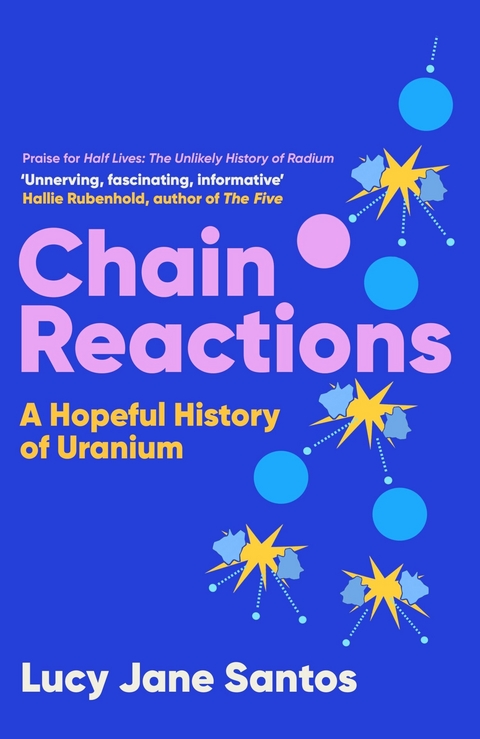
Chain Reactions (eBook)
318 Seiten
Icon Books Ltd (Verlag)
978-1-83773-155-8 (ISBN)
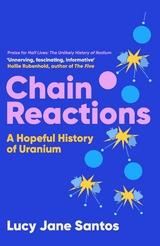
Lucy Jane Santos, author of Half Lives: The Unlikely History of Radium and Chain Reactions: A Hopeful History of Uranium, is an expert in the history of the twentieth-century with a particular interest in the cultural history of all things nuclear. She is the Executive Secretary of the British Society for the History of Science. Lucy lives in England.
Lucy Jane Santos, author of Half Lives: The Unlikely History of Radium and Chain Reactions: A Hopeful History of Uranium, is an expert in the history of twentieth-century with a particular interest in the cultural history of all things nuclear. She is the Executive Secretary of the British Society for the History of Science. Lucy lives in England.
| THE EARLY HISTORY | 1 |
Johannes Kentmann was fascinated by rocks. The Dresden-born physician had other passions – he also wrote books about herbal medicine, as well as biology and botany1 – but it was mineralogy that stirred him the most. Kentmann was so passionate about his subject that he had a cabinet with thirteen numbered drawers installed to house his comprehensive collection of minerals, which he called an ‘ark’. In 1565, this collection was catalogued in De Omni Rerum Fossilium Genere, Gemmis, Lapidibus, Metallis, et huiusmodi (On Every Kind of Fossils, Gems, Stones, Metals and the Like), a composite volume of works by seven authors edited by the Swiss naturalist Conrad Gessner.
Kentmann’s volume – described in Gessner’s book as being collated by ‘the first man in Europe to make a collection of minerals’ – consisted of individual entries for 1,608 specimens representing 26 different groups of minerals from 135 locations. And one of these, the ore bechblende, is the beating black heart in the story of uranium.
Pechblende (somewhere in the fourteenth century there was a shift in German vowels and the b became a p) seems to have been named for both its appearance and for its reputation. As Kentmann’s catalogue entry indicates, the substance was black, hence ‘pech’, which in German can mean dark and sticky. ‘Blende’ means mixture, which is a fitting description, as pechblende can be made up from up to 30 different elements. But there was a double meaning to the name as well: ‘blenden’ means to deceive and ‘pech haben’ is to have bad luck. While Kentmann was the first to publish a formal identification – listing it as a sterile lead similar to black pitch – the mineral wasn’t totally unknown.
In fact, miners were very familiar with pechblende, much to their annoyance. Finding pechblende meant the valuable stuff you were looking for, like silver or gold, was almost running out. Pechblende was a sign to move on.
Later, the sheer quantity of pechblende would be a huge problem for miners working in the Erzgebirge mountain range, which ran between the borders of Saxony and Bohemia. But it wasn’t always that way; in the early 1500s a rich vein of silver ore had been discovered in the Bohemian part of the Erzgebirge, an area that is now part of the Czech Republic.
The owner of the land, Count Stefan Schlick, built a castle called Schloss Freudenstein to fortify a newly built town to house the miners. By 1518, there were over 400 houses and 8,000 miners working the site, and the town came to be known as Sankt Joachimsthal.2
Thanks to the rich pickings in the mine, St Joachimsthal grew in importance, being granted royal status in 1520.3 As befitting of their new significance, the Schlicks were also given permission to mint their own coins, an honour which allowed them to consolidate the power of the town. Schlick brought in two mint masters, Ulrich Gebhart and Stephan Gemisch, and developed a new currency based on coins known as ‘Joachimsthalers’. By the seventeenth century the use of these large silver coins had spread across central Europe and they became the dominant unit of currency, accepted in neighbouring kingdoms without the need to exchange for local monies.4
The Schlicks had been appointed as administrators and the principal suppliers of the silver used to mint all the coins. However, these privileges only lasted a few years. The state treasury soon realised they were missing out on the profits from producing their own coins and took the Schlick mint and placed it under royal administration and operation. Nevertheless, the Schlicks still profited greatly from the arrangement, with an estimated 250,000 kilograms of silver mined between 1516 and 1554.5
Joachimsthal was a prosperous and vibrant town that attracted many influential people, including Georg Bauer, who was better known by his pen name Georgius Agricola. Bauer was a linguist, scholar and teacher who was appointed as the town’s physician in 1527, having obtained his medical degree from the University of Bologna.6 During his few years in the town, he became very interested in the mines and its workers and went on to publish ten texts on the topic, the first one in 1530.
His best-known work, De Re Metallica (On the Nature of Metals) was published posthumously. Written in Latin, the book is divided into twelve chapters, each of which deals with a different aspect of mining and metallurgy. It is also known for its vivid, detailed illustrations, made by artists and woodcutters.7 Some of the images in De Re Metallica show miners digging for ore, using hand tools and explosives to extract minerals from the earth. Others show the refining process, such as the smelting of metals in furnaces and the casting of metals into moulds. The book also includes images of various technologies in use at the time, such as bellows to provide air to furnaces and waterwheels to power mills.
Bauer was specifically concerned about the working conditions of the miners and, ultimately, the perils of following profits at all costs warning:
It remains for me to speak of the ailments and accidents of miners, and of the methods by which they can guard against these, for we should always devote more care to maintaining our health, that we may freely perform our body functions, than to making profits.8
While mining was, and still is, an incredibly dangerous occupation in its own right, Bauer was particularly concerned about a respiratory illness known as bergsucht, which had first been described by the alchemist known as Paracelsus in 1533 and referred to as ‘Mala Metallorum’.9
Although no one knew exactly what caused this often-fatal illness, it was widely accepted that it was caused by some kind of poisonous dust. And while arsenic, one of the many toxic minerals found in the mountains, was the official suspect, the miners had their own theory: evil mountain gnomes who were intent on punishing those who violated their underground domain.10
Bauer didn’t discount this:
In some of our mines, however, though in very few, there are other pernicious pests. These are demons of ferocious aspect, about which I have spoken in my book De animatibus subterrabeis [On Underground Spirits]. Demons of this kind are expelled and put to flight by prayer and fasting.11
Bauer didn’t just report on the problems; he also suggested practical ways to improve the conditions within the mines, including masks, gloves and protective clothing.12 Over fifteen pages Bauer discusses the construction of different types of ventilation machines, using wind, fans and bellows, which could help provide fresh air rather than the stagnant air naturally present in the mines.13
Bauer died in 1555 at the age of 61 – his recommendations either not carried out or found ineffective against the dreaded bergsucht. His contemporary Paracelsus was also unable to pinpoint what was ailing the miners, but he did distinguish between the acute and chronic toxic effects of metals.14
By the latter half of the sixteenth century, Joachimsthal’s prospects were in a downward spiral that it never really recovered from. There were outbreaks of plague, a change of ruling empires, suppression of nationalism, the town was sacked and Freudenstein castle was destroyed by fire. Competition from outside of Europe was also driving the price of silver down, most notably the discovery and exploitation of vast silver mines in Mexico and Peru following the conquests of Cortés and Pizarro. These mines were worked on a massive scale, using forced labour, including African slaves. The Spanish colonisers in Peru even encouraged coca-chewing by the workers to increase their energy and therefore their productivity.15 And compounding these issues was the fact that the silver in the Joachimsthal mines, or at least the silver that the technology available at the time allowed them to reach, was running out.16
Decades after Joachimsthal had begun its freefall into historical obscurity, a man started a journey that would change the town’s fortunes once again. Martin Heinrich Klaproth might have set out on the path to priesthood, but fate had other plans for him. Instead of pursuing a religious vocation, Klaproth became a self-taught expert in analysing minerals, investigating hundreds of different samples in his lifetime. And he made some game-changing discoveries along the way. Arguably the founder of the new science of analytic chemistry, he discovered zirconium (1789), separated strontium-28 from calcium and confirmed the discovery of the substance that came to be known as titanium (1792).
But Klaproth’s most groundbreaking work came in 1789 while investigating two of the minerals found in Erzgebirge’s silver deposits: pechblende and torbernite. What he encountered during his analysis of torbernite led him to a stunning discovery, but it was pechblende that he used to conduct his further investigations.17 Dissolving the ore in nitric acid and neutralising the solution with sodium hydroxide, he found a yellow compound that he heated with charcoal to obtain a black powder. As his experiments had determined that this sample was chemically indivisible, i.e. he couldn’t separate anything else from it, Klaproth was convinced he had discovered a new element.
On the evening of 24 September 1789, Klaproth addressed the Royal Prussian Academy of Sciences in Berlin and...
| Erscheint lt. Verlag | 4.7.2024 |
|---|---|
| Verlagsort | London |
| Sprache | englisch |
| Themenwelt | Geisteswissenschaften ► Geschichte |
| Naturwissenschaften ► Physik / Astronomie ► Atom- / Kern- / Molekularphysik | |
| ISBN-10 | 1-83773-155-1 / 1837731551 |
| ISBN-13 | 978-1-83773-155-8 / 9781837731558 |
| Informationen gemäß Produktsicherheitsverordnung (GPSR) | |
| Haben Sie eine Frage zum Produkt? |
 EPUB (Wasserzeichen)
DRM: Digitales Wasserzeichen
Dieses eBook enthält ein digitales Wasserzeichen und ist damit für Sie personalisiert. Bei einer missbräuchlichen Weitergabe des eBooks an Dritte ist eine Rückverfolgung an die Quelle möglich.
Dateiformat: EPUB (Electronic Publication)
EPUB ist ein offener Standard für eBooks und eignet sich besonders zur Darstellung von Belletristik und Sachbüchern. Der Fließtext wird dynamisch an die Display- und Schriftgröße angepasst. Auch für mobile Lesegeräte ist EPUB daher gut geeignet.
Systemvoraussetzungen:
PC/Mac: Mit einem PC oder Mac können Sie dieses eBook lesen. Sie benötigen dafür die kostenlose Software Adobe Digital Editions.
eReader: Dieses eBook kann mit (fast) allen eBook-Readern gelesen werden. Mit dem amazon-Kindle ist es aber nicht kompatibel.
Smartphone/Tablet: Egal ob Apple oder Android, dieses eBook können Sie lesen. Sie benötigen dafür eine kostenlose App.
Geräteliste und zusätzliche Hinweise
Buying eBooks from abroad
For tax law reasons we can sell eBooks just within Germany and Switzerland. Regrettably we cannot fulfill eBook-orders from other countries.
aus dem Bereich