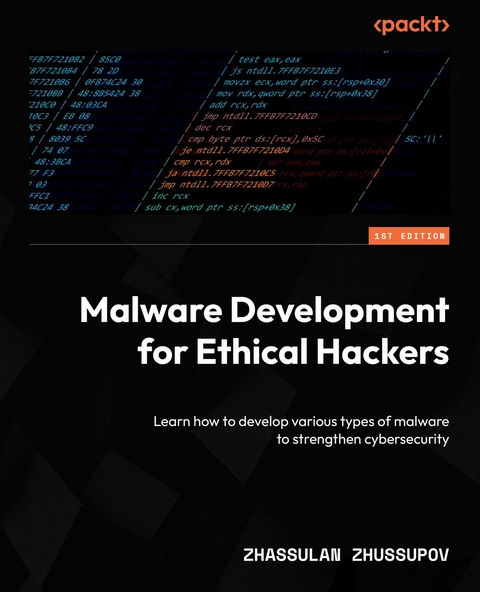
Malware Development for Ethical Hackers (eBook)
390 Seiten
Packt Publishing Limited (Verlag)
9781801076975 (ISBN)
No detailed description available for "e;Malware Development for Ethical Hackers"e;.
Preface
Welcome to our comprehensive guide on malware development and offensive programming. In this book, we embark on a journey through the intricate world of malware, exploring its evolution, development techniques, and defensive strategies. From understanding the anatomy of malware to mastering advanced cryptographic techniques, each chapter will equip you with valuable insights and practical knowledge. Whether you’re a cybersecurity enthusiast, a budding malware analyst, or a seasoned professional, this book offers something for you. By the end of our journey, you’ll be well-versed in the tools, tactics, and techniques used by both malware creators and researchers in the ever-evolving landscape of cybersecurity.
Who this book is for
This book is tailored for cybersecurity professionals, malware analysts, penetration testers, and aspiring ethical hackers seeking to deepen their understanding of malware development and offensive programming. It is also suitable for software developers and IT professionals interested in enhancing their knowledge of cybersecurity threats and defensive techniques. While some familiarity with programming languages such as C/C++, Python, or PowerShell will be beneficial, the book provides comprehensive explanations and examples suitable for both intermediate and advanced readers. Whether you’re looking to bolster your offensive cybersecurity skill set or gain insights into the tactics employed by malicious actors, this book offers valuable insights and practical examples.
What this book covers
Chapter 1, A Quick Introduction to Malware Development, aims to familiarize you with the intricate domain of malware development and offensive programming. It covers essential concepts, the structure of malware, diverse development techniques, and basic compilation methods. Additionally, it discusses the tools and Windows internals theory employed by malware developers.
Chapter 2, Exploring Various Malware Injection Attacks, explores practical demonstrations of various malware injection strategies. It begins with conventional approaches, such as code and DLL injection, and advances to more sophisticated techniques, including thread hijacking and API hooking.
Chapter 3, Mastering Malware Persistence Mechanisms, discusses how to achieve persistence on a compromised system, as it significantly enhances the stealthiness of malware, enabling it to persist even after system restarts, logoffs, or reboots following a single injection or exploit. This chapter concentrates exclusively on Windows systems, given their extensive support for persistence mechanisms such as Autostart. It covers prevalent techniques for establishing persistence on Windows machines. You will develop basic malware and implement various methods to ensure its persistence on the victim’s system.
Chapter 4, Mastering Privilege Escalation on Compromised Systems, delves into common privilege escalation techniques employed in Windows operating systems. In many cases, malware may not have sufficient access upon initial compromise to fully execute its malicious objectives. This is where privilege escalation becomes crucial. From Access Token Manipulation to DLL search order hijacking and bypassing User Access Control, this chapter explores various methods and techniques. You will not only learn about the underlying mechanisms but also witness practical applications in real-world scenarios.
Chapter 5, Anti-Debugging Tricks, explores the methods by which an application can identify if it is being debugged or scrutinized by an analyst. Numerous techniques exist for detecting debugging, and we’ll delve into several of them in this chapter. While analysts can counteract each technique, some are more intricate than others.
Chapter 6, Navigating Anti-Virtual Machine Strategies, explains how to implement anti-virtual machine (anti-VM) measures to thwart analysis attempts. Anti-VM techniques are prevalent in widely distributed malware, such as bots, scareware, and spyware, primarily because VMs are commonly used in sandboxes. Since these malware types typically target average users’ computers, which are less likely to run VMs, anti-VM strategies are crucial.
Chapter 7, Strategies for Anti-Disassembly, focuses on equipping readers with anti-disassembly and anti-debugging methods to fortify their code. Anti-disassembly involves incorporating specific code or data into a program to deceive disassembly analysis tools, leading to an inaccurate program listing. Malware authors employ this technique either manually, using dedicated tools during creation and deployment, or by integrating it into their malware’s source code. This chapter enhances the expertise necessary for successful malware development.
Chapter 8, Navigating the Antivirus Labyrinth – a Game of Cat and Mouse, enhances your malware development skills by explaining how to circumvent AV/EDR systems. Currently, antivirus software utilizes diverse methods to detect harmful code within files. These techniques include static detection, dynamic analysis, and behavioral analysis, particularly in more advanced Endpoint Detection and Response (EDR) systems.
Chapter 9, Exploring Hash Algorithms, explores prevalent hash algorithms utilized in malware and provides examples illustrating their implementation. Hash algorithms are pivotal in malware, and are frequently employed for diverse tasks such as verifying the integrity of downloaded components or evading detection by altering a file’s hash.
Chapter 10, Simple Ciphers, delves into the usage of ciphers in malware for code obfuscation or data encryption. It simplifies advanced cryptography by focusing on basic ciphers such as the Caesar cipher, the substitution cipher, and the transposition cipher. You will learn about these foundational encryption methods and their mechanisms, strengths, and weaknesses. Practical examples demonstrate their application in real malware, illustrating how even simple ciphers can pose challenges to analysts.
Chapter 11, Unveiling Common Cryptography in Malware, investigates the prevalent cryptographic methods utilized in malware for securing communication and safeguarding payloads.
Chapter 12, Advanced Math Algorithms and Custom Encoding, introduces intricate mathematical algorithms and personalized encoding methods that certain malware creators utilize to elevate the complexity of their malware. This chapter will scrutinize such techniques, going beyond conventional cryptographic approaches to examine advanced mathematical algorithms and customized encoding techniques employed by malware developers to fortify their creations. Topics encompass custom encryption and encoding schemes for obfuscation, as well as sophisticated mathematical constructs and number theory. Real-world instances of malware utilizing these advanced techniques will be employed to elucidate these concepts.
Chapter 13, Classic Malware Examples, guides you through the historical evolution of malware, analyzing iconic examples that have significantly impacted the digital realm. Since the inception of computing, malware has posed a persistent threat. From early viruses such as ILOVEYOU and MyDoom to infamous worms such as Stuxnet, Carberp, and Carbanak, you will delve into the functionalities, propagation methods, and payloads of these historic menaces. Each case study not only elucidates fundamental concepts of malware design and operation but also provides context for the emergence of these threats, offering a comprehensive understanding of the continually evolving strategies in malware development and the cyber threat landscape.
Chapter 14, APT and Cybercrime, introduces Advanced Persistent Threats (APTs) and their significance in cybercrime. You will learn about the characteristics of APTs, explore infamous examples, and delve into the techniques employed by these APTs.
Chapter 15, Malware Source Code Leaks, explores the impact of malware source code leaks on cyber security, highlighting both the opportunities they present for researchers and the risks they pose for the proliferation of more sophisticated malicious software. You will examine notable historical incidents of malware source code leaks and gain an understanding of how these leaks occur and the information they reveal. Additionally, this chapter delves into the ways in which leaked source code has influenced the development of advanced malware techniques. By discussing strategies for managing and securing source code, you will also learn how to analyze leaked code for offensive purposes.
Chapter 16, Ransomware and Modern Threats, delves into modern ransomware threats, elucidating their encryption methods, communication with command and control servers, and ransom demands. It also...
| Erscheint lt. Verlag | 12.7.2024 |
|---|---|
| Sprache | englisch |
| Themenwelt | Informatik ► Netzwerke ► Sicherheit / Firewall |
| Informatik ► Theorie / Studium ► Kryptologie | |
| Mathematik / Informatik ► Informatik ► Web / Internet | |
| Naturwissenschaften | |
| ISBN-13 | 9781801076975 / 9781801076975 |
| Informationen gemäß Produktsicherheitsverordnung (GPSR) | |
| Haben Sie eine Frage zum Produkt? |
 PDF (Wasserzeichen)
Größe: 28,4 MB
DRM: Digitales Wasserzeichen
Dieses eBook enthält ein digitales Wasserzeichen und ist damit für Sie personalisiert. Bei einer missbräuchlichen Weitergabe des eBooks an Dritte ist eine Rückverfolgung an die Quelle möglich.
Dateiformat: PDF (Portable Document Format)
Mit einem festen Seitenlayout eignet sich die PDF besonders für Fachbücher mit Spalten, Tabellen und Abbildungen. Eine PDF kann auf fast allen Geräten angezeigt werden, ist aber für kleine Displays (Smartphone, eReader) nur eingeschränkt geeignet.
Systemvoraussetzungen:
PC/Mac: Mit einem PC oder Mac können Sie dieses eBook lesen. Sie benötigen dafür einen PDF-Viewer - z.B. den Adobe Reader oder Adobe Digital Editions.
eReader: Dieses eBook kann mit (fast) allen eBook-Readern gelesen werden. Mit dem amazon-Kindle ist es aber nicht kompatibel.
Smartphone/Tablet: Egal ob Apple oder Android, dieses eBook können Sie lesen. Sie benötigen dafür einen PDF-Viewer - z.B. die kostenlose Adobe Digital Editions-App.
Buying eBooks from abroad
For tax law reasons we can sell eBooks just within Germany and Switzerland. Regrettably we cannot fulfill eBook-orders from other countries.
 EPUB (Ohne DRM)
Digital Rights Management: ohne DRM
Dieses eBook enthält kein DRM oder Kopierschutz. Eine Weitergabe an Dritte ist jedoch rechtlich nicht zulässig, weil Sie beim Kauf nur die Rechte an der persönlichen Nutzung erwerben.
Dateiformat: EPUB (Electronic Publication)
EPUB ist ein offener Standard für eBooks und eignet sich besonders zur Darstellung von Belletristik und Sachbüchern. Der Fließtext wird dynamisch an die Display- und Schriftgröße angepasst. Auch für mobile Lesegeräte ist EPUB daher gut geeignet.
Systemvoraussetzungen:
PC/Mac: Mit einem PC oder Mac können Sie dieses eBook lesen. Sie benötigen dafür die kostenlose Software Adobe Digital Editions.
eReader: Dieses eBook kann mit (fast) allen eBook-Readern gelesen werden. Mit dem amazon-Kindle ist es aber nicht kompatibel.
Smartphone/Tablet: Egal ob Apple oder Android, dieses eBook können Sie lesen. Sie benötigen dafür eine kostenlose App.
Geräteliste und zusätzliche Hinweise
Buying eBooks from abroad
For tax law reasons we can sell eBooks just within Germany and Switzerland. Regrettably we cannot fulfill eBook-orders from other countries.
aus dem Bereich