


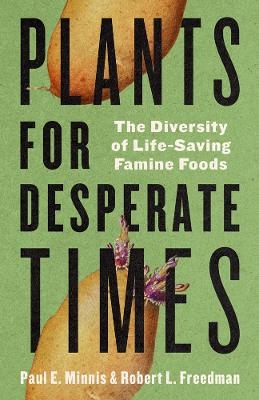
Plants for Desperate Times
The Diversity of Life-Saving Famine Foods
Seiten
2024
University of Arizona Press (Verlag)
978-0-8165-5376-1 (ISBN)
University of Arizona Press (Verlag)
978-0-8165-5376-1 (ISBN)
Famines and other serious food shortages have been one of the scourges faced by humanity for millennia. Plants for Desperate Times is an introduction to the diversity of plant foods that have saved millions of lives during lethal food shortages. The work highlights one hundred plants.
Famines and other serious food shortages have been one of the scourges faced by humanity for millennia.
Plants for Desperate Times is an introduction to the diversity of plant foods that have saved millions of lives during lethal food shortages. While not a field guide, it addresses questions about what famine foods are and why they are important. The work highlights one hundred plants. Each entry includes the common and scientific names, botanical family, distribution, use as a famine food and other uses, and nutritional information. The species come from across the botanical kingdom, demonstrating the diversity of life-saving plants and the human ingenuity of making what might seem to be inedible plants edible. Unexpectedly, important famine foods include alternative uses of important crops as well as native plants.
Beyond a study of famine foods, the authors share why keeping an inventory of plant foods of last resort is so important. They help to build an understanding of little-known and underappreciated foods that may have a greater role in provisioning humanity in the future. As much as we may hope that severe food scarcity will never occur again, history suggests otherwise, and Plants for Desperate Times provides invaluable documentation of these vital foods.
Famines and other serious food shortages have been one of the scourges faced by humanity for millennia.
Plants for Desperate Times is an introduction to the diversity of plant foods that have saved millions of lives during lethal food shortages. While not a field guide, it addresses questions about what famine foods are and why they are important. The work highlights one hundred plants. Each entry includes the common and scientific names, botanical family, distribution, use as a famine food and other uses, and nutritional information. The species come from across the botanical kingdom, demonstrating the diversity of life-saving plants and the human ingenuity of making what might seem to be inedible plants edible. Unexpectedly, important famine foods include alternative uses of important crops as well as native plants.
Beyond a study of famine foods, the authors share why keeping an inventory of plant foods of last resort is so important. They help to build an understanding of little-known and underappreciated foods that may have a greater role in provisioning humanity in the future. As much as we may hope that severe food scarcity will never occur again, history suggests otherwise, and Plants for Desperate Times provides invaluable documentation of these vital foods.
Paul E. Minnis is a professor emeritus of anthropology at the University of Oklahoma now living in Tucson, Arizona, where he is a visiting scholar in the School of Anthropology at the University of Arizona. He is the author or editor of fifteen books, including Famine Foods: Plants We Eat to Survive, and numerous articles. Robert L. Freedman received a BA in Oriental studies and cultural anthropology from the University of Arizona. In 1996, Freedman created The Famine Foods Database, which is hosted by Purdue University’s New Crops website.
| Erscheinungsdatum | 25.10.2024 |
|---|---|
| Zusatzinfo | 111 b&w photos, 6 tables |
| Verlagsort | Tucson |
| Sprache | englisch |
| Maße | 140 x 216 mm |
| Themenwelt | Sachbuch/Ratgeber ► Natur / Technik ► Natur / Ökologie |
| Naturwissenschaften ► Geowissenschaften ► Geografie / Kartografie | |
| Sozialwissenschaften ► Ethnologie | |
| Sozialwissenschaften ► Soziologie | |
| ISBN-10 | 0-8165-5376-9 / 0816553769 |
| ISBN-13 | 978-0-8165-5376-1 / 9780816553761 |
| Zustand | Neuware |
| Informationen gemäß Produktsicherheitsverordnung (GPSR) | |
| Haben Sie eine Frage zum Produkt? |
Mehr entdecken
aus dem Bereich



aus dem Bereich
die Geschichte einer außergewöhnlichen Begegnung
Buch | Hardcover (2025)
Klett-Cotta (Verlag)
CHF 34,90
eine Geschichte der letzten 500 Jahre
Buch | Hardcover (2025)
C.H.Beck (Verlag)
CHF 47,60


