


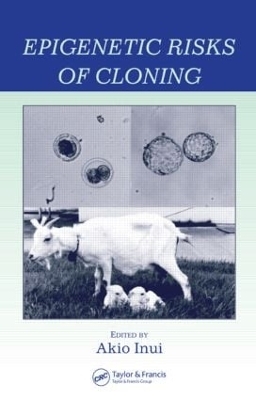
Epigenetic Risks of Cloning
Seiten
2005
Crc Press Inc (Verlag)
978-0-8493-2527-4 (ISBN)
Crc Press Inc (Verlag)
978-0-8493-2527-4 (ISBN)
Describes various cloning methods that are employed with various animal models. This book considers the high rates of fetal, perinatal, and neonatal loss, as well as the production of abnormal offspring.
Cloning has the potential to be an extremely valuable tool across many fields. In agriculture, the reproductive cloning of farm animals could prove to be advantageous. In clinical medicine, the employment of therapeutic cloning for cell, tissue, and organ replacement appears to be imminent. In Epigenetic Risks of Cloning, 32 leading researchers detail the cloning methods being employed with various animal models, providing both a review of current findings and a discussion of potential concerns. Less than four percent of reconstructed embryos typically develop to adulthood, the cumulative result of inefficiencies occurring at every stage of development. This book considers the very real consequences of those inefficiencies: high rates of fetal, perinatal, and neonatal loss, as well as the production of abnormal offspring. At present, there is a legitimate concern that the propensity for epigenetic errors could be paralleled in human embryos.
Cloning has the potential to be an extremely valuable tool across many fields. In agriculture, the reproductive cloning of farm animals could prove to be advantageous. In clinical medicine, the employment of therapeutic cloning for cell, tissue, and organ replacement appears to be imminent. In Epigenetic Risks of Cloning, 32 leading researchers detail the cloning methods being employed with various animal models, providing both a review of current findings and a discussion of potential concerns. Less than four percent of reconstructed embryos typically develop to adulthood, the cumulative result of inefficiencies occurring at every stage of development. This book considers the very real consequences of those inefficiencies: high rates of fetal, perinatal, and neonatal loss, as well as the production of abnormal offspring. At present, there is a legitimate concern that the propensity for epigenetic errors could be paralleled in human embryos.
Akio Inui
Health Consequences of Cloning Mice. Cloning Pigs from Somatic Cells and Its Applications. Amphibian Nuclear Transfer and Future Directions of Research. Cloning in Cattle. Cloning the Equine. Cloning in the Rabbit: Present Situation and Prospects. Evidence For and Against Associations between ART and Congenital Malformation Syndromes. Current Concepts in Cat Cloning. Ovine Somatic Cell Nuclear Transfer: Retrospective Overview and Analysis of Epigenetic and Phenotypic Effects of Cloning Procedures. Cloning in the Rat. Index.
| Erscheint lt. Verlag | 25.7.2005 |
|---|---|
| Zusatzinfo | 29 Tables, black and white; 20 Halftones, black and white; 42 Illustrations, black and white |
| Verlagsort | Bosa Roca |
| Sprache | englisch |
| Maße | 156 x 234 mm |
| Gewicht | 432 g |
| Themenwelt | Naturwissenschaften ► Biologie ► Genetik / Molekularbiologie |
| Naturwissenschaften ► Biologie ► Zoologie | |
| Technik ► Umwelttechnik / Biotechnologie | |
| ISBN-10 | 0-8493-2527-7 / 0849325277 |
| ISBN-13 | 978-0-8493-2527-4 / 9780849325274 |
| Zustand | Neuware |
| Informationen gemäß Produktsicherheitsverordnung (GPSR) | |
| Haben Sie eine Frage zum Produkt? |
Mehr entdecken
aus dem Bereich


aus dem Bereich
Theorien, Modelle, Methoden
Buch | Softcover (2024)
Springer Fachmedien (Verlag)
CHF 34,90


