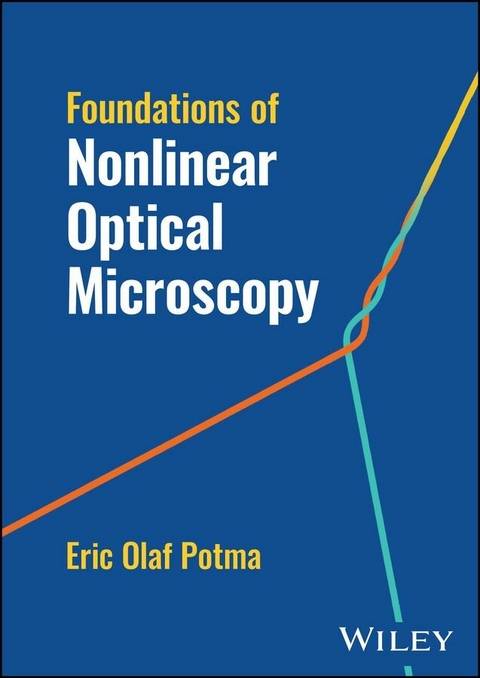
Foundations of Nonlinear Optical Microscopy (eBook)
872 Seiten
John Wiley & Sons (Verlag)
978-1-119-81490-0 (ISBN)

Concise yet comprehensive resource presenting the foundations of nonlinear optical microscopy
Foundations of Nonlinear Optical Microscopy brings together all relevant principles of nonlinear optical (NLO) microscopy, presenting NLO microscopy within a consistent framework to allow for the origin of the signals and the interrelation between different NLO techniques to be understood. The text provides rigorous yet practical derivations, which amount to expressions that can be directly related to measured values of resolution, sensitivity, and imaging contrast.
The book also addresses typical questions students ask, and answers them with clear explanations and examples. Readers of this book will develop a solid physical understanding of NLO microscopy, appreciate the advantages and limitations of each technique, and recognize the exciting possibilities that lie ahead.
Foundations of Nonlinear Optical Microscopy covers sample topics such as:
- Light propagation, focusing of light, pulses of light, classical description of light-matter interactions, and quantum mechanical description of light-matter interactions
- Molecular transitions, selection rules, signal radiation, and detection of light
- Multi-photon fluorescence and pump-probe microscopy
- Harmonic generation, sum-frequency generation, and coherent Raman scattering
Senior undergraduate and graduate students in chemistry, physics, and biomedical engineering, along with students of electrical engineering and instructors in both of these fields, can use the information within Foundations of Nonlinear Optical Microscopy and the included learning resources to gain a concise yet comprehensive overview of the subject.
Eric Olaf Potma is Professor at the University of California, Irvine, in the Department of Chemistry. His research interests are quantitative imaging with nonlinear optical microscopy, nonlinear optics of individual molecules and nanostructures, and nonlinear optical scan probe microscopy.
Foundations of Nonlinear Optical Microscopy Concise yet comprehensive resource presenting the foundations of nonlinear optical microscopy Foundations of Nonlinear Optical Microscopy brings together all relevant principles of nonlinear optical (NLO) microscopy, presenting NLO microscopy within a consistent framework to allow for the origin of the signals and the interrelation between different NLO techniques to be understood. The text provides rigorous yet practical derivations, which amount to expressions that can be directly related to measured values of resolution, sensitivity, and imaging contrast. The book also addresses typical questions students ask, and answers them with clear explanations and examples. Readers of this book will develop a solid physical understanding of NLO microscopy, appreciate the advantages and limitations of each technique, and recognize the exciting possibilities that lie ahead. Foundations of Nonlinear Optical Microscopy covers sample topics such as: Light propagation, focusing of light, pulses of light, classical description of light-matter interactions, and quantum mechanical description of light-matter interactionsMolecular transitions, selection rules, signal radiation, and detection of lightMulti-photon fluorescence and pump-probe microscopyHarmonic generation, sum-frequency generation, and coherent Raman scattering Senior undergraduate and graduate students in chemistry, physics, and biomedical engineering, along with students of electrical engineering and instructors in both of these fields, can use the information within Foundations of Nonlinear Optical Microscopy and the included learning resources to gain a concise yet comprehensive overview of the subject.
Eric Olaf Potma is Professor at the University of California, Irvine, in the Department of Chemistry. His research interests are quantitative imaging with nonlinear optical microscopy, nonlinear optics of individual molecules and nanostructures, and nonlinear optical scan probe microscopy.
1
Light: Electromagnetic Radiation
1.1 Introduction
In order to understand the imaging properties of the nonlinear optical microscope, we first have to have a basic understanding of light itself. In particular, a description of light in terms of propagating waves is needed to model the formation of the tightly focused volume. Fortunately, such a description is well established, and in this chapter, we review two useful forms of propagating light, namely the plane wave and the spherical wave. We also summarize helpful notations for the polarization state of light, and briefly discuss relevant expressions for reflected and transmitted light. The final aim of this chapter is to study the way in which a thin lens modifies an incident plane wave.
1.2 Electromagnetic Fields
The study of electromagnetic radiation is fascinating, and many aspects of electromagnetic radiation are worthy topics of discussion. In this book, however, we focus only on the bare essentials. Our goal is to find good descriptions of propagating light, which we can then use to model the tightly focused volume in the microscope. To arrive at such descriptions, we first have to glance at Maxwell's equations and the wave equation that follows from them.
1.2.1 Vector Fields
Light is electromagnetic radiation. In a classical description, light radiates through space as propagating electromagnetic waves. A wave is defined through its electric and magnetic fields, which oscillate in time in a synchronized manner. In vacuum, the electric and magnetic fields are indicated as and , respectively, which are position dependent vector fields that vary as a function of time. In Cartesian coordinates, defined by the axes , and , the electric field takes on the following form
where are unit vectors that point in the directions, respectively. The electric field is expressed in SI units of . At a given point in space, the electric field is a vector with projections of magnitude along the respective Cartesian coordinates, see Figure 1.1. The projections are also referred to as the orthogonal polarization components of the field. The corresponding expression for the magnetic field is similar, with replaced by , which has units of V · s/m2.
Figure 1.1 The electric field as a vector field. The vector is a position vector indicating the location at which the field is considered. The field vector at location has projections of magnitude , and along the () coordinates, respectively.
Electromagnetic waves in vacuum propagate at the speed of light, defined as . The quantity is called the vacuum permeability, which in classical terms relates to the magnetic inductance of a vacuum. Similarly, , called vacuum permittivity, is a measure of the capacitance of a vacuum. Together, and pose a limit to how fast an electromagnetic disturbance can travel through a vacuum. The established value for the vacuum permeability is . Using , the value for the vacuum permittivity is .
1.2.2 Wave Equation in Vacuum
Electromagnetic waves, in the form of the electric and magnetic fields, are not arbitrarily defined. Instead, the fields are described by a set of equations known as Maxwell's equations. In vacuum, the equations in differential form are written as
where the curl operator indicates the circulation density of the field and the divergence operator denotes the flux density of the field. Here, we have written the electric field and magnetic field in shorthand form as and , respectively. Maxwell's equations show that the electric and magnetic fields are interdependent. For instance, equation (1.2), known as Maxwell–Faraday's law, states that a time‐varying magnetic field induces an electric field. Similarly, a time‐varying electric field gives rise to a magnetic field, as described by equation (1.3). The remaining two expressions, equations (1.4) and (1.5), indicate that in vacuum the flux density of the electric and magnetic fields is zero.
Maxwell's equations can be rewritten to bring out the wave character of the electromagnetic field. For this purpose, we take the curl of equation (1.2) and use the vector identity . We then use the fact that is zero, as per equation (1.4), and use equation (1.3) to write the curl of in terms of the time derivative of . These operations result in the following equation
This expression shows that the second‐order derivative of the field in space is proportional to the field's second‐order derivative in time, a characteristic of a wave equation. Equation (1.6), therefore, is known as Maxwell's wave equation in vacuum. A similar form can be derived for the magnetic field.
We are interested in time‐harmonic solutions of the form , in which the spatial part of the solution is expressed as , a complex quantity, whereas the temporal part is described by .1 More generally, we can write a monochromatic, time‐harmonic field mode that oscillates at angular frequency as
where the quantity is introduced as a matter of convenience, in order to avoid the explicit use of the prefactor. The electric field is a real quantity, but it is expressed here as a sum of complex functions. For mathematical purposes, it is often more convenient to work with the complex function than the full expression of the field given in (1.7). The actual (real) electric field can then be obtained by taking the real part of the complex function .
Example 1.1 Show that expression (1.7) represents a real quantity.
Solution The complex conjugate of is , which means that expression (1.7) can be written as
The field in equation (1.7) thus equals , which is a real quantity.
By substituting the complex time‐harmonic field into equation (1.6), the wave equation can be rewritten as
where is called the angular wave number. Equation (1.8) is known as the vector Helmholtz equation, which expresses the spatial properties of the field. If a solution for can be found that complies with equation (1.8), it is also a valid solution of Maxwell's equations. Section 1.3 discusses several useful solutions of the Helmholtz equation.
1.2.3 Fields and Matter
We can measure the presence of electromagnetic waves because its electric and magnetic fields exert a force on electric charges. In general, the Lorentz force experienced by a charge moving at a velocity in the presence of an electromagnetic field is given as
Because the electromagnetic field interacts with charges, it can bring about change to matter. Of particular relevance to the topic of this book is the force experienced by the electrons bound to atoms that make up materials, such as optical glasses or biological samples inspected in microscopy experiments. Due to the action of the field, the electrons will move under the influence of the time‐periodic electromagnetic force, thereby inducing a time‐varying polarization in the material. Vice versa, the presence of charges can also alter the properties of the electromagnetic field. For instance, the induced polarization in the material forms the basis for the exchange of energy between fields and matter, as is the case in the process of optical absorption. In addition, the induced motion of charges in matter is also responsible for the observed propagation effects of electromagnetic waves as they encounter materials, such as the redirection of the wave's propagation direction at interfaces or the focusing of waves by lenses.
To understand these effects, we first need to consider the behavior of fields in the presence of charges and currents in a certain volume, as well as how the fields might, in turn, alter the material properties within that volume. Maxwell's equations (1.2)–(1.5) are only valid for electromagnetic fields in vacuum. To include the effects of current density and charge density on the fields, as well as the response of the material to the presence of the fields, the equations can be expanded as
The two new quantities are the electric displacement field and the magnetizing field , which are defined through the following so‐called “constitutive relations”
The electric displacement field describes the combined effect of the electric field and the polarization density in the material (in units of ) caused by . The field in equation (1.15) now includes both the magnetizing field as well as the material's magnetization density (in units of ) in the presence of the magnetizing field. In vacuum , i.e. the field is directly proportional to the magnetizing field. This is no longer the case in matter, and to indicate this difference, the field is often...
| Erscheint lt. Verlag | 13.3.2024 |
|---|---|
| Sprache | englisch |
| Themenwelt | Naturwissenschaften ► Chemie |
| Schlagworte | Bildgebende Verfahren i. d. Biomedizin • biomedical engineering • Biomedical Imaging • Biomedizintechnik • Biowissenschaften • Chemie • Chemistry • Coherent Raman scattering • Detection of light • focusing of light • harmonic generation • Life Sciences • Light-matter Interactions • light propagation • Microscopy • Mikroskopie • molecular excitations • multi-photon excited fluorescence • Nichtlineare Optik • pulses of light • pump-probe microscopy • signal radiation • sum-frequency generation |
| ISBN-10 | 1-119-81490-1 / 1119814901 |
| ISBN-13 | 978-1-119-81490-0 / 9781119814900 |
| Informationen gemäß Produktsicherheitsverordnung (GPSR) | |
| Haben Sie eine Frage zum Produkt? |
 EPUB (Adobe DRM)
Kopierschutz: Adobe-DRM
Adobe-DRM ist ein Kopierschutz, der das eBook vor Mißbrauch schützen soll. Dabei wird das eBook bereits beim Download auf Ihre persönliche Adobe-ID autorisiert. Lesen können Sie das eBook dann nur auf den Geräten, welche ebenfalls auf Ihre Adobe-ID registriert sind.
Details zum Adobe-DRM
Dateiformat: EPUB (Electronic Publication)
EPUB ist ein offener Standard für eBooks und eignet sich besonders zur Darstellung von Belletristik und Sachbüchern. Der Fließtext wird dynamisch an die Display- und Schriftgröße angepasst. Auch für mobile Lesegeräte ist EPUB daher gut geeignet.
Systemvoraussetzungen:
PC/Mac: Mit einem PC oder Mac können Sie dieses eBook lesen. Sie benötigen eine
eReader: Dieses eBook kann mit (fast) allen eBook-Readern gelesen werden. Mit dem amazon-Kindle ist es aber nicht kompatibel.
Smartphone/Tablet: Egal ob Apple oder Android, dieses eBook können Sie lesen. Sie benötigen eine
Geräteliste und zusätzliche Hinweise
Buying eBooks from abroad
For tax law reasons we can sell eBooks just within Germany and Switzerland. Regrettably we cannot fulfill eBook-orders from other countries.
aus dem Bereich