


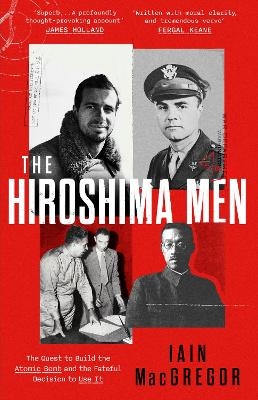
The Hiroshima Men
The Quest to Build the Atomic Bomb, and the Fateful Decision to Use It
Seiten
2025
Constable (Verlag)
978-1-4087-1950-3 (ISBN)
Constable (Verlag)
978-1-4087-1950-3 (ISBN)
A vivid account of one of history's most significant events: the approval, construction, and fateful decision to drop the atomic bomb - based on new research and interviews, timed to coincide with the 80th anniversary of the Hiroshima attack.
'Really outstanding' Jonathan Dimbleby
At 8:15 a.m. on August 6th, 1945, the Japanese port city of Hiroshima was struck by the world's first atomic bomb. Built in the US by the top-secret Manhattan Project and delivered by a B-29 Superfortress, a revolutionary long-range bomber, the weapon destroyed large swaths of the city, instantly killing tens of thousands. The world would never be the same again.
The Hiroshima Men's unique narrative recounts the decade-long journey towards this first atomic attack. It charts the race for nuclear technology before, and during the Second World War, as the allies fought the axis powers in Europe, North Africa, China, and across the vastness of the Pacific, and is seen through the experiences of several key characters: General Leslie Groves, leader of the Manhattan Project alongside Robert Oppenheimer; pioneering Army Air Force bomber pilot Colonel Paul Tibbets II; the mayor of Hiroshima, Senkichi Awaya, who would die alongside over eighty-thousand of his fellow citizens; and Pulitzer Prize-winning novelist John Hersey, who travelled to post-war Japan to expose the devastation the bomb had inflicted upon the city, and in a historic New Yorker article, described in unflinching detail the dangers posed by its deadly after-effect, radiation poisoning.
This thrilling account takes the reader from the corridors of the White House to the laboratories and test sites of New Mexico; from the air war above Nazi Germany and the savage reconquest of the Pacific to the deadly firebombing air raids across the Japanese Home Islands. The Hiroshima Men also includes Japanese perspectives - a vital aspect often missing from Western narratives - to complete MacGregor's nuanced, deeply human account of the bombing's meaning and aftermath.
'Really outstanding' Jonathan Dimbleby
At 8:15 a.m. on August 6th, 1945, the Japanese port city of Hiroshima was struck by the world's first atomic bomb. Built in the US by the top-secret Manhattan Project and delivered by a B-29 Superfortress, a revolutionary long-range bomber, the weapon destroyed large swaths of the city, instantly killing tens of thousands. The world would never be the same again.
The Hiroshima Men's unique narrative recounts the decade-long journey towards this first atomic attack. It charts the race for nuclear technology before, and during the Second World War, as the allies fought the axis powers in Europe, North Africa, China, and across the vastness of the Pacific, and is seen through the experiences of several key characters: General Leslie Groves, leader of the Manhattan Project alongside Robert Oppenheimer; pioneering Army Air Force bomber pilot Colonel Paul Tibbets II; the mayor of Hiroshima, Senkichi Awaya, who would die alongside over eighty-thousand of his fellow citizens; and Pulitzer Prize-winning novelist John Hersey, who travelled to post-war Japan to expose the devastation the bomb had inflicted upon the city, and in a historic New Yorker article, described in unflinching detail the dangers posed by its deadly after-effect, radiation poisoning.
This thrilling account takes the reader from the corridors of the White House to the laboratories and test sites of New Mexico; from the air war above Nazi Germany and the savage reconquest of the Pacific to the deadly firebombing air raids across the Japanese Home Islands. The Hiroshima Men also includes Japanese perspectives - a vital aspect often missing from Western narratives - to complete MacGregor's nuanced, deeply human account of the bombing's meaning and aftermath.
Iain MacGregor is the author of the acclaimed history of Cold War Berlin: Checkpoint Charlie, and the award-winning The Lighthouse of Stalingrad: The Hidden Truth Behind WWII's Greatest Battle. He is a Fellow of the Royal Historical Society, has spoken at many literary festivals and conferences in the UK and abroad, appeared on podcasts such as The Rest is History and on television documentaries. His writing has appeared in the Washington Post, the Spectator, BBC History Magazine, and the Guardian. He lives in London.
| Erscheinungsdatum | 07.06.2025 |
|---|---|
| Zusatzinfo | 2 x 8pp (Colour and b&w)/35 images |
| Verlagsort | London |
| Sprache | englisch |
| Maße | 164 x 236 mm |
| Gewicht | 700 g |
| Themenwelt | Geschichte ► Allgemeine Geschichte ► 1918 bis 1945 |
| Geschichte ► Teilgebiete der Geschichte ► Militärgeschichte | |
| Naturwissenschaften ► Physik / Astronomie ► Atom- / Kern- / Molekularphysik | |
| ISBN-10 | 1-4087-1950-9 / 1408719509 |
| ISBN-13 | 978-1-4087-1950-3 / 9781408719503 |
| Zustand | Neuware |
| Informationen gemäß Produktsicherheitsverordnung (GPSR) | |
| Haben Sie eine Frage zum Produkt? |
Mehr entdecken
aus dem Bereich


aus dem Bereich
Deutschland 1933 bis 1945
Buch | Hardcover (2025)
S. Fischer (Verlag)
CHF 47,60
ein Psychologe erlebt das Konzentrationslager
Buch | Hardcover (2024)
Kösel (Verlag)
CHF 30,80


