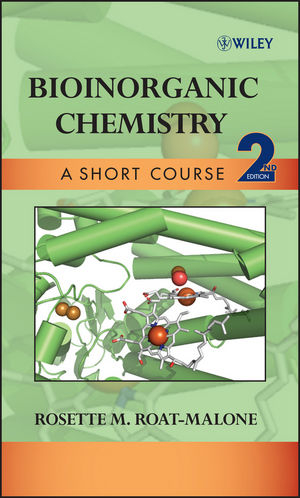
Bioinorganic Chemistry
Wiley-Interscience (Verlag)
978-0-471-76113-6 (ISBN)
- Titel erscheint in neuer Auflage
- Artikel merken
An updated, practical guide to bioinorganic chemistry
Bioinorganic Chemistry: A Short Course, Second Edition provides the fundamentals of inorganic chemistry and biochemistry relevant to understanding bioinorganic topics. Rather than striving to provide a broad overview of the whole, rapidly expanding field, this resource provides essential background material, followed by detailed information on selected topics. The goal is to give readers the background, tools, and skills to research and study bioinorganic topics of special interest to them. This extensively updated premier reference and text:
Presents review chapters on the essentials of inorganic chemistry and biochemistry
Includes up-to-date information on instrumental and analytical techniques and computer-aided modeling and visualization programs
Familiarizes readers with the primary literature sources and online resources
Includes detailed coverage of Group 1 and 2 metal ions, concentrating on biological molecules that feature sodium, potassium, magnesium, and calcium ions
Describes proteins and enzymes with iron-containing porphyrin ligand systems-myoglobin, hemoglobin, and the ubiquitous cytochrome metalloenzymes-and the non-heme, iron-containing proteins aconitase and methane monooxygenase
Appropriate for one-semester bioinorganic chemistry courses for chemistry, biochemistry, and biology majors, this text is ideal for upper-level undergraduate and beginning graduate students. It is also a valuable reference for practitioners and researchers who need a general introduction to bioinorganic chemistry, as well as chemists who want an accessible desk reference.
ROSETTE M. ROAT-MALONE, PhD,is Adjunct Professor of Chemistry at Washington College in Chestertown, Maryland. She developed the advanced bioinorganic chemistry course that formed the basis for this book-s predecessor, Bioinorganic Chemistry: A Short Course. Her research in the reactions of platinum coordination compounds used as anticancer agents with biological molecules has been supported by the National Science Foundation, the Petroleum Research Fund, and the Research Corporation.
Preface xiii
Acknowledgments xix
1 Inorganic Chemistry Essentials 1
1.1 Introduction 1
1.2 Essential Chemical Elements 1
1.3 Metals in Biological Systems: A Survey 3
1.4 Inorganic Chemistry Basics 6
1.5 Biological Metal Ion Complexation 8
1.5.1 Thermodynamics 8
1.5.2 Kinetics 9
1.6 Electronic and Geometric Structures of Metals in Biological Systems 13
1.7 Bioorganometallic Chemistry 19
1.8 Electron Transfer 22
1.9 Conclusions 26
References 27
2 Biochemistry Fundamentals 29
2.1 Introduction 29
2.2 Proteins 30
2.2.1 Amino Acid Building Blocks 30
2.2.2 Protein Structure 33
2.2.3 Protein Sequencing and Proteomics 39
2.2.4 Protein Function Enzymes and Enzyme Kinetics 43
2.3 Nucleic Acids 47
2.3.1 DNA and RNA Building Blocks 47
2.3.2 DNA and RNA Molecular Structures 47
2.3.3 Transmission of Genetic Information 53
2.3.4 Genetic Mutations and Site-Directed Mutagenesis 56
2.3.5 Genes and Cloning 58
2.3.6 Genomics and the Human Genome 61
2.4 Zinc-Finger Proteins 63
2.4.1 Descriptive Examples 67
2.5 Summary and Conclusions 73
References 74
3 Instrumental Methods 76
3.1 Introduction 76
3.1.1 Analytical Instrument-Based Methods 76
3.1.2 Spectroscopy 77
3.2 X-Ray Absorption Spectroscopy (XAS) and Extended X-Ray Absorption Fine Structure (EXAFS) 78
3.2.1 Theoretical Aspects and Hardware 78
3.2.2 Descriptive Examples 81
3.3 X-Ray Crystallography 83
3.3.1 Introduction 83
3.3.2 Crystallization and Crystal Habits 84
3.3.3 Theory and Hardware 88
3.3.4 Descriptive Examples 95
3.4 Nuclear Magnetic Resonance 98
3.4.1 Theoretical Aspects 98
3.4.2 Nuclear Screening and the Chemical Shift 101
3.4.3 Spin–Spin Coupling 104
3.4.4 Techniques of Spectral Integration and Spin–Spin Decoupling 106
3.4.5 Nuclear Magnetic Relaxation 107
3.4.6 The Nuclear Overhauser Effect (NOE) 108
3.4.7 Obtaining the NMR Spectrum 110
3.4.8 Two-Dimensional (2D) NMR Spectroscopy 111
3.4.9 Two-Dimensional Correlation Spectroscopy (COSY) and Total Correlation Spectroscopy (TOCSY) 112
3.4.10 Nuclear Overhauser Effect Spectroscopy (NOESY) 115
3.4.11 Multidimensional NMR 116
3.4.12 Descriptive Examples 117
3.5 Electron Paramagnetic Resonance 122
3.5.1 Theory and Determination of g-Values 122
3.5.2 Hyperfine and Superhyperfi ne Interactions 127
3.5.3 Electron Nuclear Double Resonance (ENDOR) and Electron Spin-Echo Envelope Modulation (ESEEM) 129
3.5.4 Descriptive Examples 129
3.6 Mössbauer Spectroscopy 132
3.6.1 Theoretical Aspects 132
3.6.2 Quadrupole Splitting and the Isomer Shift 134
3.6.3 Magnetic Hyperfine Interactions 136
3.6.4 Descriptive Examples 137
3.7 Other Instrumental Methods 139
3.7.1 Atomic Force Microscopy 139
3.7.2 Fast and Time-Resolved Methods 143
3.7.2.1 Stopped-Flow Kinetic Methods 143
3.7.2.2 Flash Photolysis 144
3.7.2.3 Time-Resolved Crystallography 146
3.7.3 Mass Spectrometry 148
3.8 Summary and Conclusions 153
References 154
4 Computer Hardware Software and Computational Chemistry Methods 157
4.1 Introduction to Computer-Based Methods 157
4.2 Computer Hardware 157
4.3 Molecular Modeling and Molecular Mechanics 160
4.3.1 Introduction to MM 160
4.3.2 Molecular Modeling Molecular Mechanics and Molecular Dynamics 161
4.3.3 Biomolecule Modeling 166
4.3.4 A Molecular Modeling Descriptive Example 167
4.4 Quantum Mechanics-Based Computational Methods 170
4.4.1 Introduction 170
4.4.2 Ab Initio Methods 170
4.4.3 Density Function Theory 171
4.4.4 Semiempirical Methods 173
4.5 Computer Software for Chemistry 174
4.5.1 Mathematical Software 180
4.6 World Wide Web Online Resources 181
4.6.1 Nomenclature and Visualization Resources 181
4.6.2 Online Societies Online Literature Searching and Materials and Equipment Websites 183
4.7 Summary and Conclusions 185
References 185
5 Group I and II Metals in Biological Systems: Homeostasis and Group I Biomolecules 189
5.1 Introduction 189
5.2 Homeostasis of Metals (and Some Nonmetals) 192
5.2.1 Phosphorus as Phosphate 192
5.2.2 Potassium Sodium and Chloride Ions 193
5.2.3 Calcium Homeostasis 194
5.3 Movement of Molecules and Ions Across Membranes 195
5.3.1 Passive Diffusion 195
5.3.2 Facilitated Diffusion 197
5.3.2.1 Gated Channels 197
5.3.3 Active Transport—Ion Pumps 197
5.4 Potassium-Dependent Molecules 199
5.4.1 Na+/K+ ATPase: The Sodium Pump 199
5.4.2 Potassium (K+) Ion Channels 203
5.4.2.1 Introduction 203
5.4.2.2 X-Ray Crystallographic Studies 205
5.5 Conclusions 235
References 235
6 Group I and II Metals in Biological Systems: Group II 238
6.1 Introduction 238
6.2 Magnesium and Catalytic RNA 238
6.2.1 Introduction 238
6.2.2 Analyzing the Role of the Metal Ion 241
6.2.3 The Group I Intron Ribozyme 244
6.2.4 The Hammerhead Ribozyme 261
6.3 Calcium-Dependent Molecules 301
6.3.1 Introduction 301
6.3.2 Calmodulin 302
6.3.2.1 Introduction 302
6.3.2.2 Calmodulin Structure by X-Ray and NMR 303
6.3.2.3 Calmodulin Interactions with Drug Molecules 308
6.3.2.4 Calmodulin–Peptide Binding 313
6.3.2.5 Conclusions 326
6.4 Phosphoryl Transfer: P-Type ATPases 327
6.4.1 Introduction 327
6.4.2 Calcium P-Type ATPases 327
6.4.2.1 Ca2+-ATPase Protein SERCA1a and the Ca2+-ATPase Cycle 329
6.5 Conclusions 337
References 338
7 Iron-Containing Proteins and Enzymes 343
7.1 Introduction: Iron-Containing Proteins with Porphyrin Ligand Systems 343
7.2 Myoglobin and Hemoglobin 343
7.2.1 Myoglobin and Hemoglobin Basics 345
7.2.2 Structure of the Heme Prosthetic Group 347
7.2.3 Behavior of Dioxygen Bound to Metals 348
7.2.4 Structure of the Active Site in Myoglobin and Hemoglobin: Comparison to Model Compounds 349
7.2.5 Some Notes on Model Compounds 352
7.2.6 Iron-Containing Model Compounds 353
7.2.7 Binding of CO to Myoglobin Hemoglobin and Model Compounds 356
7.2.8 Conclusions 359
7.3 Introduction to Cytochromes 359
7.4 Cytochrome P450: A Monooxygenase 361
7.4.1 Introduction 361
7.4.2 Cytochrome P450: Structure and Function 363
7.4.3 Cytochrome P450: Mechanism of Activity 365
7.4.4 Analytical Methods: X-Ray Crystallography 369
7.4.5 Cytochrome P450 Model Compounds 372
7.4.5.1 Introduction 372
7.4.5.2 A Cytochrome P450 Model Compound: Structural 372
7.4.5.3 Cytochrome P450 Model Compounds: Functional 374
7.4.6 Cytochrome P450 Conclusions 382
7.5 Cytochrome b(6)f: A Green Plant Cytochrome 382
7.5.1 Introduction 382
7.5.2 Cytochrome b(6)f Metal Cofactor Specifics 386
7.6 Cytochrome bc1: A Bacterial Cytochrome 388
7.6.1 Introduction 388
7.6.2 Cytochrome bc1 Structure 389
7.6.3 Cytochrome bc1 Metal Cofactor Specifics 391
7.6.4 The Cytochrome bc1 Q Cycle 395
7.6.5 Cytochrome bc1 Inhibitors 397
7.6.6 Cytochrome bc1 Conclusions 408
7.7 Cytochromes c 408
7.7.1 Introduction 408
7.7.2 Mitochondrial Cytochrome c (Yeast) 411
7.7.3 Mitochondrial Cytochrome c (Horse) 416
7.7.4 Cytochrome c Folding Electron Transfer and Cell Apoptosis 422
7.7.4.1 Cytochrome c Folding 422
7.7.4.2 Electron Transfer in Cytochrome c and Its Redox Partners 424
7.7.4.3 Apoptosis 427
7.7.5 Cytochrome c Conclusions 429
7.8 Cytochrome c Oxidase 429
7.8.1 Introduction 429
7.8.2 Metal-Binding Sites in Cytochrome c Oxidase 432
7.8.3 Dioxygen Binding Proton Translocation and Electron Transport 434
7.8.4 Cytochrome c Oxidase Model Compounds and Associated Analytical Techniques 440
7.8.5 Cytochrome c Oxidase Conclusions 453
7.9 Non-Heme Iron-Containing Proteins 454
7.9.1 Introduction 454
7.9.2 Proteins with Iron–Sulfur Clusters 454
7.9.2.1 The Enzyme Aconitase 455
7.9.3 Iron–Oxo Proteins 458
7.9.3.1 Methane Monooxygenases 459
7.10 Conclusions 465
References 466
Index 477
| Erscheint lt. Verlag | 16.10.2007 |
|---|---|
| Sprache | englisch |
| Maße | 155 x 236 mm |
| Gewicht | 762 g |
| Themenwelt | Naturwissenschaften ► Biologie ► Biochemie |
| Naturwissenschaften ► Chemie ► Anorganische Chemie | |
| ISBN-10 | 0-471-76113-3 / 0471761133 |
| ISBN-13 | 978-0-471-76113-6 / 9780471761136 |
| Zustand | Neuware |
| Informationen gemäß Produktsicherheitsverordnung (GPSR) | |
| Haben Sie eine Frage zum Produkt? |
aus dem Bereich