


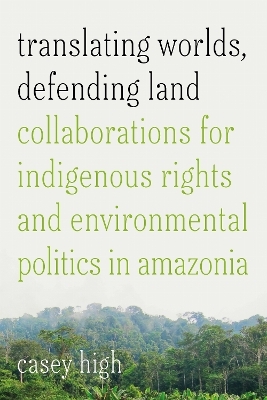
Translating Worlds, Defending Land
Collaborations for Indigenous Rights and Environmental Politics in Amazonia
Seiten
2025
|
New edition
Stanford University Press (Verlag)
978-1-5036-4048-1 (ISBN)
Stanford University Press (Verlag)
978-1-5036-4048-1 (ISBN)
In 2019, after decades of ecological damage from oil, Waorani people took to the streets of Amazonian Ecuador to protest drilling on their ancestral lands. Working with international activists, lawyers, and other Indigenous groups, they successfully sued the government for selling oil concessions without prior consent. Placing their struggle for territorial autonomy in the global spotlight, this unprecedented legal victory for environmental rights by an Indigenous people reflected the new forms of collaboration emerging in contemporary Amazonia. Translating Worlds, Defending Land explores how Waorani collaborations, whether with environmentalists or academic researchers, bring about new possibilities, challenges, and imaginative horizons.
Based on fieldwork over a period of twenty-five years, Casey High interrogates what these engagements mean for Indigenous communities and how they offer critical reflection on collaboration as a concept, method, and practice. The alliances, misunderstandings, and conflicts that emerge in these contexts challenge the assumption that productive collaborations reflect—or require—shared purposes, generating important implications for an engaged anthropology open to reconsidering what constitutes ethnographic knowledge and who it is for. As some young Waorani adults become not just community leaders or environmental citizens, but also skilled researchers and ethnographers, translating between Indigenous understandings of land and the Western language conservation, they create a powerful new voice in international environmental politics.
Based on fieldwork over a period of twenty-five years, Casey High interrogates what these engagements mean for Indigenous communities and how they offer critical reflection on collaboration as a concept, method, and practice. The alliances, misunderstandings, and conflicts that emerge in these contexts challenge the assumption that productive collaborations reflect—or require—shared purposes, generating important implications for an engaged anthropology open to reconsidering what constitutes ethnographic knowledge and who it is for. As some young Waorani adults become not just community leaders or environmental citizens, but also skilled researchers and ethnographers, translating between Indigenous understandings of land and the Western language conservation, they create a powerful new voice in international environmental politics.
Casey High is Senior Lecturer in Social Anthropology at the University of Edinburgh. He is the author of Victims and Warriors: Violence, History and Memory in Amazonia (2015).
List of Maps and Illustrations
Acknowledgments
A Note on Orthography
Introduction: Sharing Uncommon Ground
1. Collaborations in an Amazonian Contemporary
2. Speaking Differently
3. Translating Environmental Politics
4. COP26 and the Limits of Collaboration
5. How Anthropologists Lie
Conclusion: Unfinished Business
Between Hope and Apocalypse: An Epilogue
Notes
Bibliography
Index
| Erscheinungsdatum | 30.01.2025 |
|---|---|
| Zusatzinfo | 15 halftones, 1 map |
| Verlagsort | Palo Alto |
| Sprache | englisch |
| Maße | 152 x 229 mm |
| Themenwelt | Naturwissenschaften ► Biologie ► Ökologie / Naturschutz |
| Sozialwissenschaften ► Ethnologie | |
| Sozialwissenschaften ► Soziologie | |
| ISBN-10 | 1-5036-4048-5 / 1503640485 |
| ISBN-13 | 978-1-5036-4048-1 / 9781503640481 |
| Zustand | Neuware |
| Informationen gemäß Produktsicherheitsverordnung (GPSR) | |
| Haben Sie eine Frage zum Produkt? |
Mehr entdecken
aus dem Bereich


aus dem Bereich
Methoden – Lösungen – Anwendungen
Buch | Hardcover (2025)
Hanser (Verlag)
CHF 69,95


