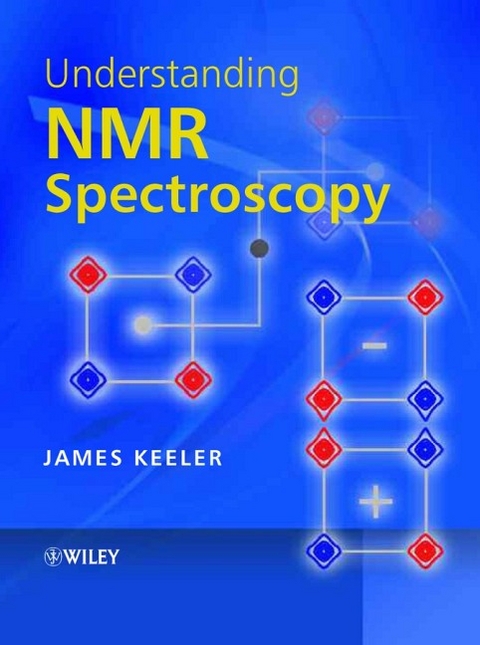
Understanding NMR Spectroscopy
John Wiley & Sons Ltd (Verlag)
978-0-470-01786-9 (ISBN)
- Titel erscheint in neuer Auflage
- Artikel merken
"Understanding NMR Spectroscopy" is written by James Keeler Department of Chemistry, University of Cambridge in UK. This text discusses the high-resolution NMR of liquid samples and concentrates exclusively on spin-half nuclei (mainly 1H and 13C). It is aimed at people who are familiar with the use of routine NMR for structure determination and who wish to deepen their understanding of just exactly how NMR experiments work. It demonstrates that in NMR it is possible, quite literally on the back of an envelope, to make exact predictions of the outcome of quite sophisticated experiments. The experiments chosen are likely to be encountered in the routine NMR of small to medium-sized molecules, but are also applicable to the study of large biomolecules, such as proteins and nucleic acids. The book starts off at a gentle pace, working through some more-or-less familiar ideas, and then elaborating these as the book progresses. Each chapter ends with exercises which are designed to assist in the understanding of the ideas presented and to grasp the underlying ideas.
Dr James Keeler is a Senior Lecturer in Chemistry at the University of Cambridge, and a Fellow of Selwyn College. In addition to being actively involved in the development of new NMR techniques, he is also responsible for the undergraduate chemistry course, and is Editor in Chief of Magnetic Resonance in Chemistry. Dr Keeler is well know for his clear and accessible exposition of NMR spectroscopy.
1. What this book is aout and who should read it. 1.1 How this book is organised. 1.2 Scope and limitations. 1.3 Context and further reading. 1.4 On line resources. 1.5 Abbreviations. 2. Setting the scene. 2.1 NMR frequencies and chemical shifts. 2.2 Linewidths, lineshapes and integrals. 2.3 Scalar coupling. 2.4 Weak and strong coupling. 2.5 The basic NMR experiment. 2.6 Frequency, oscillations and rotations. 2.7 Photons. 2.8 Moving on. 2.9 Exercises. 3. Energy levels and NMR spectra. 3.1 The problem with the energy level approach. 3.2 Introducing quantum mechanics. 3.3 The spectrum from one spin. 3.4 Writing the hamiltonian in frquency units. 3.5 The energy levels for two coupled spins. 3.6 The spectrum from two coupled spins. 3.7 Three spins. 3.8 Summary. 3.9 Exercises. 4. The vector model. 4.1 The bulk magnetization. 4.2 Larmor precession. 4.3 Detection. 4.4 Pulses. 4.5 On resonance pulses. 4.6 Detection in the roatating frame. 4.7 The basic pulse aquire experiment. 4.8 Pulse calibration. 4.9 The spin echo. 4.10 Pulses of different phases. 4.11 Off resonance effects and soft pulses. 4.12 Moving on. 4.13 Exercises. 5. Fourier transformation and data processing. 5.1 How the fourier tranform works. 5.2 Representing the FID. 5.3 Lineshapes and phase. 5.4 Manipulating the FID and the spectrum. 5.5 Zero filing. 5.6 Truncation. 5.7 Exercises. 6. The quantum mechanics of one spin. 6.1 Introduction. 6.2 Superposition states. 6.3 Some quatum mechanical tools. 6.4 Computing the bulk magnetization. 6.5 Summary. 6.6 The evolution. 6.7 RF Pulses. 6.8 Making faster progress: the density operator. 6.9 Coherence. 6.10 Exercises. 7. Product operators. 7.1 Operators fopr one spin. 7.2 Analysis of pulse sequences for a one spin system. 7.3 Speeding things up. 7.4 Operators for two coupled spins. 7.5 In phase and anrti phase terms. 7.6 Hamiltonians for two spins. 7.7 Notation for heteronuclear spin systems. 7.8 Spin echoes and J modulation. 7.9 Coherence transfer. 7.10 The INEPT Experiment. 7.11 Selective COSY. 7.12 Coherence order and multiple quantum coherences. 7.13 Summary. 7.14 Exercises. 8. Two dimentional NMR. 8.1 The general scheme for two dimentional NMR. 8.2 Modulation and lineshapes. 8.3 Axes and frequency scales in two dimentional spectra. 8.4 COSY. 8.5 Double quantum filtered COSY (DQF COSY). 8.6 Double quantum spectroscopy. 8.7 Heteronuclear correlation spectra. 8.8 HSQC. 8.9 HMQC. 8.10 Long range correlation: HMBC. 8.11 HETCOR. 8.12 TOCSY. 8.13 Frequency descrimination and lineshapes. 8.14 Exercises. 9. Relaxation and the NOE. 9.1 What is relaxtaion?. 9.2 Relaxation mechanisms 9.3 Describing random motion the correlation time. 9.4 Populations. 9.5 Longitudinal relaxation behavour of isolated spins. 9.6 Longitudinal Dipolar relaxation of tqo spins. 9.7 The nuclear overhauser effect (NOE). 9.8 Transverse relaxation. 9.9 Homogeneous and inhomogeneous broadening. 9.10Relaxation due to chemical shift anisotropy. 9.11 Cross correlation. 9.12 Summary. 9.13 Exercises. 10. Advanced topics in tqo dimentional NMR. 10.1 Product operators for three spins. 10.2 COSY for three spins. 10.3 Reduced multiplets in COSY spectra. 10.4 Polarization operators. 10.5 ZCOSY. 10.6 HMBC. 10.7 Sensitivity ehanced experiments. 10.8 Constant time experiments. 10.9 TROSY. 10.10 Exercises. 11. Coherence selection: phase cycling and field gradient pulses. 11.1 Coherence order. 11.2 Evolution of operators of particular coherence orders. 11.3 The effect of pu;lses. 11.4 The receiver ohase. 11.5 Introducing phase cycling. 11.6 Some phase cycling tricks . 11.7 Axial peak suppression. 11.8 CYCLOPS. 11.9 Examples of practical phase cycles. 11.10 Concluding remarks concerning phase cycling. 11.11 Introducing field gradient pulses. 11.12 Features of selection using gradients. 11.13 Examples of using gradient pulses for coherence. 11.14 Advantages and disadvantages of coherence selection with gradients. 11.15 Suppression of zero quantum coherence. 11.16 Selective excitation with the aid of gradients. 11.17 Further reading 12. How the spectrometer works. 12.1 The magnet. 12.2 The probe. 12.3 The transmitter. 12.4 The receiver. 12.5 Digitizing the signal. 12.6 Quadrature detection. 12.7 The pulse programmer. 12.8 Further reading. 12.9. Exercises. Appendix: Some mathematical topics. Index.
| Erscheint lt. Verlag | 7.10.2005 |
|---|---|
| Zusatzinfo | Illustrations |
| Verlagsort | Chichester |
| Sprache | englisch |
| Maße | 198 x 253 mm |
| Gewicht | 1188 g |
| Einbandart | gebunden |
| Themenwelt | Naturwissenschaften ► Chemie ► Analytische Chemie |
| ISBN-10 | 0-470-01786-4 / 0470017864 |
| ISBN-13 | 978-0-470-01786-9 / 9780470017869 |
| Zustand | Neuware |
| Informationen gemäß Produktsicherheitsverordnung (GPSR) | |
| Haben Sie eine Frage zum Produkt? |
aus dem Bereich