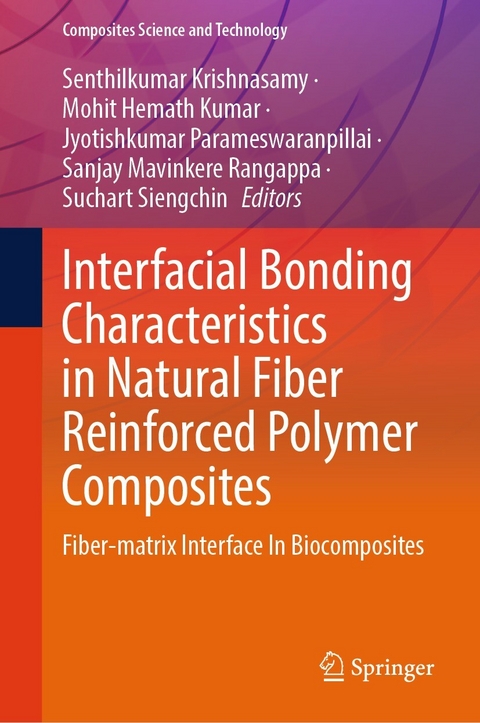
Interfacial Bonding Characteristics in Natural Fiber Reinforced Polymer Composites (eBook)
347 Seiten
Springer Nature Singapore (Verlag)
978-981-99-8327-8 (ISBN)
This book provides a general overview of the importance of fibre-matrix interfacial bonding characteristics in natural fibre-based composites to obtain optimal material properties for a specific application. Composites materials are prepared by combining fibres and polymers to achieve superior materials properties than those of the individual components. Composite materials are used to produce lightweight components with increased stiffness and strength; their properties can also be tailored for any specific applications. The glass fibre reinforced composites dominate 95% of the thermoplastic and thermoset-based composites. However, the natural fibre reinforced composites can give competition to the glass fibres due to their advantages such as biodegradability, low density, low cost, and good mechanical properties. This book looks into biocomposites and its important aspect of optimization of materials’ performance by fine-tuning the fibre-matrix bonding characteristics. The chapters in the book look at different plant fibres such as kenaf, pineapple leaf, jute, date palm, luffa, cotton, hemp, wood, bamboo, flax, and straw and the different approaches to enhance the fibre-matrix interfacial bonding through physical and/or chemical treatment methods. It demonstrates that the nature of fibre-matrix bonding has a significant effect on the properties such as tensile, flexural, impact, inter-laminar shear strength, moisture absorption, thickness swelling, thermal, chemical, damping, creep, and fatigue. Its content appeals to academics, students, researcher, and scientist who are working in the field to produce biodegradable and recyclable materials in the composite industry.
This book provides a general overview of the importance of fibre-matrix interfacial bonding characteristics in natural fibre-based composites to obtain optimal material properties for a specific application. Composites materials are prepared by combining fibres and polymers to achieve superior materials properties than those of the individual components. Composite materials are used to produce lightweight components with increased stiffness and strength; their properties can also be tailored for any specific applications. The glass fibre reinforced composites dominate 95% of the thermoplastic and thermoset-based composites. However, the natural fibre reinforced composites can give competition to the glass fibres due to their advantages such as biodegradability, low density, low cost, and good mechanical properties. This book looks into biocomposites and its important aspect of optimization of materials' performance by fine-tuning the fibre-matrix bonding characteristics. The chapters in the book look at different plant fibres such as kenaf, pineapple leaf, jute, date palm, luffa, cotton, hemp, wood, bamboo, flax, and straw and the different approaches to enhance the fibre-matrix interfacial bonding through physical and/or chemical treatment methods. It demonstrates that the nature of fibre-matrix bonding has a significant effect on the properties such as tensile, flexural, impact, inter-laminar shear strength, moisture absorption, thickness swelling, thermal, chemical, damping, creep, and fatigue. Its content appeals to academics, students, researcher, and scientist who are working in the field to produce biodegradable and recyclable materials in the composite industry.
| Erscheint lt. Verlag | 17.1.2024 |
|---|---|
| Reihe/Serie | Composites Science and Technology | Composites Science and Technology |
| Zusatzinfo | IX, 347 p. 119 illus., 81 illus. in color. |
| Sprache | englisch |
| Themenwelt | Naturwissenschaften ► Chemie ► Organische Chemie |
| Technik ► Maschinenbau | |
| Schlagworte | Bamboo Fiber Composties • Fire Retardation Composites • Hemp Fiber Composites • interfacial bonding • Kenaf Fiber Composites • Natural Fiber Composites • Pineapple Leaf Fiber Composites • Plant Fibers • polymer matrix composites • Straw Fiber Composites |
| ISBN-10 | 981-99-8327-4 / 9819983274 |
| ISBN-13 | 978-981-99-8327-8 / 9789819983278 |
| Informationen gemäß Produktsicherheitsverordnung (GPSR) | |
| Haben Sie eine Frage zum Produkt? |
 PDF (Wasserzeichen)
DRM: Digitales Wasserzeichen
Dieses eBook enthält ein digitales Wasserzeichen und ist damit für Sie personalisiert. Bei einer missbräuchlichen Weitergabe des eBooks an Dritte ist eine Rückverfolgung an die Quelle möglich.
Dateiformat: PDF (Portable Document Format)
Mit einem festen Seitenlayout eignet sich die PDF besonders für Fachbücher mit Spalten, Tabellen und Abbildungen. Eine PDF kann auf fast allen Geräten angezeigt werden, ist aber für kleine Displays (Smartphone, eReader) nur eingeschränkt geeignet.
Systemvoraussetzungen:
PC/Mac: Mit einem PC oder Mac können Sie dieses eBook lesen. Sie benötigen dafür einen PDF-Viewer - z.B. den Adobe Reader oder Adobe Digital Editions.
eReader: Dieses eBook kann mit (fast) allen eBook-Readern gelesen werden. Mit dem amazon-Kindle ist es aber nicht kompatibel.
Smartphone/Tablet: Egal ob Apple oder Android, dieses eBook können Sie lesen. Sie benötigen dafür einen PDF-Viewer - z.B. die kostenlose Adobe Digital Editions-App.
Buying eBooks from abroad
For tax law reasons we can sell eBooks just within Germany and Switzerland. Regrettably we cannot fulfill eBook-orders from other countries.
aus dem Bereich