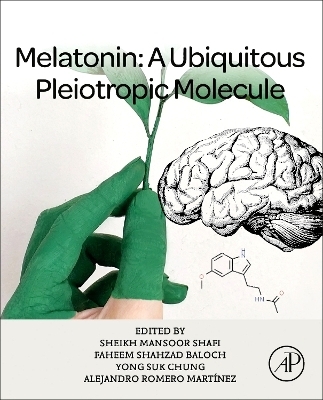
Melatonin
Academic Press Inc (Verlag)
978-0-443-13814-0 (ISBN)
The book also covers the importance of melatonin in a range of fields, including drug discovery and disease resistance, agriculture, botany, and biotechnology, and is an ideal reference for researchers across these disciplines.
Dr. Sheikh Mansoor Shafi currently serves as a postdoctoral researcher at the Phenomics Laboratory within Jeju National University in South Korea. His primary research focuses on high-throughput phenomics, remote sensing and precision agriculture. Prior to this role, he held positions as a Postdoc Research Associate at SKIMS Srinagar and as a Project Associate-I at CSIR-Indian Institute of Integrative Medicine Jammu (IIIM). Throughout his academic journey, Dr. Mansoor has had the opportunity to work in reputed laboratories, including the Transcriptomics Labs at SKUAST Kashmir and the Department of Biotechnology and Pathology at Central Institute of Temperate Horticulture (CITH) Rangreth Srinagar. His educational background comprises a BSc degree from SP College of Science (University of Kashmir), an MSc degree from HNBGU Uttarakhand, and a Ph.D. degree from Sher-e-Kashmir University of Agricultural Sciences and Technology of Jammu. Dr. Faheem Shahzad Baloch is working as Professor of plant genetics and breeding Mersin University, Turkey. He received his Ph.D. with a dissertation on ‘QTL mapping in wheat’ from the faculty of agriculture, University of Çukurova, Adana, Turkey in 2012 with a joint fellowship of Turkish ministry of education and Turkish scientific and Technological council of Turkey (TÜBİTAK). In 2013, he started to work as assistant professor at Niğde Ömer Halis Demir University, Niğde Turkey. In 2015, he joined Bolu Abant İzzet Baysal Bolu, Turkey as Assistant professor. In 2018, he was promoted to associate professor in the same institute. In August 2020, he joined Sivas university of science and Technology as associate professor and is currently working as professor in the Mersin university. Dr. Faheem has more than 11 years of teaching and research experience in the plant phenomics, genetics and genomics, biotechnology specially in next generation sequencing (NGS) and DNA molecular markers in plant genetics for germplasm characterization, identification of genomic regions for traits of agricultural interest, development and validation of molecular markers for their use in marker assisted selection, and genomic prediction for plant improvement program particularly cereals and legumes and also for developing strategies for preserving this precious germplasm from Türkiye, which is the hot spot of biodiversity for most of agricultural crops and also thousands of endemic species. He led and participated in many projects funded by national and international organizations. He supervised and co-supervised MSC, PhD and post doc candidates from various countries. He visited more than 30 countries over different continents for research and collaborative purposes. He is now Management Committee from Türkiye of two COST actions (CA22146 and CA22157) and active members of different COST actions and playing important roles in different work packages of various COST actions. He participated in many international trainings on plant molecular genetics particularly at ICARDA-Syria, Copenhagen University -Denmark, Minnesota University-USA. He has over 120 publications in Web of Sciences database. He has co-edited 6 books and written over 17 book chapters on important aspects of molecular genetics in relation to plant species. He has extensive array of citations with over 4000 times as per google scholar with an h-Index of 34. Dr. Faheem serves as Editorial board member of several impacted journals such as Turkish journal agriculture and forestry, BMC Genomic data, Agronomy Journal. Biotechnology and Biotechnological Equipment, BMC Plant Biology, and guest editor for special issues in Plants and Molecular Biology Reports and also reviewer for more than 55 peer-reviewed international journals with more than 121 verified reviews according to Publons. Young Suk Chung is an Associate Professor in the field of Plant Breeding and Plant Genetics, with a specialization in Precision Agriculture. Currently affiliated with Jeju National University in South Korea, he holds a pivotal role in the Department of Plant Resources and Environment. His academic journey commenced with a Bachelor of Science degree from Korea University, followed by a Master of Science degree from the University of Wisconsin- Madison. He further advanced his studies at the same institution, completing his PhD and serving as a Postdoctoral Research Associate. He engaged in phenomics research activities at the Plant Sciences Institute at Iowa State University. His expertise lies at the intersection of plant breeding, phenomics, and precision agriculture, areas in which he has made substantial contributions. Notably, he has been an active member of the Working Group in COST Action CA22146 for Harnessing the Potential of Underutilized Crops to Promote Sustainable Food Production (DIVERSICROP), representing a commitment to sustainable agricultural practices on a global scale. Additionally, his involvement with the European Cooperation in Science and Technology underscores his dedication to collaborative research endeavors. With over 200 publications to his credit, he has established himself as a prolific researcher, contributing valuable insights to the scientific community. His expertise is further recognized through his roles as an editor and reviewer for esteemed journals, indicating his commitment to upholding academic rigor and quality standards. Additionally, his role as an Adjunct Professor at Ton Duc Thang University in Ho Chi Minh, Vietnam, reflects his global engagement in advancing agricultural knowledge and education. Alejandro Romero Martínez, PhD in Biological Sciences from the University of Vigo (2000), is a Tenured Professor in Toxicology at the University Complutense of Madrid. His research activity has resulted in 105 Journal Citation Reports (JCR) articles (h-index 38). He is also the coauthor of 12 international book chapters and 4 national. Moreover, he coauthors >50 international and >40 national congress communications and 2 patents. He has supervised two doctoral theses. He is a member of 4 editorial committees and has acted as reviewer/evaluator of 72 international journals in his specialty with JCR relative quality index. He combines his interest and background on molecular toxicology and neuroprotection studies of new molecules with therapeutic interest against neurodegeneration and focuses on novel melatonin-based therapies. He has made important contributions in cell/molecular biology of new multitarget compounds synthesized against key targets in Alzheimer’s disease and advances in the knowledge of melatonin as a pleiotropic agent against several pathologies and mechanisms of toxicity. Dr. Martinez led the MELVES project (medical countermeasures program SYP41804) to test melatonin as a potential health support measure for treatment and prophylaxis. Remarkably, the Spanish Ministry of Defence-General Directorate of Armament and Material/SDG PLATIN has displayed interest by selecting his project. He has collaborated as an external reviewer for the Czech Science Foundation and Medical Research Council’s Developmental Pathway Funding Scheme (DPFS). Moreover, he is a member of the Spanish Association of Toxicology (AETOX) since January 2011, and certified as a European Registered Toxicologist (ERT).
Section I: Phyto-Melatonin in Plant System
1. Phyto-Melatonin occurrence, biosynthesis, and regulation
2. Phyto-Melatonin receptors and interacting protein
3. Melatonin: A positive regulator of plant growth and development
4. Phytomelatonin: Plant immunity and plant-microbial interactions
5. Exogenous application of melatonin in plants under stress conditions to enhance the quality of agricultural/horticulture crops
6. Antioxidant potential of phytomelatonin
7. Phytomelatonin crosstalk with plant growth regulators
8. Multidimensional role of Phytomelatonin
Section II. Melatonin in Human System
9. Physiological functions of melatonin
10. Therapeutic and pharmacological potential of melatonin
11. Melatonin and immune modulation
12. Neuroendocrine role of melatonin
13. Melatonin and its derivatives: The potential roles as anti-cancer agents
14. Melatonin in cancer research and treatment: From bench to bedside
15. Melatonin in oxidative stress management
Section III. Melatonin: The multitasking hormone
16. Melatonin and sleep
17. Melatonin signaling and drug-receptor interaction
18. Nutraceutical potential of melatonin on human health
19. The impact of melatonin on maternal and fetal health during pregnancy
| Erscheinungsdatum | 22.08.2024 |
|---|---|
| Verlagsort | San Diego |
| Sprache | englisch |
| Maße | 191 x 235 mm |
| Gewicht | 750 g |
| Themenwelt | Naturwissenschaften ► Biologie ► Biochemie |
| Naturwissenschaften ► Biologie ► Botanik | |
| Naturwissenschaften ► Biologie ► Genetik / Molekularbiologie | |
| ISBN-10 | 0-443-13814-1 / 0443138141 |
| ISBN-13 | 978-0-443-13814-0 / 9780443138140 |
| Zustand | Neuware |
| Informationen gemäß Produktsicherheitsverordnung (GPSR) | |
| Haben Sie eine Frage zum Produkt? |
aus dem Bereich