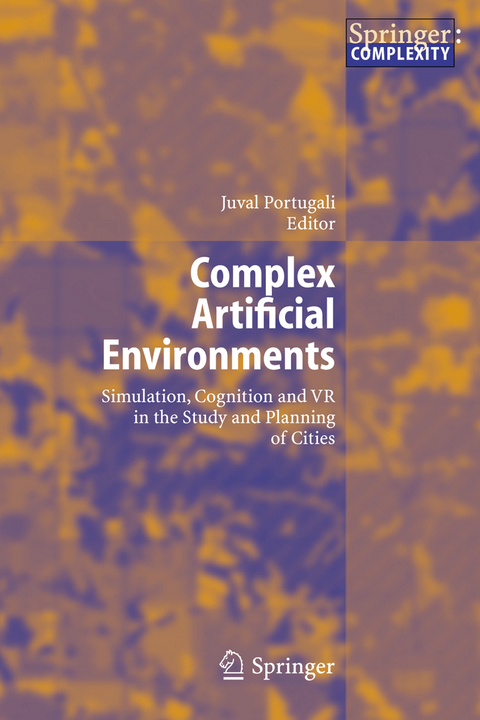
Complex Artificial Environments

Juval Portugali The notion of complex artificial environments (CAE) refers to theories of c- plexity and self-organization, as well as to artifacts in general, and to artificial - vironments, such as cities, in particular. The link between the two, however, is not trivial. For one thing, the theories of complexity and self-organization originated in the "hard" science and by reference to natural phenomena in physics and bi- ogy. The study of artifacts, per contra, has traditionally been the business of the "soft" disciplines in the humanities and social sciences. The notion of "complex artificial environments" thus implies the supposition that the theories of compl- ity and self-organization, together with the mathematical formalisms and meth- ologies developed for their study, apply beyond the domain of nature. Such a s- st position raises a whole set of questions relating to the nature of 21 century cities and urbanism, to philosophical issues regarding the natural versus the artificial, to the methodological legitimacy of interdisciplinary transfer of theories and me- odologies and to the implications that entail the use of sophisticated, state-of-t- art artifacts such as virtual reality (VR) cities and environments. The three-day workshop on the study of complex artificial environments that took place on the island of San Servolo, Venice, during April 1-3, 2004, was a gathering of scholars engaged in the study of the various aspects of CAE.
General aspects of Complex Artificial Environments.- The Scope of Complex Artificial Environments.- Recognition of Natural and Artificial Environments by Computers: Commonalities and Differences.- Visualization in Spatial Modeling.- Transferring Concepts for Urban Modeling: Capture or Exchange?.- Specific experiences.- Design Issues to be Considered for Development of an Object-Oriented System for 3D Geovisualization: The Aalborg Experience.- Complex Artificial Environments - ESLab's Experience.- Urban simulation models.- Geosimulation and its Application to Urban Growth Modeling.- Geographic Automata Systems and the OBEUS Software for Their Implementation.- The CityDev Project: An Interactive Multi-agent Urban Model on the Web.- Modeling Multi-scale Processes in a Cellular Automata Framework.- Cognition and VR.- Multi-Agent Models of Spatial Cognition, Learning and Complex Choice Behavior in Urban Environments.- Cognition and Decision in Multi-agent Modeling of Spatial Entities at Different Geographical Scales.- Cognitive Modeling of Urban Complexity.- Navigation in Electronic Environments.- Enhancing the Legibility of Virtual Cities by Means of Residents' Urban Image: a Wayfinding Support System.- Small World Modeling for Complex Geographic Environments.- Planning.- Planning and Designing with People.- Planning Support Systems Evolving: When the Rubber Hits the Road.
From the reviews:
"The book represents the current state of thinking in the use of complex systems theory with geospatial technologies for understanding cities. It is organized into five coherent parts. ... the book as a whole a unique reference source. In summary, Portugali's book can be valuable for researchers who deal with the modeling of complex land-use change processes in urban and regional contexts. It can also be used for advanced seminar courses on topics in geosimulation." (Suzana Dragicevic, Journal of Regional Science, Vol. 48 (2), 2008)
| Erscheint lt. Verlag | 16.11.2005 |
|---|---|
| Zusatzinfo | XVIII, 322 p. |
| Verlagsort | Berlin |
| Sprache | englisch |
| Maße | 155 x 235 mm |
| Gewicht | 620 g |
| Themenwelt | Naturwissenschaften ► Geowissenschaften ► Geografie / Kartografie |
| Schlagworte | Geovisualisation • Landscape/Regional and Urban Planning • Modeling • pattern formation • Spatial Cognition • Springer Complexity • Stadtplanung • urban simulation • urban transport planning • Visualization |
| ISBN-13 | 9783540259176 / 9783540259176 |
| Zustand | Neuware |
| Informationen gemäß Produktsicherheitsverordnung (GPSR) | |
| Haben Sie eine Frage zum Produkt? |
aus dem Bereich