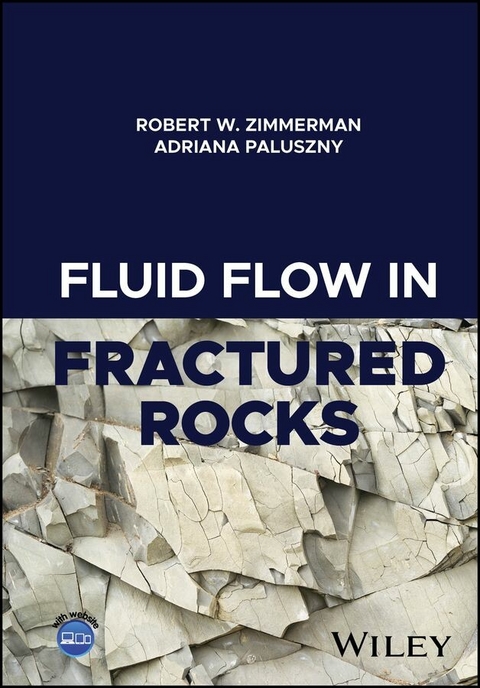
Fluid Flow in Fractured Rocks (eBook)
John Wiley & Sons (Verlag)
978-1-119-24802-6 (ISBN)
'The definitive treatise on the subject for many years to come' (Prof. Ruben Juanes, MIT)
Authoritative textbook that provides a comprehensive and up-to-date introduction to fluid flow in fractured rocks
Fluid Flow in Fractured Rocks provides an authoritative introduction to the topic of fluid flow through single rock fractures and fractured rock masses.
This book is intended for readers with interests in hydrogeology, hydrology, water resources, structural geology, reservoir engineering, underground waste disposal, or other fields that involve the flow of fluids through fractured rock masses. Classical and established models and data are presented and carefully explained, and recent computational methodologies and results are also covered. Each chapter includes numerous graphs, schematic diagrams and field photographs, an extensive reference list, and a set of problems, thus providing a comprehensive learning experience that is both mathematically rigorous and accessible.
Written by two internationally recognized leaders in the field, Fluid Flow in Fractured Rocks includes information on:
- Nucleation and growth of fractures in rock, with a multiscale characterization of their geometric traits
- Effect of normal and shear stresses on the transmissivity of a rock fracture and mathematics of fluid flow through a single rock fracture
- Solute transport in rocks, with quantitative descriptions of advection, molecular diffusion, and dispersion
Fluid Flow in Fractured Rocks is an essential resource for researchers and postgraduate students who are interested in the field of fluid flow through fractured rocks. The text is also highly suitable for professionals working in civil, environmental, and petroleum engineering.
Robert W. Zimmerman is Professor of Rock Mechanics at Imperial College London. He is the co-author, with J.C. Jaeger and N.G.W. Cook, of the authoritative monograph Fundamentals of Rock Mechanics (4th ed., Wiley, 2007).
Adriana Paluszny is Reader in Computational Geomechanics, and Royal Society University Research Fellow, at Imperial College London. She was the inaugural recipient, in 2018, of the Chin-Fu Tsang Award for Coupled Processes in Fractured Rocks.
FLUID FLOW IN FRACTURED ROCKS "e;The definitive treatise on the subject for many years to come"e; Prof. Ruben Juanes, MIT Authoritative textbook that provides a comprehensive and up-to-date introduction to fluid flow in fractured rocks Fluid Flow in Fractured Rocks provides an authoritative introduction to the topic of fluid flow through single rock fractures and fractured rock masses. This book is intended for readers with interests in hydrogeology, hydrology, water resources, structural geology, reservoir engineering, underground waste disposal, or other fields that involve the flow of fluids through fractured rock masses. Classical and established models and data are presented and carefully explained, and recent computational methodologies and results are also covered. Each chapter includes numerous graphs, schematic diagrams and field photographs, an extensive reference list, and a set of problems, thus providing a comprehensive learning experience that is both mathematically rigorous and accessible. Written by two internationally recognized leaders in the field, Fluid Flow in Fractured Rocks includes information on: Nucleation and growth of fractures in rock, with a multiscale characterization of their geometric traits Effect of normal and shear stresses on the transmissivity of a rock fracture and mathematics of fluid flow through a single rock fracture Solute transport in rocks, with quantitative descriptions of advection, molecular diffusion, and dispersion Fluid Flow in Fractured Rocks is an essential resource for researchers and postgraduate students who are interested in the field of fluid flow through fractured rocks. The text is also highly suitable for professionals working in civil, environmental, and petroleum engineering.
Robert W. Zimmerman is Professor of Rock Mechanics at Imperial College London. He is the co-author, with J.C. Jaeger and N.G.W. Cook, of the authoritative monograph Fundamentals of Rock Mechanics (4th ed., Wiley, 2007). Adriana Paluszny is Reader in Computational Geomechanics, and Royal Society University Research Fellow, at Imperial College London. She was the inaugural recipient, in 2018, of the Chin-Fu Tsang Award for Coupled Processes in Fractured Rocks.
"Fractures are ubiquitous in geologic formations, and they are often the key determinants of fluid flow and transport in the subsurface, controlling processes that are critical in environmental flows and in the energy transition, such as geothermal energy extraction, in situ mining of metals and minerals, and migration of radionuclides from geological nuclear waste disposal facilities. Despite their fundamental role in subsurface technologies, modeling fluid flow in fractured rocks is notoriously challenging because of their multiscale (fractal) nature, and the complex behavior that emerges from their interconnected network structure. In this book, world-leading experts Zimmerman and Paluszny present a didactive and insightful synthesis of the physics, mathematics, and computational modeling of fluid flow in fractured rock, that is destined to become the definitive treatise on the subject for many years to come."
(Ruben Juanes, Professor of Civil and Environmental Engineering, MIT, Cambridge, USA)
1
Genesis and Morphology of Fractures in Rock
1.1 What Are Fractures, and Why Are They Important?
Fractures are discontinuities in the mechanical integrity of brittle Earth materials. They break the mechanical continuity of the medium and provide high‐speed conduits for fluids to flow throughout the subsurface. Consequently, they are crucial to understanding how fluids migrate in the subsurface. Fractures play a key role in controlling how otherwise low‐permeability media can allow the migration of fluids through the subsurface. Therefore, fractures can effectively provide access to natural resources such as water, gas, minerals, and geothermal energy. In some cases, fractures may provide unwanted migration paths for stored fluids by breaking geological seals and enabling fluid mixing, leading to the pollution of drinking water resources. In other situations, fractures can facilitate fluid migration, lead to undesirable consequences such as induced seismicity, or possibly compromise the long‐term subsurface disposal of hazardous waste.
“Fracture” is a general term that can be used to describe discontinuities formed by extension or shear, including cracks, joints, and faults. Fractures can form veins as a result of long‐term mineralization or can be filled by the intrusion of another material, such as magma, to form dykes or other structures (Pollard and Aydin, 1988). Fractures rarely appear as stand‐alone features in the subsurface, as deformation of brittle bodies often leads to the creation of multiple simultaneous breaks in rocks, resulting in several superimposed fractures and fault patterns that form complex multi‐scale systems. These discontinuities in the rock matrix influence mechanical properties and the conduction of fluids through most low‐permeability media. Fractures are discontinuities with imperfect surfaces, which represent weakness in a mechanical sense. Terms related to the description of these discontinuities can be classified into geological, geometric, topological, and mechanical (Peacock et al., 2016). Fractures in rocks have a geological interpretation, usually tied to their setting, geometry, and chemical composition. Connectivity dictates the topological relationship between fractures, and mechanical deformation further changes a fracture's properties and its form.
From the mechanical point of view, fractures limit the strength of a rock mass, mostly due to a lack of cohesion. From the point of view of fluid flow, they represent preferred conduits for flow since the aperture of a fracture is usually much larger than the pores of the host rock. Pre‐existing fractures can be exploited, as they can channel flow through a reservoir, and their observation can serve to provide clues about how rocks conducted fluids in the past. Fractures can also be induced or enhanced to increase local fluid flow in order to turn an otherwise impermeable rock into a permeable medium. Figure 1.1 shows some examples of fractures that were formed due to folding of layered limestones off the coast of Somerset, UK.
Figure 1.1 (a) Fractures at the centimeter and meter scales cross‐cut each other to form complex multi‐scale patterns. (b) Fractures in limestone exposed in Somerset, UK.
Isolating the behavior of fractures in a rock formation often represents a bounding scenario for safety cases in evaluating the integrity of underground waste repositories. In the field of geological carbon dioxide storage, for example, a project is commonly considered unsafe if injection‐induced overpressure may cause slip along fractures. In geological nuclear waste disposal, the limiting case is often considered to be one in which fluid flow occurs only within the connected system of fractures and whether the ensuing radionuclide transport within this network exceeds some threshold. It follows that fractures are a logical point at which to start investigations on the impact that human interference has on an embedded geological setting, in terms of its mechanical and hydraulic properties.
1.2 Formation of Fractures in Rock
Materials that are quasi‐brittle, such as most rocks in the upper crust of the Earth, are subjected to stresses resulting from gravity as well as a variety of local and regional stresses such as tectonic stresses, burial, uplifting, and folding, along with chemical, thermal, and fluid flow‐related stresses. As a result, rocks deform in several stages. First, they develop micro‐cracks that occur on a small scale, often along the boundaries of individual grains of a rock. These micro‐cracks start to grow and form preferential paths which, when aligned, become material flaws. Flaws induce stress concentrations at their tips, the leading edge of the shape of the fracture, causing them to grow and extend into other areas of the rock. This self‐organization occurs at larger and larger scales, up to the kilometer scale or larger. During this process, micro‐fractures continue to form at different scales around fracture tips, as a result of stress field interactions, as well as other nonlocal chemical and thermal processes. This results in fracture growth across multiple scales to accommodate the ubiquitous deformation of the subsurface. Figure 1.2 shows several examples of interacting fractures. In all of these cases, the fractures are filled with material that delineates their shape, which is not always the case in the subsurface, but is convenient for visualization and interpretation purposes.
Figure 1.2 Fractures at the centimeter and millimeter scales in (a) and (c) limestone and (b) shale, respectively. The small fractures in (b) arise in one of the shale outcrops that cap the shallow Orcutt oil field in California, USA. In (a) and (c), fractures are filled with calcite, and in (b), fractures are tinted with naturally migrating hydrocarbon. The tracing of the fracture pattern in (c) for aperture quantification is shown in (d).
During or after fracture growth, the opposing fracture walls can be displaced in relation to one another. Under tension, fracture walls move directly apart (mode I), creating “thickness” or “aperture.” Under shear (modes II and III), fracture walls slide against each other in a direction perpendicular to or parallel to the tip of the crack, respectively. A specific case of a displaced fracture is a “fault,” which exhibits relative displacement of its walls and can appear under normal or shear deformation at scales that span from the centimeter up to the kilometer scale (Gudmundsson, 2000).
Fractures localize across large scales, usually along a preferential plane, and eventually link together to form larger features. From this moment onwards, stress is preferentially concentrated at the tips of the newly formed high‐aspect ratio fracture, and growth drives the formation and linkage of larger discontinuities. As rocks are subjected to a variety of mechanical, hydraulic, thermal, and chemical changes over millions of years, many of these flaws form around pre‐existing weaknesses in the matrix, pockets of low‐integrity rock matrix that have resulted from localized processes. Heterogeneities leading to micro‐fractures have been found to follow a Gaussian size distribution (Underwood, 1970), and in brittle rocks, they often appear as thin, penny‐shaped microcavities distributed across the matrix (Herrmann, 1990).
Computerized tomography (CT) can reveal fractures with apertures up to five times smaller than the resolution provided by a scanner (Fig. 1.3), due to the strong density contrast between rock and gas/air. CT has been used to characterize micro‐fracturing (Cnudde and Boone, 2013) and can yield three‐dimensional images of micro‐fractures embedded in porous rocks.
Many of the rocks in the upper crust, reaching a depth of around 50–70 km, are, in the most general, informal sense, “rigid,” and are elasto‐frictional, quasi‐brittle materials. A brittle rock subjected to stresses will undergo elastic deformation, but if the stress surpasses the “strength” of the rock, the rock will undergo irreversible, nonlinear deformation, leading to the creation of fractures. Numerous failure criteria have been devised to describe the triggering of fracturing due to stress concentrations, including Mohr–Coulomb (Jaeger et al., 2007), Hoek–Brown (Hoek and Brown, 1980), Drucker–Prager (Drucker and Prager, 1952), Mogi (Mogi, 1971), and their generalizations, derivations, and combinations (Bigoni and Piccolroaz, 2004). However, failure of a rock is rarely caused by the propagation of a single crack; instead, it is triggered by the coalescence of multiple aligned cracks that form during deformation (Hoek and Bieniawski, 1965). Furthermore, these types of failure criteria, based on the “continuum” stresses that are implicitly averaged over lengths much greater than those of individual pores or microcracks, cannot predict the complex crack paths that originate during crack propagation due to interaction with neighboring cracks (Brace and Bombolakis, 1963).
Failure of an initially intact, brittle material is usually a two‐stage process that begins with diffuse, inelastic degradation of the material, also known as “damage.” At a very small scale, damage can...
| Erscheint lt. Verlag | 19.12.2023 |
|---|---|
| Sprache | englisch |
| Themenwelt | Naturwissenschaften ► Geowissenschaften ► Geologie |
| Schlagworte | Angewandte u. ökonomische Geologie • earth sciences • Economic & Applied Geology • flow in fractured porous media • flow in single fractures • fracture growth • Geophysics • Geophysik • Geowissenschaften • Groundwater & Hydrogeology • growth fractures rock • Grundwasser • Grundwasser u. Hydrogeologie • rock fluid flow • Rock fractures • rock fracture transmission • rock geometric traits • rock inertia flow • rock nucleation • rock water interactions |
| ISBN-10 | 1-119-24802-7 / 1119248027 |
| ISBN-13 | 978-1-119-24802-6 / 9781119248026 |
| Informationen gemäß Produktsicherheitsverordnung (GPSR) | |
| Haben Sie eine Frage zum Produkt? |
 EPUB (Adobe DRM)
Kopierschutz: Adobe-DRM
Adobe-DRM ist ein Kopierschutz, der das eBook vor Mißbrauch schützen soll. Dabei wird das eBook bereits beim Download auf Ihre persönliche Adobe-ID autorisiert. Lesen können Sie das eBook dann nur auf den Geräten, welche ebenfalls auf Ihre Adobe-ID registriert sind.
Details zum Adobe-DRM
Dateiformat: EPUB (Electronic Publication)
EPUB ist ein offener Standard für eBooks und eignet sich besonders zur Darstellung von Belletristik und Sachbüchern. Der Fließtext wird dynamisch an die Display- und Schriftgröße angepasst. Auch für mobile Lesegeräte ist EPUB daher gut geeignet.
Systemvoraussetzungen:
PC/Mac: Mit einem PC oder Mac können Sie dieses eBook lesen. Sie benötigen eine
eReader: Dieses eBook kann mit (fast) allen eBook-Readern gelesen werden. Mit dem amazon-Kindle ist es aber nicht kompatibel.
Smartphone/Tablet: Egal ob Apple oder Android, dieses eBook können Sie lesen. Sie benötigen eine
Geräteliste und zusätzliche Hinweise
Buying eBooks from abroad
For tax law reasons we can sell eBooks just within Germany and Switzerland. Regrettably we cannot fulfill eBook-orders from other countries.
aus dem Bereich