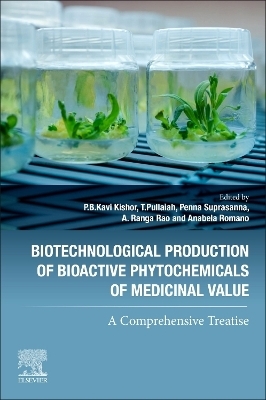
Biotechnological Production of Bioactive Phytochemicals of Medicinal Value
Elsevier - Health Sciences Division (Verlag)
978-0-443-21818-7 (ISBN)
Besides providing an alternative technology to bypass difficulties, the plant tissue culture (used in a broad sense to include cell, tissue, and organ culture) offers many advantages. In vitro technology also facilitates novel means of conserving the genetic diversity of the germplasm of medicinal plants through cryopreservation, production of novel compounds through biotransformation, somatic hybridization, and selective gene transfer through recombinant DNA technology for enhancing metabolite production.
Anabela Romano, PhD in Biology from the University of Lisbon, is a Full Professor of Biotechnology at the University of Algarve (UAlg), where she coordinates the MED-UAlg research centre. Since joining UAlg in 1995, she has led the Plant Biotechnology Laboratory and held several leadership roles, including Vice-Rector and Director of the Department of Biological Sciences and Bioengineering. Her research focuses on plant biotechnology, with an emphasis on the sustainable use of plant genetic resources and the characterization of natural compounds. She has coordinated numerous national and international projects, collaborated with academic institutions worldwide, and contributed to science policy through high-level panels under Portugal’s Recovery and Resilience Plan (PRR), appointed by the Minister of Science, Technology and Higher Education. She also serves as President of the General Assembly of the Centro de Ciência Viva de Lagos. Professor Romano is a prolific author and a frequent speaker at scientific events in Portugal and abroad, and she has served as an evaluator for various national and international research funding agencies. P.B. Kavi Kishor earned a PhD in Botany in 1981 from Maharaja Sayajirao University of Baroda and joined Osmania University’s Department of Genetics the same year, where he served until 2011. He was a CSIR Emeritus Scientist through 2019 and now mentors startup projects under the DBT-BIRAC program. He spent 1992–1994 at The Ohio State University’s Biotechnology Center under a Rockefeller Foundation program and has held Visiting Professorships at Emory University, Linköping University, and the Leibniz Institute of Plant Genetics and Crop Plant Research. An award-winning author/editor, he is ranked among the world’s top 2% of scientists by Stanford University and Elsevier. Prof. Kishor is a Fellow of the National Academy of Sciences, the National Academy of Agricultural Sciences, the Indian Botanical Society, the Andhra Pradesh Akademy of Sciences, and the Telangana Academy of Sciences, and an elected member of the Plant Tissue Culture Association of India. His research spans ontogeny and abiotic stress responses, with pioneering results informing cancer biology and therapeutics. He has also sequenced groundnut and chickpea genomes, advancing understanding of salt, drought, and heat stress mechanisms to improve crops in saline and water-deficit soils. Penna Suprasanna, PhD in Genetics, is the former Head of the Nuclear Agriculture and Biotechnology Division at the Bhabha Atomic Research Centre (BARC), Mumbai, India. He has made significant contributions to plant biotechnology, mutation breeding, stress tolerance, and novel biopolymers, and his research has advanced the molecular understanding of abiotic stress tolerance in crops and salinity-adaptive mechanisms in halophytes. He serves on the editorial boards of several national and international journals and has edited multiple books, which demonstrate a coherent research-and-translation agenda across breeding, nutrition, and digital agriculture. T. Pullaiah earned his PhD from Andhra University and then pursued a postdoctoral fellowship at Moscow State University (1976–1978). He is a former Professor of Botany at Sri Krishnadevaraya University, where he taught for more than 35 years. He served as president of the Indian Botanical Society in 2014 and of the Indian Association for Angiosperm Taxonomy in 2013. His honors include the Panchanan Maheshwari Gold Medal, the Prof. P. C. Trivedi Medal, the Dr. G. Panigrahi Memorial Lecture Award of the Indian Botanical Society, and the Prof. Y. D. Tyagi Gold Medal of IAAT. A prolific author and editor, Prof. Pullaiah has mentored students throughout his career and, for several years, has also been a member of the IUCN Species Survival Commission, a global network of over 10,000 volunteer experts dedicated to conserving biodiversity and preventing species extinction through science-based action and collaboration. Dr Ranga Rao has carried out Postdoctoral Research work in Arizona State University, Arizona (USA). Dr. Ranga Rao has been working as Associate Professor and Senior Scientist in Department of Biotechnology, Vignan’s Foundation Science, Technology and Research University (Deemed to be University), India. He has 18 years of research experience. Previously Dr. Rang Rao worked as Visiting Senior Research Fellow, Visiting Assistant Dr. Ranga Rao published more than 50 papers in peer reviewed international and national journals, edited several books and has presented over 60 conferences/symposia/seminar in international conferences. and Global Biomass Production. He was selected for Junior Scientist of the Year Award (2015) by National Environmental Science Academy, New Delhi, India; honored TWAS-Young Affiliate (2014) by Regional Office of East South-East Asia and the Pacific Chinese Academy of Sciences (CAS), China; received Young Scientist Award (2014) at the World Food Congress by International Union of Food Science and Technology (IUFoST), Canada; Carl Storm International Diversity Fellowship Award (2010) by Gordon Research Conferences, USA. He is an associate fellow of Andhra Pradesh Akademi of Sciences (2019) Government of Andhra Pradesh, India and also fellow of the Society of Applied Biotechnology (2013), India. He has received research grants and travel grant fellowship as both international and national awards, under Young Scientist schemes. He is also serving as editorial board member and reviewer for reputed international and national journals.
VOLUME 1
1. Introduction
2. Accumulation of colchicine, an anti-gout molecule in callus cultures of Gloriosa superba
3. Factors affecting accumulation of plumbagin from hairy root cultures of Plumbago rosea
4. -Radiation mutagenesis and enhancement in the production of plant secondary metabolites
5. High-value secondary metabolites from in vitro cultures of St. John's Wort (Hypericum perforatum L.)
6. Phytoecdysteroids from Sesuvium sp.: production and potential applications
7. In vitro production of alkaloids from Rauwolfia serpentina
8. Potentially bioactive secondary metabolites from underutilized wild Elaeagnus plant
9. Bacosides Neurotropic Molecules production by tissue cultures
10. Tropane Alkaloids in Vitro production, current status and perspectives
11. In vitro production of Rutin
12. Anthraquinones : Production in Plant Cell Culture from medicinal plants
13. In vitro production of asiaticoside and its derivatives from Centella and Hydrocotyle.
14. Plant suspension cell cultures: A novel bioreactor platform for industrial production of pharmaceutical proteins
15. Production of secondary metabolites by Thymus genus
16. Nanoparticle mediated elicitation of plant secondary metabolites, in vitro and in-vivo
17. Biotechnological methods of accumulation and production of vanillin flavour for food and pharmaceutical importance
18. Opportunities and challenges to large-scale production of secondary metabolites in vitro
19. Piperine production from in-vitro plant tissue culture methods
20. Production of bioactive metabolites in in vitro cultures of saffron (Crocus sativus L.): a review.
21. A non-steroidal anti-inflammatory drug Boswellic acid from Boswellia serrata
22. Cardiotonic glycosides in Digitalis. Nikam TD and Nitnaware KM
23. Biosynthesis of Polyphenols and their antioxidant potential
24. In vitro production and cheminformatic analysis of the vital compound taraxerol with their active role in living systems: a comprehensive view
25: In vitro production of phytochemicals from Bacopa monnieri with their active Principles for pharmacological activities
26. Biotechnological routes to enhance the production of the anti-cancer drug Camptothecin: Current state of the art
Experimental strategies to enhance in vitro production of plant secondary metabolites
VOLUME 2
28. In vitro cultures of some Asclepiadaceae members: A source for the production of secondary metabolites
29. Secondary metabolites of Brassica species
30. In vitro production of therapeutic compounds from Caralluma Species
31. In vitro production of secondary metabolites in Cathranthus roseus
32. Production of secondary metabolite from Morinda citrifolia (Noni) plant by elicitation methods
33. Hepatoprotective lignan production in Phyllanthus
34. Antipsychotic and medicinally important harmala alkaloid production in tissue culture of Tribulus and Peganum
35. Phytochemical prospecting and biological evaluation of leaves, stem and root of in vitro propagation of Libidibia ferrea (Fabaceae)
36. Quality of LED light on the callogenesis and somatic embryogenesis of Libidibia ferrea (Fabaceae) as an alternative source for the production of secondary metabolites
37. Morphogenic potential of nodal segments of ironwood (Libidibia ferrea (Mart. ex Tul.) L. P. Queiroz var. ferrea) cultivated in vitro aiming at maximizing the biotechnological production of secondary metabolites
38. Biotechnological Exploitation of Bioresource for Enhanced Production of Paclitaxel
39. In vitro production, medical applications and antimicrobial activity of 1,8 cineole. 1-Evrim
40: Rhinacanthins: Sources, Properties and Biotechnological Production
41: Stevia rebaudiana – A comprehensive review on in vitro culture studies for phytochemical production
42: In vitro propagation of medicinal plants of Ethiopia
44. In vitro production of Bioactive phytochemicals in Datura metel
45 Phytochemical Constituents and Pharmacological Activities of Dioscorea bulbifera: An endangered medicinal plant in Africa
46. Production of anti-cancerous bioactive compounds using hairy root cultures of Catharanthus roseus (L.) G.Don
47. In vitro Production of bio active phytochemicals of medicinal value of some medicinal plants in Sri Lanka
48. In vitro production of anthocyanins
49. Adoption of biotechnologies for Withania somnifera for sustainable utilization
50. Application of different tissue culture techniques for in vitro production of gymnemic acid: factors, approaches, and challenges to achieving higher yield
51. In vitro Production of bio active phytochemicals of medicinal value of medicinal plants in Sri Lanka: Aloe vera (Aloaceae), Munronia pinnata (Meliaceae), Zingiber officinale (Zingiberaceae), Curcuma longa (Zingiberaceae), Gyrinops walla (Thymelaeaceae)
52. Piperine production in vitro and elcitation from Piper species
53. In vitro cultures and production of bioactive compounds of black cumin Nigella sativa L
54. In vitro studies and hairy root development with reference to secondary metabolite production in a rare and threatened medicinal species Solanum erianthum D.Don
| Erscheinungsdatum | 22.08.2024 |
|---|---|
| Verlagsort | Philadelphia |
| Sprache | englisch |
| Maße | 152 x 229 mm |
| Gewicht | 1060 g |
| Themenwelt | Naturwissenschaften ► Biologie |
| Technik ► Elektrotechnik / Energietechnik | |
| Technik ► Maschinenbau | |
| ISBN-10 | 0-443-21818-8 / 0443218188 |
| ISBN-13 | 978-0-443-21818-7 / 9780443218187 |
| Zustand | Neuware |
| Informationen gemäß Produktsicherheitsverordnung (GPSR) | |
| Haben Sie eine Frage zum Produkt? |
aus dem Bereich