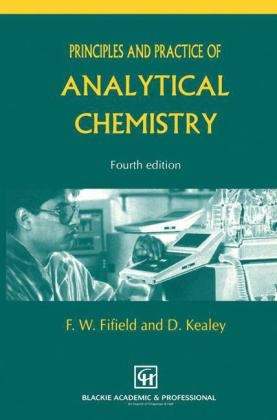
Principles and Practice of Analytical Chemistry
Nelson Thornes Ltd (Verlag)
978-0-7514-0226-1 (ISBN)
- Titel erscheint in neuer Auflage
- Artikel merken

There have been significant advances in both analytical instrumentation and computerised data handling during the five years since the third edition was published in 1990. Windows-based computer software is now widely available for instrument control and real-time data processing and the use of laboratory information and management systems (LIMS) has become commonplace. Whilst most analytical techniques have undergone steady improvements in instrument design, high-performance capillary electrophoresis (HPCE or CE) and two- dimensional nuclear magnetic resonance spectrometry (2D-NMR) have developed into major forces in separation science and structural analysis respectively. The powerful and versatile separation technique of CE promises to rival high-performance liquid chromatography, particularly in the separ- ation of low levels of substances of biological interest. The spectral inform- ation provided by various modes of 2D-NMR is enabling far more complex molecules to be studied than hitherto.
The electrophoresis section of chapter 3 and the NMR section of chapter 9 have therefore been considerably expanded in the fourth edition along with a revision of aspects of atomic spectrometry (chapter 8). New material has been included on fluorescence spectrometry (chapter 9), the use of Kovats Retention Indices in gas chroma- tography (chapter 3) and solid phase extraction for sample cleanup and concentration (chapter 12). Additions to high performance liquid chroma- tography (chapter 3) reflect the growing importance of chiral stationary phases, solvent optimization and pH control, continuous regeneration car- tridges for ion chromatography and HPLC-MS.
1 Introduction.- 2 The Assessment of Analytical Data.- 2.1 Definitions and basic concepts.- 2.2 The nature and origin of errors.- 2.3 The evaluation of results and methods.- 3 Ph, Complexation And Solubility Equilibria.- 3.1 Chemical reactions in solution.- 3.2 Solvents in analytical chemistry.- 3.3 Acid-base equilibria.- 3.4 Complexation equilibria.- 3.5 Solubility equilibria.- 4 Separation Techniques.- 4.1 Solvent extraction.- 4.2 Chromatography.- 4.3 Electrophoresis.- 5 Titrimetry and Gravimetry.- 5.1 Titrimetry.- 5.2 Gravimetry.- 6 Electrochemical Techniques.- 6.1 Potentiometry.- 6.2 Polarography, stripping voltammetry and amperometric techniques.- 6.3 Electrogravimetry and coulometry.- 6.4 Conductometric titrations.- 7 An Introduction to Analytical Spectrometry.- 8 Atomic Spectrometry.- 8.1 Arc/spark atomic (optical) emission spectrometry.- 8.2 Glow discharge atomic emission spectrometry.- 8.3 Plasma emission spectrometry.- 8.4 Inductively coupled plasma-mass spectrometry (ICP-MS).- 8.5 Flame emission spectrometry.- 8.6 Atomic absorption spectrometry.- 8.7 X-ray emission spectrometry.- 9 Molecular Spectrometry.- 9.1 Visible and ultraviolet spectrometry.- 9.2 Infrared spectrometry.- 9.3 Nuclear magnetic resonance spectrometry (nmr).- 9.4 Mass spectrometry.- 9.5 Spectrometric identification of organic compounds.- 10 Radiochemical Methods In Analysis.- 10.1 Nuclear structure and nuclear reactions.- 10.2 Instrumentation and measurement of radioactivity.- 10.3 Analytical uses of radionucleides.- 11 Thermal Techniques.- 11.1 Thermogravimetry.- 11.2 Differential thermal analysis (DTA).- 11.3 Differential scanning calorimetry (DSC).- 11.4 Thermomechanical analysis (TMA) and dynamic mechanical analysis (DMA).- 11.5 Pyrolysis - gas chromatography.- 12 Overall Analytical Procedures and Their Automation.- 12.1 Sampling and sample pretreatment.- 12.2 Examples of analytical problems and procedures.- 12.3 The automation of analytical procedures.- 13 The Role of Computers and Microprocessors in Analytical Chemistry.- 13.1 Introduction.- 13.2 Computers and microprocessors.- 13.3 Instrument-computer interfaces.- 13.4 The scope of microprocessor control and computers in analytical laboratories.
| Erscheint lt. Verlag | 6.4.1995 |
|---|---|
| Zusatzinfo | biography |
| Verlagsort | Oxford |
| Sprache | englisch |
| Maße | 155 x 235 mm |
| Gewicht | 1060 g |
| Einbandart | gebunden |
| Themenwelt | Naturwissenschaften ► Chemie ► Analytische Chemie |
| ISBN-10 | 0-7514-0226-5 / 0751402265 |
| ISBN-13 | 978-0-7514-0226-1 / 9780751402261 |
| Zustand | Neuware |
| Informationen gemäß Produktsicherheitsverordnung (GPSR) | |
| Haben Sie eine Frage zum Produkt? |
aus dem Bereich