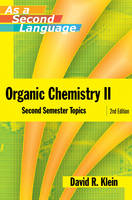
Organic Chemistry II as a Second Language
John Wiley & Sons Inc (Verlag)
978-0-471-73808-4 (ISBN)
- Titel ist leider vergriffen;
keine Neuauflage - Artikel merken
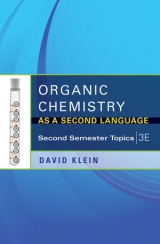
Building on the resounding success of the first volume (0-471-27235-3), Organic Chemistry as a Second Language, Volume 2 provides readers with clear, easy-to-understand explanations of fundamental principles. It explores the critical concepts while also examining why they are relevant. The core content is presented within the framework of predicting products, proposing mechanisms, and solving synthesis problems. Readers will fine-tune the key skills involved in solving those types of problems with the help of interactive, step-by-step instructions and problems.
David Klein is a lecturer at Johns Hopkins University where he teaches Organic and General Chemistry. He is a dynamic and creative teacher and uses analogy to help students grasp difficult topics. Klein's unique informal voice and manner of presentation help students truly master key topics in this course. He is also the author of Organic Chemistry as a Second Language and General Chemistry as a Second Language, which have both been highly successful.
Chapter 1. THE SKILLS YOU NEED. 1.1 The Goal of This book. 1.2 Mechanisms Are Your Keys to Success. Chapter 2. INTRO TO IONIC MECHANISMS. 2.1 Curved Arrows. 2.2 The Basic Moves. 2.3 Combining the Basic Moves. Chapter 3. ELECTROPHILIC AROMATIC SUBSTITUTION. 3.1 Halogenation and the role of Lewis Acids. 3.2 Nitration. 3.3 Friedel-Crafts Alkylation and Acylation. 3.4 Sulfonation. 3.5 Modifying the Nucleophilicity of the Nucleophile. 3.6 Predicting Directing Effects. 3.7 Identifying Activators and Deactivators. 3.8 Predicting and Exploiting Steric Effects. 3.9 Synthesis Strategies. Chapter 4. NUCLEOPHILIC AROMATIC SUBSTITUTION. 4.1 Criteria for Nucleophilic Aromatic Substitution. 4.2 SNAr Mechanism. 4.3 Elimination-Addition. 4.4 Mechanism Strategies. Chapter 5. KETONES AND ALDEHYDES. 5.1 Preparation of Ketones and Aldehydes. 5.2 Stability and Reactivity of the Carbonyl. 5.3 H-Nucleophiles. 5.4 O-Nucleophiles. 5.5 S-Nucleophiles. 5.6 N-Nucleophiles. 5.7 C-Nucleophiles. 5.8 Some Important Exceptions to the Rule. 5.9 How to Approach Synthesis Problems. Chapter 6. CARBOXYLIC ACID DERIVATIVES. 6.1 General Rules. 6.2 Acyl Halides. 6.3 Anhydrides. 6.4 Esters. 6.5 Amides and Nitriles. 6.6 Synthesis Problems. Chapter 7. ENOLS AND ENOLATES. 7.1 Keto-Enol Tautomerism. 7.2 Reactions Involving Enols. 7.3 Making Enolates. 7.4 Haloform Reactions. 7.5 Alkylation of Enolates. 7.6 Aldol Reaction and Aldol Condensation. 7.7 Claisen Condensation. 7.8 Decarboxylation Provides Some Useful Synthetic Techniques. 7.9 Michael Reactions. Chapter 8. AMINES. 8.1 Nucleophilicity and Basicity of Amines and Amides. 8.2 Preparation of Amines through SN2 Reactions. 8.3 Preparation of Amines through Reductive Amination. 8.4 Preparation of Amines from Amides. 8.5 Acylation of Amines. 8.6 Reactions of Amines with Nitrous Acid. 8.7 Aromatic Diazonium Salts. Answer Key. Index.
| Erscheint lt. Verlag | 8.11.2005 |
|---|---|
| Zusatzinfo | Illustrations |
| Verlagsort | New York |
| Sprache | englisch |
| Maße | 163 x 228 mm |
| Gewicht | 336 g |
| Themenwelt | Naturwissenschaften ► Chemie ► Organische Chemie |
| ISBN-10 | 0-471-73808-5 / 0471738085 |
| ISBN-13 | 978-0-471-73808-4 / 9780471738084 |
| Zustand | Neuware |
| Informationen gemäß Produktsicherheitsverordnung (GPSR) | |
| Haben Sie eine Frage zum Produkt? |
aus dem Bereich