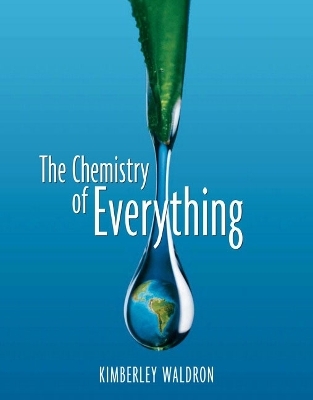
The Chemistry of Everything
Pearson
978-0-13-008522-1 (ISBN)
- Titel ist leider vergriffen;
keine Neuauflage - Artikel merken
Through innovative themes and fascinating applications, the text provides an engaging introduction to chemistry for non-science majors. Chemistry content is blended with these compelling applications, striking an amazing balance.
Dr. Kimberley Waldron is an Associate Professor of Chemistry at Regis University where, in addition to lower division courses for majors and nonmajors, she teaches advanced courses in the fields of inorganic and biological chemistry. She also serves as Director of the Regis Environmental Studies Program. Dr. Waldron received her bachelor’s degree in chemistry from the University of Virginia and her doctoral degree in inorganic chemistry from Virginia Commonwealth University. She then worked as a postdoctoral fellow at the California Institute of Technology in the area of bioinorganic chemistry before joining the faculty at Regis University as a Clare Boothe Luce Assistant Professor of Chemistry. Dr. Waldron lives in Denver, Colorado with her family, along with two dogs and one cat.
Chapter 1: Everything
An Overview of the Composition of Matter and the Way that Scientists Study It.
1.1 Atoms—The Basis of Everything
1.2 Our First Chemical Reaction
1.3 A Peek Into Your Medicine Cabinet
1.4 Numbers in Science—SI Units and Conversion Factors
1.5 The Metric Epicurean
Students Often Ask: What Is the Volume of One Drop?
1.6 Chemistry in the Limelight
Summary
Key Terms
Questions
WWW Resources
Chapter 2: Dirt
How Atoms Interact With One Another: An Introduction to Chemical Bonds and Simple Reactions
2.1 What is Dirt?
Students Often Ask: How Much Gold Is Left In the Ground?
2.2 Why do Minerals Exist?
2.3 Why Neutrons Matter
2.4 Coming to Terms with the Very Large and the Very Small
2.5 Atmospheric Dirt: An Introduction to Redox Chemistry
2.6 Compass or Bacterium?
Students Often Ask: Why are Gemstones Different Colors?
Issues in Chemistry: The Dark Side of Chemicals: Asbestos and Baby Powder
2.7 Dirt as Forensic Evidence
Summary
Key Terms
Questions
WWW Resources
Chapter 3: Diamonds
An Examination of Carbon Allotropes, Covalent Bonding and the Structure of Simple Organic Molecules
3.1 Why is Carbon Special?
3.2 Do Diamonds Really Last Forever?
3.3 Graphite and the Multiple Bond
3.4 Buckyballs and the Concept of Resonance
3.5 Carbon Baguettes: The Development of Nanotubes
Beyond the Ordinary: Nanoears
3.6 Organic Molecules and Electronic Bookkeeping
3.7 Molecules on Your Toothbrush
Students Often Ask: What Makes New Cars Smell So Good?
3.8 Molecules in Three Dimensions
Students Often Ask: When drawing an Electron Dot Structure for a Tetrahedral Molecule, Does It Matter Which Atom I Show at Which Vertex of the Tetrahedron?
3.9 Silicon: Carbon’s Big Sister
Students Often Ask: Is a life form based on Silicon Rather than Carbon Possible?
Summary
Key Terms
Questions
WWW Resources
Chapter 4 Salt
The Study of the Behavior of Ions, Including Acids and Bases, and The Notion of Equilibrium
4.1 Ionic Liquid: A Contradiction in Terms
4.2 Egyptian Mummies and the Polyatomic Ion
4.3 Keeping Your Mummy Dry
4.4 Gatorade and the Chemistry of Electrolytes
Students Often Ask: Is Fortified Water Useful for Ion Replacement or Is It Just Very Expensive Water?
4.5 Not Your Father’s Tomato
Students Often Ask: How Do Home Water Purifiers Remove Ions ?
4.6 The Autoionization of Water
Chemistry At The Crime Scene: Determining Time of Death
Beyond the Ordinary: Polka Dotted Airplanes
4.7 Bad Air, Bad Water
Summary
Key Terms
Questions
WWW Resources
Chapter 5 Film
The Study of Light and How Electrons Respond to It
5.1 Electron Headquarters
5.2 Electrons on the Move
5.3 Smile! Electrons Moving Through Film
Students Often Ask: How Do Photogray Sunglasses Turn Dark Outdoors?
5.4 More Rambling Electrons: Electrochemical Cells
5.5 Working Batteries
Students Often Ask: Do Electric Eels Really Have Electricity In Them?
5.6 Electron Movement in Organic Molecules: Free Radicals
Students Often Ask: Why does some fruit turn brown when you cut it?
5.7 Still More rambling Electrons: Light Driven Reactions
5.8 Electrons At the Beach and In the Darkroom
Students Often Ask: How Are Colors Incorporated into Color Film?
Summary
Key Terms
Questions
WWW Resources
Chapter 6 Sunshine
A Study of Nuclear Events and the Inherent Instability of (Some) Atoms
6.1 Weight Gain for Atoms: Fusion
6.2 Alchemy
Students Often Ask: How are New Elements Confirmed and Who Gets to Name Them?
6.3 Weight Loss for Atoms: Radioactive Decay
Issues In Chemistry: Three Women
6.4 It’s A Wonderful Half-Life
Beyond the Ordinary: A New Old Way of “Seeing” Alpha Particles
Students Often Ask: How Do Smoke Detectors Work?
6.5 Power from the Nucleus: Fission
6.6 Living Organisms and Radiation
Issues In Chemistry: Who’s Going to Take the Trash Out?
Issues In Chemistry: The Tragedy at Chernobyl
Summary
Key Terms
Questions
WWW Resources
Chapter 7 Water
A Look At Intermolecular Interactions, Particularly Those Involving the Unique Properties of Water
7.1 Songbirds and Hydrogen Atoms
7.2 Water with Water
Students Often Ask: How Can Insects Walk on Water?
7.3 Solid Water
Students Often Ask: Why is Salt Used to Melt Ice on Wintry Roads?
Students Often Ask: Can it Really be Too Cold to Snow?
7.4 Shifting Phases
7.5 How to Boil Water
Students Often Ask: Does Adding Salt to Water Make Pasta Cook More Quickly?
7.6 From Aerosol Cans to Scuba Diving
7.7 Like Dissolves Like
Chemistry At The Crime Scene: Death By Drowning
Students Often Ask: How Do Detergents Get Greasy Dirt Out of Clothing?
Summary
Key Terms
Questions
WWW Resources
Chapter 8 Air
A Study of the Gaseous Atmosphere in Which We Live and the Laws That Dictate the Behavior of Gases
8.1 Trouble in Tokyo
8.2 “Better Killing Through Chemistry”
Beyond The Ordinary: Mind Your Own Bees-ness
8.3 Keep a Lid On It
Students Often Ask: Why are tires filled with air instead of being solid?
8.4 Under Pressure
8.5 Turn Up the Thermostat
Students Often Ask: How does a thermos keep hot things hot and cold things cold?
Students Often Ask: Why is it more difficult for an airplane to take off at high altitude or on a hot day?
8.6 Designer Gas Laws
Issues In Chemistry: Do Human Pheromones Really Exist?
8.7 Stay Cool: Ozone and Global Warming
Issues In Chemistry: The Tuvalu Blues
Summary
Key Terms
Questions
WWW Resources
Chapter 9 Explosives
A Study of Organic Molecules with Simple Functional Groups and The Forces Within Them
9.1 The Smoking Gun
Beyond the Ordinary: Disappearing Ships
9.2 Keeping Track of Hydrocarbons
Students Often Ask: What is the meaning of the octane number reported for gasoline?
9.3 Cocktails and Anesthetics
Issues In Chemistry: MBTE in Gasoline
9.4 Bigger Bangs
Students Often Ask: Why do people with heart conditions take nitroglycerin?
9.5 High Explosives, Low Explosives
Students Often Ask: What’s the most explosive compound known?
9.6 Chaos
9.7 Arson and the Analysis of Explosives
Chemistry At the Crime Scene: The Dog Nose Knows
Summary
Key Terms
Questions
WWW Resources
Chapter 10 Chains I
A Study Of Synthetic Polymers And The Ways They Improve Everyday Life
10.1 Dubble Bubble
10.2 Monomers to Polymers
Students Often Ask: If superglue adheres immediately to everything it touches, why doesn’t it adhere to the inside walls of the superglue tube?
10.3 Groovy, baby: The Science Behind Polyester
10.4 Design-Your-Own Plastics
10.5 Get Out of My Way!
Chemistry At The Crime Scene: Synthetic Fibers
10.6 The Weakest Link
Students Often Ask: If esters are hydrolyzed by water, why can we wash polyester clothes?
Issues In Chemistry: University of Arizona Garbage Project
Summary
Key Terms
Questions
WWW Resources
Chapter 11 Chains II
A Survey of Natural Polymers, Including Proteins and Nucleic Acids
11.1 Tapping Mother Nature
11.2 Amino Acids: Nature’s Building Blocks
Students Often Ask: What is the difference between a peptide and a protein?
Issues In Chemistry: Transgenic Plants—Friend or Foe?
11.3 Protein: Nature’s Jack of All Trades
11.4 The Secret Language of Chains
11.5 Genetic Engineering: The DNA Shuffle
Chemistry At The Crime Scene: DNA-- True to Life
Summary
Key Terms
Questions
WWW Resources
Chapter 12 Groceries
The Chemistry of the Foods We Eat
12.1 The Fat Tax
12.2 Organized Fat
Students Often Ask: What are Trans-Fats, and why should I worry about them?
12.3 Bite, Chew, and Swallow
Beyond the Ordinary: The Most Amazing Enzymes Known
12.4 Sugar, Sugar
Students Often Ask: Are artificial sweeteners really okay to eat?
Chemistry at the Crime Scene: A Practical Guide to Dining Out Before Being Murdered
12.5 Weight Watching
12.6 Fake Food
Issues In Chemistry: Honey-Mustard Glazed Irradiated Pork Tenderloin with Grilled Vegetables
Summary
Key Terms
Questions
WWW Resources
Chapter 13 Drugs
How Drugs Are Designed to Benefit the Human Body
13.1 Eat Your Broccoli!
13.2 The Ideal Drug
Students Often Ask: Why do patients undergoing chemotherapy for cancer so often get sick from the medicine?
13.3 Gumming Up the Works
13.4 On the Other Hand…
13.5 Left or Right, Right or Wrong?
Students Often Ask: How do time-release medications work?
Summary
Key Terms
Questions
WWW Resources
Chapter 14 Drugs II
The Dark Side of Drug Use
14.1 That Ubiquitous Nitrogen Atom
Students Often Ask: What causes bad breath?
14.2 “Speed”
Students Often Ask: What is the difference between Ecstacy and Speed?
14.3 Are You On Drugs?
14.4 The State of the Art
Chemistry At The Crime Scene: Drug Testing at Sporting Events
14.5 Cocaine, Coca-Cola, Crack
Students Often Ask: Does Coca-Cola really contain cocaine?
14.6 Smoke and Mirrors
Summary
Key Terms
Questions
WWW Resources
| Erscheint lt. Verlag | 30.3.2006 |
|---|---|
| Sprache | englisch |
| Maße | 276 x 215 mm |
| Gewicht | 1388 g |
| Themenwelt | Naturwissenschaften ► Chemie |
| ISBN-10 | 0-13-008522-7 / 0130085227 |
| ISBN-13 | 978-0-13-008522-1 / 9780130085221 |
| Zustand | Neuware |
| Informationen gemäß Produktsicherheitsverordnung (GPSR) | |
| Haben Sie eine Frage zum Produkt? |
aus dem Bereich