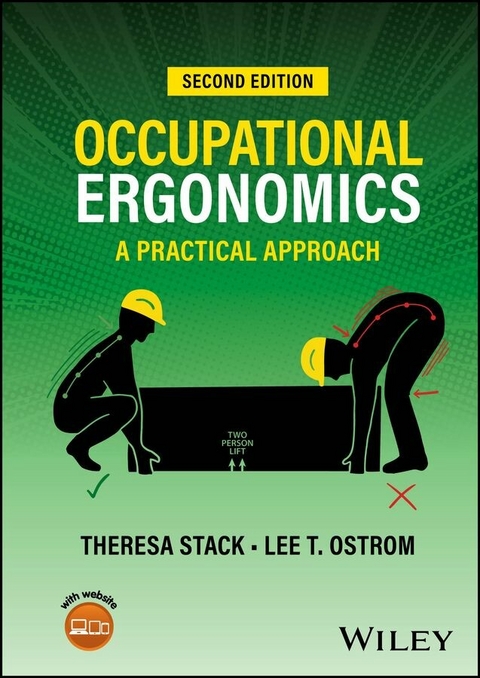
Occupational Ergonomics (eBook)
997 Seiten
John Wiley & Sons (Verlag)
978-1-119-71432-3 (ISBN)
Develop a healthier connection between worker and work with this practical introduction
The United States Bureau of Labor Statistics estimates that 34% of all workdays lost each year are the result of work-related musculoskeletal disorders (WMSDs). These disorders result from a mismatch between a worker, their working conditions, and the task they perform. Improperly designed tasks or equipment, insufficient downtime between shifts or tasks, or even simple sitting position can all produce WMSDs. The key insights into preventing these disorders are produced by ergonomics, the scientific study of human bodies as they relate to objects, systems, and environments, especially work environments.
Occupational Ergonomics: A Practical Approach aims to supply an ergonomic toolkit for creating healthier relationships between workers' bodies and their work. Beginning with a set of foundational ergonomic principles, it then details multiple assessment techniques in ways easily adapted to specific workplace situations. This balance of theory and practice has made Occupational Ergonomics an essential reference concerning human beings and the work they do.
Readers of the second edition will also find:
- Up-to-date ergonomic research reflecting the latest clinical and workplace data
- Entirely new chapters on Work Physiology, Total Worker Health, Return on Investment, and more
- Major revisions to chapters on Elements of an Ergonomic Program, Workstation Design, Work-Related MSDs, How to Conduct an Assessments, and Office Ergonomics
- Detailed and updated case studies applying ergonomic assessment techniques to common workplace scenarios
Occupational Ergonomics is a must for workplace safety managers, safety coordinators, ergonomics program coordinators, facilities managers, and any professionals concerned with the work environment, and worker health and safety.
Theresa Stack is an Occupational Safety and Heath Consultant and Instructor for the Montana Department of Labor and Industries. She is a Certified Professional Ergonomist and a Certified Safety Professional with over twenty-seven years of professional hands-on experience at the publishing of this text. Theresa also supports universities, providing instruction and conducting scientific research with a primary focus on ergonomics, objective workplace evaluation, OSHA compliance and hand tool design. Prior to joining the DLI, she provided consultation program management support as the Department of the Navy's Senior Occupational Ergonomist for fifteen years and spent nine years as a tenured professor. Theresa continues to instruct for various universities and provide subject matter expert consultation for their shared company Solutions 4 Work LLC.
Lee T. Ostrom is Professor Emeritus and was previously Center Executive Officer at Idaho Falls Center and full Professor in the College of Engineering. His doctorate is in industrial engineering from Texas Tech University in 1988. He worked eleven years for the Idaho National Laboratory in the Human Factors Group and came to the University of Idaho full-time in 2000. He has over forty years of experience in egonomics, human factors, and safety and health. He has authored or co-authored four books and numerous book chapters and articles.
OCCUPATIONAL ERGONOMICS Develop a healthier connection between worker and work with this practical introduction The United States Bureau of Labor Statistics estimates that 34% of all workdays lost each year are the result of work-related musculoskeletal disorders (WMSDs). These disorders result from a mismatch between a worker, their working conditions, and the task they perform. Improperly designed tasks or equipment, insufficient downtime between shifts or tasks, or even simple sitting position can all produce WMSDs. The key insights into preventing these disorders are produced by ergonomics, the scientific study of human bodies as they relate to objects, systems, and environments, especially work environments. Occupational Ergonomics: A Practical Approach aims to supply an ergonomic toolkit for creating healthier relationships between workers bodies and their work. Beginning with a set of foundational ergonomic principles, it then details multiple assessment techniques in ways easily adapted to specific workplace situations. This balance of theory and practice has made Occupational Ergonomics an essential reference concerning human beings and the work they do. Readers of the second edition will also find: Up-to-date ergonomic research reflecting the latest clinical and workplace data Entirely new chapters on Work Physiology, Total Worker Health, Return on Investment, and more Major revisions to chapters on Elements of an Ergonomic Program, Workstation Design, Work-Related MSDs, How to Conduct an Assessments, and Office Ergonomics Detailed and updated case studies applying ergonomic assessment techniques to common workplace scenarios Occupational Ergonomics is a must for workplace safety managers, safety coordinators, ergonomics program coordinators, facilities managers, and any professionals concerned with the work environment, and worker health and safety.
Theresa Stack is an Occupational Safety and Heath Consultant and Instructor for the Montana Department of Labor and Industries. She is a Certified Professional Ergonomist and a Certified Safety Professional with over twenty-seven years of professional hands-on experience at the publishing of this text. Theresa also supports universities, providing instruction and conducting scientific research with a primary focus on ergonomics, objective workplace evaluation, OSHA compliance and hand tool design. Prior to joining the DLI, she provided consultation program management support as the Department of the Navy's Senior Occupational Ergonomist for fifteen years and spent nine years as a tenured professor. Theresa continues to instruct for various universities and provide subject matter expert consultation for their shared company Solutions 4 Work LLC. Lee T. Ostrom is Professor Emeritus and was previously Center Executive Officer at Idaho Falls Center and full Professor in the College of Engineering. His doctorate is in industrial engineering from Texas Tech University in 1988. He worked eleven years for the Idaho National Laboratory in the Human Factors Group and came to the University of Idaho full-time in 2000. He has over forty years of experience in egonomics, human factors, and safety and health. He has authored or co-authored four books and numerous book chapters and articles.
Preface ix
About the Companion Website x
1 Book Organization 1
2 The Basics of Ergonomics 5
3 Anthropometry 19
4 Office Ergonomics 101
5 Exercise Physiology 125
6 Elements of Ergonomics Programs 153
7 Biomechanics 185
8 Psychophysics 201
9 Hand Tools 227
10 Vibration 251
11 Industrial Workstation Design 275
12 Manual Materials Handling 297
13 Work-Related Musculoskeletal Disorders 307
14 How to Conduct an Ergonomic Assessment and Ergonomic Assessment Tools 345
15 Ergonomics in the Healthcare Industry 381
16 Case Studies 429
17 Return on Investment 461
18 Ergonomic Climate 493
Appendix A Guides 501
Appendix B Tools 513
Glossary 541
Index 545
CHAPTER 2
The Basics of Ergonomics
LEARNING OBJECTIVES
At the end of this module, students will be able to identify the basic principles of ergonomics, including a working definition of the term, and a brief history of the development of ergonomics and human factors. Students will also be able to recognize the physical workplace risk factors and other contributors to the development of work‐related musculoskeletal disorders (WMSDs) as well as potential resolutions to reduce or control workplace risk.
Introduction
Ergonomics is a field of study that involves the application of knowledge about physiological, psychological, and biomechanical capacities and limitations of people (Butterworth, 1974). This knowledge is applied in the planning, design, and evaluation of work environments, jobs, tools, and equipment to enhance worker performance, safety, and health. Ergonomics is essentially the science of work.
Defining Ergonomics
Wojciech Jastrzębowski, a Polish biologist, coined the word “ergonomics” as the science of work in an 1857 philosophical narrative “based upon the truths drawn from the Science of Nature.” The term ergonomics – er·go·nom·ics / ûrg‐go‐’näm‐iks/ – is derived from two Greek words, Ergon meaning work and Nomos meaning principles or laws. Jasterzebowis understood the human and economic impacts of the Industrial Revolution during a time when a society of farmers traded in their hoes for 14‐hour days in factories, growing iron and steel in lieu of wheat and potatoes. Factories brought people, process, and power together like never before.
A more commonly used definition of ergonomics today, as defined by one of the fathers of modern ergonomics Étienne Grandjean, is “fitting the work to the worker.” Ergonomics is an applied science combining various disciplines that cater to the special needs of humans as they interact with their work environment. Ergonomics is a goal‐oriented science that seeks to reduce or eliminate injuries and disorders, increase productivity, and improve life quality.
Ergonomics, as defined by the Board of Certification for Professional Ergonomists (BCPE), “is a body of knowledge about human abilities, human limitations and human characteristics that are relevant to design. Ergonomic design is the application of this body of knowledge to the design of tools, machines, systems, tasks, jobs, and environments for safe, comfortable and effective human use” (Ergonomics, 2023). The profession has two major branches with considerable overlap. One area of the discipline referred to as “industrial ergonomics,” or “occupational biomechanics,” concentrates on the physical aspects of work and human capabilities such as force, posture, and repetition. The second branch, referred to as “human factors,” is oriented to the psychological aspects of work such as mental loading and decision‐making.
The History of Ergonomics
Disease and work have a long history; however, let us begin this story with Bernardino Ramazzini born in Carpi, Italy, in 1633. While he was still a medical student at Parma University, his attention was drawn to diseases suffered by workers. In 1682, when he was appointed chair of theory of medicine at the University of Modena, Ramazzini focused on workers’ health problems in a systematic and scholarly way (Brauer, 2005). He visited workplaces, observed workers’ activities, and discussed their illnesses with them. The medicine courses he taught were dedicated to the diseases of workers. Primarily, on the basis of this work, Ramazzini is called “the father of occupational medicine” (Report, 2012). Ramazzini systematized the existing knowledge and made a large personal contribution to the field by collecting his observations in De Morbis Artificum Diatriba (Diseases of Workers); the first edition was printed in Modena in 1700 and the second in Padua in 1713.
Each chapter of the De Morbis Artificum Diatriba contains a description of the disease associated with a particular work activity followed by a literature analysis, workplace description, questions for workers, disease description, remedies, and advice. Ramazzini regularly asked his patients about the kind of work they did and suggested that all physicians do the same, expanding on the list of questions by Hippocrates (Giluliano Franco, 2009).
Ramazzini realized that not all workers’ diseases were attributable to the working environment (chemical or physical agents): “The first and most potent is the harmful character of the material that they handle, for these emit noxious vapors and very fine particles … and induce particular diseases (in humans). The second cause I ascribe to certain violent and irregular motions and unnatural posture of the body, by reason of which the natural structure of the vital machine is so impaired that serious disease gradually develop …”
Ramazzini observed that a variety of common workers’ diseases appeared to be due to prolonged, violent, and irregular motions and prolonged postures. Such cumulative trauma and repetitive motion injuries have recently been called the occupational epidemic of the 1990s (Giluliano Franco, 2009) and have been linked to the 2010 opioid epidemic. Figure 2.1 displays the risk factors for housemaid’s knee or bursitis.
FIGURE 2.1 Housemaid’s’ knee as in bursitis.
Source: Library of Congress / Public Domain
Ergonomics and the Industrial Révolution
In the 19th century, Frederick Winslow Taylor pioneered the “scientific management” method, which proposed a way to find the optimum method of carrying out a given task by maximizing human performance. Occupational ergonomics today seeks to decrease injury while enhancing performance. Taylor found, for example, that you could triple the amount of coal workers shoveled by incrementally reducing the weight of coal or ore in shovels by increasing the shovel size and shape, Figure 2.2. Over time, he determined the fastest shovelings literally matching the task and tools to the worker. Frank and Lillian Gilbreth expanded Taylor’s methods with formal “time and motion study.” They aimed to improve the efficiency by eliminating unnecessary steps and actions. By applying this approach, Gilbreth et al. reduced the number of motions in bricklaying from 18 to 4.5, allowing bricklayers to increase their productivity from 120 to 350 bricks per hour. Industrial engineering, lean engineering, and Six sigma are built on the same underlying principles, Figure 2.3.
Prior to World War I (1914), the focus of aviation psychology or human factors was on the aviator, but the war shifted the focus onto the aircraft, in particular the design of controls and displays, adjustability of controls and seating, and the physical size of the aviator within the flight deck. The war witnessed the emergence of aeromedical research and the need for repeatable testing and measurement methods to ensure, as much as possible, that aviators cognitive and physical capacities were maximized but not exceeded.
Henry Ford’s (1920) efficiency of motion focused on decreasing the cost of manufacturing an automobile while increasing quality through consistency. In the modern production line, as Henry Ford stated, “…. the work must be brought to the man waist‐high, no worker must ever have to stoop to attach a wheel, a bolt, a screw or anything else to the moving chassis.” World War II (1940) marked the development of complex machines and new demands on operators’ cognition and physical capacity. In 1943, Alphonse Chapanis, a lieutenant in the U.S. Army, showed that this so‐called “pilot error” could be greatly reduced when more logical and differentiable controls replaced confusing designs in airplane cockpits. After the war, the Air Force published 19 volumes summarizing the research.
FIGURE 2.2 The size and shape of the shovel maximize use if matched to the task. A coal shovel, second from the right, is wide and flat. A gravel shovel, far right, is smaller because gravel weighs more than coal. A spade, first on the left, is used for digging, whereas it is impossible to dig a hole with.
Source: Angie from Sawara, Chiba‐ken, Japan/Wikimedia Commons
FIGURE 2.3 Staging the raw stock close to the work location is another method to reduce long reaches and unnecessary movements.
Source: kalpis/Adobe Stock
The Human Factors Society, the main professional organization for human factors and ergonomics practitioners in the United States, was formed in 1957, with approximately 90 people attending the first annual meeting. The name was changed to the Human Factors and Ergonomics Society in 1992. In 2021, the society had 3500 members (Society, 2021) and is the benchmark for an internationally recognized designation in the practice of ergonomics, the Certified Professional Ergonomist.
Ergonomics and Technology
Starting in the mid‐1960s, the discipline expanded into computer hardware (1960s); computer software (1970s); nuclear power plants and weapon systems (1980s); the Internet and automation...
| Erscheint lt. Verlag | 10.11.2023 |
|---|---|
| Sprache | englisch |
| Themenwelt | Naturwissenschaften ► Chemie |
| Schlagworte | Advanced Manufacturing • Arbeitsschutz u. Arbeitssicherheit • Arbeitssicherheit u. Umweltschutz i. d. Chemie • Chemical and Environmental Health and Safety • Chemie • Chemistry • Energy demands • forensic ergonomics • Gesundheits- u. Sozialwesen • Health & Social Care • Human Factors • Industrial Engineering • Industrial Engineering / Manufacturing • Industrial Hygiene • Industrielle Verfahrenstechnik • Occupational Health & Safety • Produktion i. d. Industriellen Verfahrenstechnik • risk assessment • Safety and Health • Safety management • thermal exposure • Work Physiology • Workplace Management • work rest cycles |
| ISBN-10 | 1-119-71432-X / 111971432X |
| ISBN-13 | 978-1-119-71432-3 / 9781119714323 |
| Informationen gemäß Produktsicherheitsverordnung (GPSR) | |
| Haben Sie eine Frage zum Produkt? |
 EPUB (Adobe DRM)
Kopierschutz: Adobe-DRM
Adobe-DRM ist ein Kopierschutz, der das eBook vor Mißbrauch schützen soll. Dabei wird das eBook bereits beim Download auf Ihre persönliche Adobe-ID autorisiert. Lesen können Sie das eBook dann nur auf den Geräten, welche ebenfalls auf Ihre Adobe-ID registriert sind.
Details zum Adobe-DRM
Dateiformat: EPUB (Electronic Publication)
EPUB ist ein offener Standard für eBooks und eignet sich besonders zur Darstellung von Belletristik und Sachbüchern. Der Fließtext wird dynamisch an die Display- und Schriftgröße angepasst. Auch für mobile Lesegeräte ist EPUB daher gut geeignet.
Systemvoraussetzungen:
PC/Mac: Mit einem PC oder Mac können Sie dieses eBook lesen. Sie benötigen eine
eReader: Dieses eBook kann mit (fast) allen eBook-Readern gelesen werden. Mit dem amazon-Kindle ist es aber nicht kompatibel.
Smartphone/Tablet: Egal ob Apple oder Android, dieses eBook können Sie lesen. Sie benötigen eine
Geräteliste und zusätzliche Hinweise
Buying eBooks from abroad
For tax law reasons we can sell eBooks just within Germany and Switzerland. Regrettably we cannot fulfill eBook-orders from other countries.
aus dem Bereich