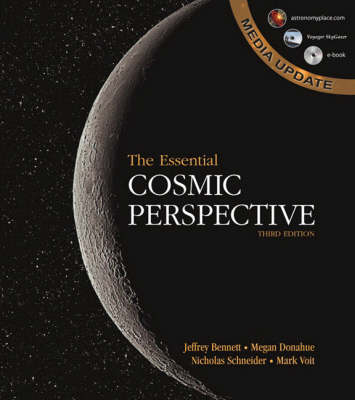
The Essential Cosmic Perspective Media Update with Astronomy Place website, Skygazer Planetarium Software, eBook CDROM and Astronomy media workbook
Benjamin-Cummings Publishing Company, Subs of Addison Wesley Longman, Inc (Verlag)
978-0-8053-8956-2 (ISBN)
- Titel erscheint in neuer Auflage
- Artikel merken
The Essential Cosmic Perspective, Third Edition Media Update is now more accessible than ever for students in a one-semester astronomy class. The Third Edition Media Update includes all the hallmark and new features from the Third Edition as well as an enhanced media package, including an e-book, a new version of Voyager:SkyGazer planetarium software, additional interactive tutorials and interactive figures on The Astronomy Place website, and is automatically bundled with The Astronomy Media Workbook — a collection of nearly 75 activities using The Astronomy Place tutorials and Voyager: SkyGazer, an enhanced and expanded version of the highly-acclaimed Cosmic Lecture Launcher in-class CD-ROM. Like the Third Edition, the Third Edition Media Update features a new an effective learning program that uses chapter openers, headers, callouts in the text, and highly-visual chapter summaries to make learning goals more explicit and to tie together important concepts. Key content has been consolidated and streamlined specifically for this one-semester course. The material is linked to everyday life to help students develop an appreciation for the scientific method and to see how physics and astronomy provide foundations for understanding their world.
Jeffrey Bennett received a B.A. in biophysics from the University of California, San Diego (1981) and a Ph.D. in astrophysics from the University of Colorado, Boulder (1987). He currently spends most of his time as a teacher, speaker, and writer. He has taught extensively at all levels, including having founded and run a science summer school for elementary and middle school children. At the college level, he has taught more than fifty classes in subjects ranging from astronomy, physics, and mathematics, to education. He served two years as a visiting senior scientist at NASA headquarters, where he helped create numerous programs for science education. He also proposed the idea for and helped develop the Voyage Scale Model Solar System, which opened in 2001 on the National Mall in Washington, D.C. In addition to The Cosmic Perspective, he has written college-level textbooks in astrobiology, mathematics, and statistics, and a book for the general public, On the Cosmic Horizon (Addison-Wesley, 2001). He also recently completed his first children's book, Max Goes to the Moon (Big Kid Science, 2003). When not working, he enjoys participating in masters swimming and in the daily adventures of life with his wife, Lisa, his children Grant and Brooke, and his dog, Max. Megan Donahue is an associate professor in the Department of Physics and Astronomy of Michigan State University. Her current research is mainly on clusters of galaxies: their contents—dark matter, hot gas, galaxies, active galactic nuclei—and what they reveal about the contents of the universe and how galaxies form and evolve. She grew up on a farm in Nebraska and received a bachelor's degree in physics from MIT, where she began her research career as an X-ray astronomer. She has a Ph.D. in astrophysics from the University of Colorado, for a thesis on theory and optical observations of intergalactic and intracluster gas. That thesis won the 1993 Trumpler Award from the Astronomical Society for the Pacific for an outstanding astrophysics doctoral dissertation in North America. She continued post-doctoral research in optical and X-ray observations as a Carnegie Fellow at Carnegie Observatories in Pasadena, California, and later as an STScl Institute Fellow at Space Telescope. Megan was a staff astronomer at the Space Telescope Science Institute, when she joined the MSU faculty. Megan is married to Mark Voit, who is also a frequent collaborator of hers on many projects, including The Cosmic Perspective and the raising of their three children, Michaela, Sebastian, and Angela. Between the births of Sebastian and Angela, Megan qualified for and ran the 2000 Boston Marathon. She hopes to run another one soon. Nicholas M. Schneider is an associate professor in the Department of Astrophysical and Planetary Sciences at the University of Colorado and a researcher in the Laboratory for Atmospheric and Space Physics. He received his B.A. in physics and astronomy from Dartmouth College in 1979 and his Ph.D. in planetary science from the University of Arizona in 1988. In 1991, he received the National Science Foundation's Presidential Young Investigator Award. His research interests include planetary atmospheres and planetary astronomy, with a focus on the odd case of Jupiter's moon Io. He enjoys teaching at all levels and is active in efforts to improve undergraduate astronomy education. Off the job, he enjoys exploring the outdoors with his family and figuring out how things work. Mark Voit is an associate professor in the department of Physics and Astronomy at Michigan State University. He earned his A.B. in astrophysical sciences at Princeton University and his Ph.D. in astrophysics at the University of Colorado in 1990. He continued his studies at the California Institute of Technology, where he was a research fellow in theoretical astrophysics, then moved on to Johns Hopkins University as a Hubble Fellow. Before coming to Michigan State, Mark worked in the Office of Public Outreach at the Space Telescope, where he developed museum exhibitions about the Hubble Space Telescope and was the scientist behind NASA's HubbleSite. His research interests range from interstellar processes in our own galaxy to the clustering of galaxies in the early universe. He is married to co-author Megan Donahue, and they try to play outdoors with their three children whenever possible, enjoying hiking, camping, running, and orienteering. Mark is also author of the popular book Hubble Space Telescope: New Views of the Universe.
I. DEVELOPING PERSPECTIVE
1. Our Place in the Universe
2. Discovering the Universe for Yourself
3. The Science of Astronomy
II. KEY CONCEPTS FOR ASTRONOMY
4. Making Sense of the Universe -Understanding Motion, Energy and Gravity
5. Light - The Cosmic Messenger
III. LEARNING FROM OTHER WORLDS
6. Our Solar System and Its Origin
7. Earth and the Terrestrial Worlds
8. Jovian Planet Systems
9. Remnants of Rock and Ice: Asteroids, Comets, and Pluto
IV. STARS
10. Our Star
11. Other Stars
12. Star Stuff
13. The Bizarre Stellar Graveyard
V. GALAXIES AND BEYOND
14. Our Galaxy
15. A Universe of Galaxies
16. Dark Matter and the Fate of the Universe
17. The Beginning of Time
VI. LIFE ON EARTH AND BEYOND
18. Life in the Universe: Prospects for Microbes, Civilizations, and Interstellar Travel
| Erscheint lt. Verlag | 17.3.2005 |
|---|---|
| Verlagsort | San Francisco |
| Sprache | englisch |
| Gewicht | 2102 g |
| Themenwelt | Naturwissenschaften ► Physik / Astronomie ► Astronomie / Astrophysik |
| ISBN-10 | 0-8053-8956-3 / 0805389563 |
| ISBN-13 | 978-0-8053-8956-2 / 9780805389562 |
| Zustand | Neuware |
| Informationen gemäß Produktsicherheitsverordnung (GPSR) | |
| Haben Sie eine Frage zum Produkt? |
aus dem Bereich