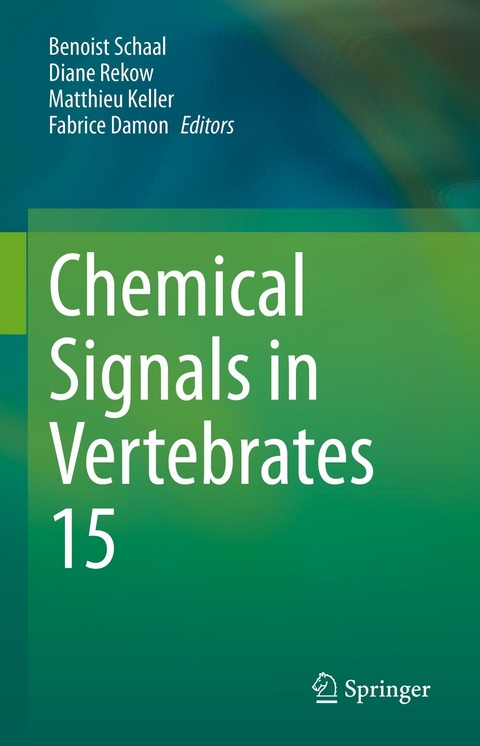
Chemical Signals in Vertebrates 15 (eBook)
516 Seiten
Springer International Publishing (Verlag)
978-3-031-35159-4 (ISBN)
The 15th Meeting on Chemical Signals in Vertebrates (CSiV) reunited participants from 20 countries from 5 continents who 'electronically commuted' to Dijon, France, during three days (3-5 November 2021). This virtual meeting was a great opportunity to share information on how amphibians, reptiles, birds, and mammals communicate through chemosignals and integrate their environment through chemical cues. Scientists from varied disciplines ranging from biology and psychology to chemistry and biostatistics attended the meeting to share their research on how vertebrates produce and release chemical cues and signals, how they detect, discriminate, process, and interpret them; how they respond to them behaviorally, physiologically, and/or neurally in adaptive ways; how the typical or atypical environment modulates such chemocommunication loops, and chemoreception in general.
In total, this 2021 CSiV meeting presented important new findings, representative of the growing points in the rapidly expanding field of research on chemocommunication among vertebrates. As appreciated by D Müller-Schwarze (a well-known pioneer in the field and the founding father of the book series in question) in his foreword to the meeting, 'Our field has broadened to new horizons: besides multicomponent cues, we now learn about multisource and multifunction chemical signals. The range of study animals and settings has become richer, and we have learned enough that practical applications are becoming realistic.' This proceedings documents key presentations from this virtual conference.
Benoist Schaal is a neuroscientist and cultural anthropologist at the Centre for Taste and Feeding Behaviour (CSGA), France, where he is a Group Leader. He received an M.S. in animal biology from the Université Louis Pasteur in Strasbourg, France, an M.S. in behavioral biology from the University of Franche-Comté and an M.S. in social and cultural anthropology from the Université Marc Bloch in Strasbourg. He obtained his Ph.D. in neurosciences at University of Franche-Comté. Most recently, Schaal has been researching the role of odors in the relationship between mothers and infants in an animal model - the rabbit - as well as continuing his research on humans.
| Erscheint lt. Verlag | 16.10.2023 |
|---|---|
| Zusatzinfo | XVII, 516 p. 1 illus. |
| Sprache | englisch |
| Themenwelt | Naturwissenschaften ► Biologie ► Zoologie |
| Schlagworte | animal behavior • Applications • conference proceedings • Ethology • olfactory communication • Pheromone • Research |
| ISBN-10 | 3-031-35159-2 / 3031351592 |
| ISBN-13 | 978-3-031-35159-4 / 9783031351594 |
| Informationen gemäß Produktsicherheitsverordnung (GPSR) | |
| Haben Sie eine Frage zum Produkt? |
 PDF (Wasserzeichen)
DRM: Digitales Wasserzeichen
Dieses eBook enthält ein digitales Wasserzeichen und ist damit für Sie personalisiert. Bei einer missbräuchlichen Weitergabe des eBooks an Dritte ist eine Rückverfolgung an die Quelle möglich.
Dateiformat: PDF (Portable Document Format)
Mit einem festen Seitenlayout eignet sich die PDF besonders für Fachbücher mit Spalten, Tabellen und Abbildungen. Eine PDF kann auf fast allen Geräten angezeigt werden, ist aber für kleine Displays (Smartphone, eReader) nur eingeschränkt geeignet.
Systemvoraussetzungen:
PC/Mac: Mit einem PC oder Mac können Sie dieses eBook lesen. Sie benötigen dafür einen PDF-Viewer - z.B. den Adobe Reader oder Adobe Digital Editions.
eReader: Dieses eBook kann mit (fast) allen eBook-Readern gelesen werden. Mit dem amazon-Kindle ist es aber nicht kompatibel.
Smartphone/Tablet: Egal ob Apple oder Android, dieses eBook können Sie lesen. Sie benötigen dafür einen PDF-Viewer - z.B. die kostenlose Adobe Digital Editions-App.
Buying eBooks from abroad
For tax law reasons we can sell eBooks just within Germany and Switzerland. Regrettably we cannot fulfill eBook-orders from other countries.
aus dem Bereich