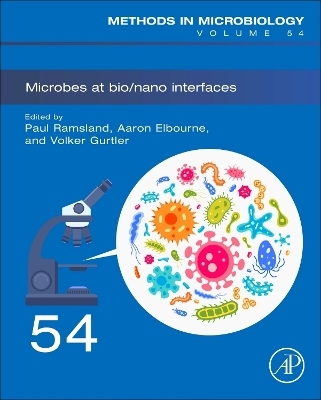
Microbes at Bio/Nano Interfaces
Academic Press Inc (Verlag)
978-0-443-19119-0 (ISBN)
Other sections cover Using next generation sequencing to study host-pathogen interactions, Microbial Nano-Biosynthesis: Biomedical, Food and Environmental Applications, and Functional co-expression of LEA peptides: Providing an environment for efficient cellular recombinant protein expression.
Associate Professor Paul A. Ramsland received his PhD (1998) in Molecular Immunology from the University of Technology, Sydney (UTS) supervised by Robert L. Raison. His postdoctoral studies (1998-2001) in antibody structure were with Allen B. Edmundson at the Oklahoma Medical Research Foundation, USA. From 2001 – 2015, he worked in independent medical research institutes in Melbourne, Australia. After being awarded a 2015 Vice Chancellor’s Senior Research Fellowship from the Royal Melbourne Institute of Technology (RMIT) University, he relocated there in 2016. At RMIT University, the group continues to pursue collaborative projects in antibody-carbohydrate interactions, with a new focus on recognition at cell surfaces, interfaces and in biomaterials. Dr. Aaron Elbourne is an ARC DECRA Research Fellow within the School of Science at RMIT University, Melbourne, Australia. He is currently the recipient of a Jack Brockhoff Foundation Early Career Medical Research Fellowship, an ARC Discovery Project, and an ARC Discovery Early Career Researcher Award (DECRA). He obtained his PhD in Chemistry in 2017 from The University of Newcastle, Australia under the supervision of Professor Erica J. Wanless. He began his postdoctoral fellowship in February of 2017. His research interests involve high-resolution atomic force microscopy, ion adsorption, solid-liquid interfaces, bio-interfaces, nanomaterials, liquid metals, and antimicrobial technologies. Dr Gurtler completed a Ph.D. program in 1996 at La Trobe University in the Department of Microbiology. The main contribution of this work was the development of a universal bacterial typing technique based on the 16S-23S rDNA spacer region. The technique is now extensively used in many areas of Microbiology including Diagnostic, Environmental and Veterinary Microbiology. Citations to the articles Dr Gurtler wrote on this topic total >1000 with >830 citations alone to the 1996 review published in the journal “Microbiology. Dr Gurtler wrote an invited review on genomic typing, taxonomy and identification of bacterial isolates for the International Journal of Systematic and Evolutionary Microbiology (IJSEM). In addition to fundamental research, Dr Gurtler has also had experience with the application of this technology to the medical diagnostic laboratory in the fields of molecular microbiology and human molecular genetics. Dr Gurtler has been involved full time in diagnostic microbiology over many years resulting in the adoption of a method that identifies Mycobacterium species directly from clinical specimens without the need for culture in specimens positive for acid fast bacilli, the discovery of Nocardia veterana, and the development of many diagnostic tests. In the last twelve years Dr Gurtler has been an Editor for the Journal of Microbiological Methods (JMM) and in the last 5 years Serial Editor of Methods in Microbiology (MIM) with the publication of 9 volumes covering diverse subjects such as Biofilms, Nanotechnology, COVID-19 and Fluorescent Probes.
1. Advanced Hydrogel for Management of Bacterial Wound Infections
Hanif Haidari and Zlatko Kopecki
2. Biofilm Characterization: Imaging, analysis and considerations
Samuel Cheeseman
3. (chapter title to follow)
Charlotte Conn and Brendan Dyett
4. Parasitic worm interactions with host molecular machinary
Bernd Heinz Kalinna and Anna Walduck
5. Investigation of microbes and surface carbohydrates using Atomic Force Microscopy
Daniel Sijmons, Anna Walduck, Aaron Elbourne and Paul A. Ramsland
6. Interactions Between Microbial Cells and Titanium Implant Surfaces
Rachel Anne Caruso and Louisa Huang
7. Targeting Bacterial Polysaccharides with Antibodies and Vaccines
Gerald B. Pier and Tomas Maira-Litran
8. Using next generation sequencing to study host-pathogen interactions
Thi Thu Hao Van and Bronwyn E. Campbell
9. Microbial Nano-Biosynthesis: Biomedical, Food and Environmental Applications
Belma Nural Yaman and Benan Inan
10. Functional co-expression of LEA peptides: Providing an environment for efficient cellular recombinant protein expression
Shinya Ikeno
| Erscheinungsdatum | 23.03.2024 |
|---|---|
| Reihe/Serie | Methods in Microbiology |
| Verlagsort | San Diego |
| Sprache | englisch |
| Maße | 152 x 229 mm |
| Gewicht | 1000 g |
| Themenwelt | Naturwissenschaften ► Biologie ► Biochemie |
| Naturwissenschaften ► Biologie ► Genetik / Molekularbiologie | |
| Naturwissenschaften ► Physik / Astronomie ► Angewandte Physik | |
| ISBN-10 | 0-443-19119-0 / 0443191190 |
| ISBN-13 | 978-0-443-19119-0 / 9780443191190 |
| Zustand | Neuware |
| Informationen gemäß Produktsicherheitsverordnung (GPSR) | |
| Haben Sie eine Frage zum Produkt? |
aus dem Bereich