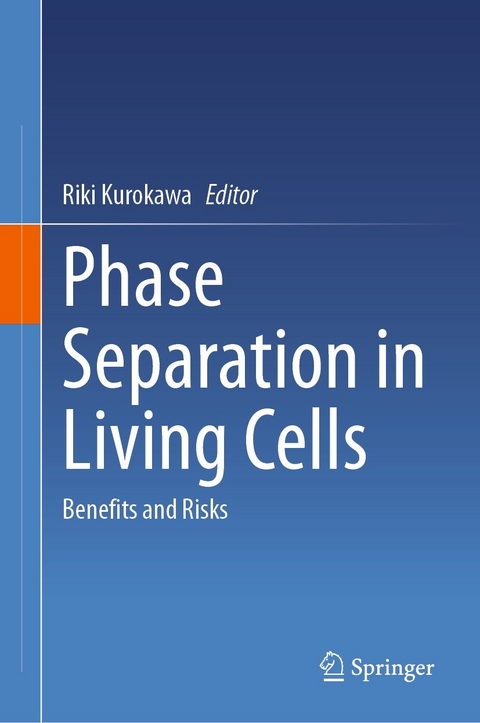
Phase Separation in Living Cells (eBook)
318 Seiten
Springer Nature Singapore (Verlag)
9789819948864 (ISBN)
This book presents the latest cutting-edge research on phase separation. It discusses the benefits and risks of phase separation for living cells from the perspectives of physics, chemistry, biology, and medicine.
Phase separation is a physico-chemical process that induces a single solution of solvent and intrinsically disordered proteins (IDPs) to separate into two phases, one phase containing only solvent and the other containing IDPs in the solvent. A key molecule in phase separation is the intrinsically disordered region (IDR) proteins (IDPs), mostly comprised of RNA-binding proteins (RBPs). One of the major roles of phase separation is to generate condensates, membrane-less organelles including stress granule, Cajal body, and nucleolus.
Biological actions of phase separation in various aspects of science have received increasing attention in recent years. The book consists of four parts; Part I on physics and chemistry includes topics on structural biology of RBP FUS/TLS and chaperone for phase separation, computational approach of phase separation, and chemistry of G-quadruplex of DNA and RNA. Part II on molecular biology presents molecular mechanism of IDR sequence phase separation and potential cellular function of these labile fibers, formation of membrane-less organelles, and roles of noncoding RNAs in phase separation. Part III on biology covers topics from nuclear pore complex, developmental biology regarding force-dependent remodeling, and neurobiology and higher order brain functions. Finally, Part IV on medicine presents condensates and cancer therapy, pathogenesis of neurodegenerative diseases based on IDPs, and responses of microglia to amyloid. The last chapter highlights the latest topic on how the SARS-Cov-2 virus takes advantage of phase separation for its infections.
This book brings together the studies of phase separation in each area in a single volume. The comprehensive approach provides new insights to the research andwill benefit the readers by responding to the emerging needs for understanding phase separation.
This book presents the latest cutting-edge research on phase separation. It discusses the benefits and risks of phase separation for living cells from the perspectives of physics, chemistry, biology, and medicine.Phase separation is a physico-chemical process that induces a single solution of solvent and intrinsically disordered proteins (IDPs) to separate into two phases, one phase containing only solvent and the other containing IDPs in the solvent. A key molecule in phase separation is the intrinsically disordered region (IDR) proteins (IDPs), mostly comprised of RNA-binding proteins (RBPs). One of the major roles of phase separation is to generate condensates, membrane-less organelles including stress granule, Cajal body, and nucleolus.Biological actions of phase separation in various aspects of science have received increasing attention in recent years. The book consists of four parts; Part I on physics and chemistry includes topics on structural biology of RBP FUS/TLS and chaperone for phase separation, computational approach of phase separation, and chemistry of G-quadruplex of DNA and RNA. Part II on molecular biology presents molecular mechanism of IDR sequence phase separation and potential cellular function of these labile fibers, formation of membrane-less organelles, and roles of noncoding RNAs in phase separation. Part III on biology covers topics from nuclear pore complex, developmental biology regarding force-dependent remodeling, and neurobiology and higher order brain functions. Finally, Part IV on medicine presents condensates and cancer therapy, pathogenesis of neurodegenerative diseases based on IDPs, and responses of microglia to amyloid. The last chapter highlights the latest topic on how the SARS-Cov-2 virus takes advantage of phase separation for its infections.This book brings together the studies of phase separation in each area in a single volume. The comprehensive approach provides new insights to the research andwill benefit the readers by responding to the emerging needs for understanding phase separation.
| Erscheint lt. Verlag | 29.9.2023 |
|---|---|
| Zusatzinfo | VIII, 318 p. 1 illus. |
| Sprache | englisch |
| Themenwelt | Medizin / Pharmazie |
| Naturwissenschaften ► Biologie ► Biochemie | |
| Naturwissenschaften ► Biologie ► Genetik / Molekularbiologie | |
| Naturwissenschaften ► Biologie ► Zellbiologie | |
| Naturwissenschaften ► Physik / Astronomie ► Angewandte Physik | |
| Schlagworte | Aggregation • brain • Intrinsically Disordered Protein • liquid-liquid phase separation • low complexity domain • membrane-less organelle • Neurodegenerative Disease • noncoding RNA • nuclear pore complex • Phase separation |
| ISBN-13 | 9789819948864 / 9789819948864 |
| Informationen gemäß Produktsicherheitsverordnung (GPSR) | |
| Haben Sie eine Frage zum Produkt? |
 PDF (Wasserzeichen)
DRM: Digitales Wasserzeichen
Dieses eBook enthält ein digitales Wasserzeichen und ist damit für Sie personalisiert. Bei einer missbräuchlichen Weitergabe des eBooks an Dritte ist eine Rückverfolgung an die Quelle möglich.
Dateiformat: PDF (Portable Document Format)
Mit einem festen Seitenlayout eignet sich die PDF besonders für Fachbücher mit Spalten, Tabellen und Abbildungen. Eine PDF kann auf fast allen Geräten angezeigt werden, ist aber für kleine Displays (Smartphone, eReader) nur eingeschränkt geeignet.
Systemvoraussetzungen:
PC/Mac: Mit einem PC oder Mac können Sie dieses eBook lesen. Sie benötigen dafür einen PDF-Viewer - z.B. den Adobe Reader oder Adobe Digital Editions.
eReader: Dieses eBook kann mit (fast) allen eBook-Readern gelesen werden. Mit dem amazon-Kindle ist es aber nicht kompatibel.
Smartphone/Tablet: Egal ob Apple oder Android, dieses eBook können Sie lesen. Sie benötigen dafür einen PDF-Viewer - z.B. die kostenlose Adobe Digital Editions-App.
Buying eBooks from abroad
For tax law reasons we can sell eBooks just within Germany and Switzerland. Regrettably we cannot fulfill eBook-orders from other countries.
aus dem Bereich