


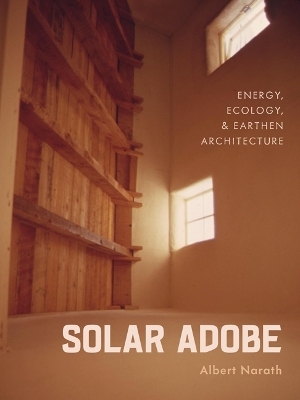
Solar Adobe
Energy, Ecology, and Earthen Architecture
Seiten
2024
University of Minnesota Press (Verlag)
978-1-5179-1406-6 (ISBN)
University of Minnesota Press (Verlag)
978-1-5179-1406-6 (ISBN)
How a centuries-old architectural tradition reemerged as a potential solution to the political and environmental crises of the 1970s
Against the backdrop of a global energy crisis, a widespread movement embracing the use of raw earth materials for building construction emerged in the 1970s. Solar Adobe examines this new wave of architectural experimentation taking place in the United States, detailing how an ancient tradition became a point of convergence for issues of environmentalism, architecture, technology, and Indigenous resistance.
Utilized for centuries by the Pueblo people of the American Southwest and by Spanish colonialists, adobe construction found renewed interest as various groups contended with the troubled legacies of modern architecture and an increasingly urgent need for sustainable design practices. In this period of critical experimentation, design networks that included architects, historians, counterculture communities, government weapons labs, and Indigenous activists all looked to adobe as a means to address pressing environmental and political issues.
Albert Narath charts the unique capacities of adobe construction across a wide range of contexts, consistently troubling simple distinctions between traditional and modern technologies, high design and vernacular architecture. Drawing insightful parallels between architecture, environmentalism, and movements for Indigenous sovereignty, Solar Adobe stresses the importance of considering the history of the built environment in conjunction with architecture’s larger impact on the natural world.
Against the backdrop of a global energy crisis, a widespread movement embracing the use of raw earth materials for building construction emerged in the 1970s. Solar Adobe examines this new wave of architectural experimentation taking place in the United States, detailing how an ancient tradition became a point of convergence for issues of environmentalism, architecture, technology, and Indigenous resistance.
Utilized for centuries by the Pueblo people of the American Southwest and by Spanish colonialists, adobe construction found renewed interest as various groups contended with the troubled legacies of modern architecture and an increasingly urgent need for sustainable design practices. In this period of critical experimentation, design networks that included architects, historians, counterculture communities, government weapons labs, and Indigenous activists all looked to adobe as a means to address pressing environmental and political issues.
Albert Narath charts the unique capacities of adobe construction across a wide range of contexts, consistently troubling simple distinctions between traditional and modern technologies, high design and vernacular architecture. Drawing insightful parallels between architecture, environmentalism, and movements for Indigenous sovereignty, Solar Adobe stresses the importance of considering the history of the built environment in conjunction with architecture’s larger impact on the natural world.
Albert Narath is associate professor of the history of the built environment at the University of California, Santa Cruz.
Contents
INTRODUCTION
Preparing the Ground
1. MUD MACHINES
William Lumpkins, the Los Alamos Scientific
Laboratory, and the Technics of Earth
2. EARTH ECOLOGIES
Ralph Knowles, the Natural Forces Laboratory,
and Ecosystem Design
3. IN AND OUT OF SIGHT
Vincent Scully, Reyner Banham,
and the Image of Earth
4. MUD/HUD
Theodore Jojola, Indigenous Planning,
and the Politics of Adobe
CONCLUSION
Back into the Ground
Acknowledgments
Notes
Index
| Erscheinungsdatum | 07.03.2024 |
|---|---|
| Zusatzinfo | 56 black and white illustrations |
| Verlagsort | Minnesota |
| Sprache | englisch |
| Maße | 152 x 203 mm |
| Gewicht | 482 g |
| Themenwelt | Naturwissenschaften ► Biologie ► Ökologie / Naturschutz |
| Technik ► Architektur | |
| ISBN-10 | 1-5179-1406-X / 151791406X |
| ISBN-13 | 978-1-5179-1406-6 / 9781517914066 |
| Zustand | Neuware |
| Informationen gemäß Produktsicherheitsverordnung (GPSR) | |
| Haben Sie eine Frage zum Produkt? |
Mehr entdecken
aus dem Bereich



aus dem Bereich
Methoden – Lösungen – Anwendungen
Buch | Hardcover (2025)
Hanser (Verlag)
CHF 69,95


