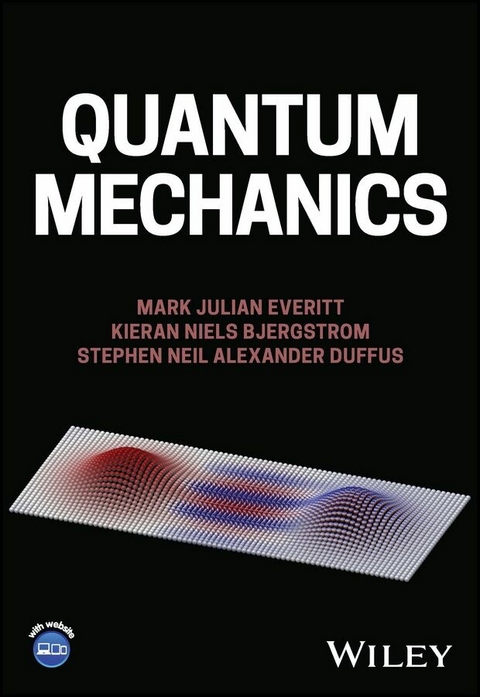
Quantum Mechanics (eBook)
John Wiley & Sons (Verlag)
978-1-119-82989-8 (ISBN)
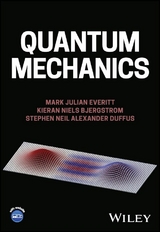
From classical analytical mechanics to quantum mechanics, simulation, foundations & engineering
Quantum mechanics is a fundamental and conceptually challenging area of physics. It is usually assumed that students are unfamiliar with Lagrangian and Hamiltonian formulations of classical mechanics and the role played by probability. As a result, quantum physics is typically introduced using heuristic arguments, obscuring synergies with classical mechanics.
This book takes an alternative approach by leveraging classical analytical mechanics to facilitate a natural transition to quantum physics. By doing so, a solid foundation for understanding quantum phenomena is provided.
Key features of this textbook include:
- Mathematics and Classical Analytical Mechanics: The necessary mathematical background and classical analytical mechanics are introduced gradually, allowing readers to focus on one conceptual challenge at a time.
- Deductive Approach: Quantum mechanics is presented on the firm foundation of classical analytical mechanics, ensuring a logical progression of concepts.
- Pedagogical Features: This book includes helpful notes, worked examples, problems, computational challenges, and problem-solving approaches to enhance understanding.
- Comprehensive Coverage: Including advanced topics such as open quantum systems, phase-space methods, and computational methods for quantum physics including good programming practice and code design. Much of the code needed to reproduce figures throughout this book is included.
- Consideration of Foundations: The measurement problem and correspondence principle are addressed, including an open and critical discussion of their interpretation and consequences.
- Introduction to Quantum Systems Engineering: This is the first book to introduce Quantum Systems Engineering approaches for applied quantum technologies development.
This textbook is suitable for undergraduate students in physics and graduate students in mathematics, chemistry, engineering, and materials science.
Mark Julian Everitt is the Director of Studies for Physics at Loughborough University, UK, where he has led a comprehensive revision of the physics degrees, increasing the level of challenge, guided by principles of authenticity and industry requirements. The first seven chapters of the book are derived from his second-year introductory core Quantum Physics module in these new degrees. His research includes the engineering of quantum circuits and devices for quantum technologies, feedback, measurement and control of quantum systems, and pioneering the field of quantum systems engineering as a distinct discipline.
Kieran Niels Bjergstrom began his career as a theoretical physicist researching the realistic modelling of open quantum systems, the reliability of quantum devices, and early notions of Quantum Systems Engineering (QSE) - which was the topic of his PhD. He has worked in academia, industry and business developing QSE principles, tools and methodologies for maturing commercially relevant quantum technologies. He is director of a technology and strategy consultancy advising on areas of innovation including the strategic impact of quantum technologies, methods and policies for realising quantum technology's commercial potential, and applied QSE.
Stephen Neil Alexander Duffus is a university teacher within the Physics Department at Loughborough University. He has an established reputation of communicating complex ideas in an engaging and accessible fashion. During his PhD, his main area of research was in open quantum systems.
Mark Julian Everitt is the Director of Studies for Physics at Loughborough University, UK, where he has led a comprehensive revision of the physics degrees, increasing the level of challenge, guided by principles of authenticity and industry requirements. The first seven chapters of the book are derived from his second-year introductory core Quantum Physics module in these new degrees. His research includes the engineering of quantum circuits and devices for quantum technologies, feedback, measurement and control of quantum systems, and pioneering the field of quantum systems engineering as a distinct discipline. Kieran Niels Bjergstrom began his career as a theoretical physicist researching the realistic modelling of open quantum systems, the reliability of quantum devices, and early notions of Quantum Systems Engineering (QSE) -- which was the topic of his PhD. He has worked in academia, industry and business developing QSE principles, tools and methodologies for maturing commercially relevant quantum technologies. He is director of a technology and strategy consultancy advising on areas of innovation including the strategic impact of quantum technologies, methods and policies for realising quantum technology's commercial potential, and applied QSE. Stephen Neil Alexander Duffus is a university teacher within the Physics Department at Loughborough University. He has an established reputation of communicating complex ideas in an engaging and accessible fashion. During his PhD, his main area of research was in open quantum systems.
Chapter 1. Mathematical Preliminaries
Chapter 2. Notes on Classical Mechanics
Chapter 3. The Schrödinger View/Picture
Chapter 4. Other Formulations of Quantum Mechanics
Chapter 5. Vectors and Angular Momentum
Chapter 6. Some Analytic and Semi-Analytic Methods
Chapter 7 Applications and Examples
Chapter 8. Computational Simulation of Quantum Systems
Chapter 9. Open Quantum Systems
Chapter 10. Foundations: Measurement and the Quantum to Classical Transition
Chapter 11. Quantum Systems Engineering
Introduction
This book introduces quantum mechanics from the perspective of classical analytical mechanics. The idea of this approach is to highlight more clearly the similarities of quantum and classical mechanics, as well as the differences. As a consequence, we believe that this makes the theoretical framework of the theory more intuitive where this is possible. Our intent is that the actual peculiarities of quantum mechanics are more clearly identified than in treatments where, e.g. the relationship between the dynamics of classical and quantum probability densities is considered.
Chapters 1–4 were written to be studied in order, subject to the various caveats listed below. There is more flexibility in the order in which later material can be studied. The content up to and including Chapter 7 forms the basis of what we consider a first course in quantum mechanics, with the remaining chapters constituting either additional reading or supporting more advanced courses.
In Chapter 1 we present most of the mathematics used in the text, introducing core concepts and notations (such as that of Dirac). We have found that some students can struggle to become comfortable with such notation. Separating the concerns of mathematics from the physics we find improves the understanding of both the mathematics and the physics. Presumably this is because it reduces the number of concepts that students need to think about at any one time. Our approach has the added advantage that we can introduce concepts such as the Heisenberg uncertainty principle in their general mathematical form. Such results have utility beyond quantum mechanics, which this presentation makes clear. In the specific case of the uncertainty principle, the separation of concerns enables us to introduce the result without incorrectly confusing it with ideas of measurement disturbance. This chapter might either be studied entirely on its own before engaging with the rest of the text, or it may be interleaved with the content of the rest of the book. Especially in early chapters, we cross-reference sections back to the prerequisite mathematical material contained within this chapter to enable either approach to be taken.
As some knowledge of Hamiltonian and Lagrangian mechanics is required, Chapter 2 provides a self-contained introduction to the subject. Even if you are familiar with most of this material, it is worth reading, as it contains important material on a formulation of classical mechanics due to Koopman and von Neumann that greatly helps in motivating the Schrödinger equation. Historically, the idea was to make classical mechanics look like quantum mechanics. We have chosen to present the ideas ahistorically, as it is an odd but not conceptually difficult jump to move from the Liouville equation to Koopman–von Neumann classical mechanics. Once we have Koopman–von Neumann classical mechanics, the Schrödinger equation does not seem anywhere near as surprising as it might do without this context. This chapter finishes with a discussion of the breakdown of classical mechanics and the correspondence principle (some understanding of which is important at this stage, as it allows us to understand the flexibility we have in formulating new theories consistently with existing ones).
In Chapter 3 we introduce the Schrödinger formulation of quantum mechanics. We try to do this in a way that makes as few assumptions as possible. This leads to a somewhat lengthy discussion, but it is one that draws out the key assumptions and issues of the Schrödinger picture (such as that the initial state is all that is needed to determine a system's evolution, just like in the Liouville equation). We motivate the Schrödinger equation as being similar in form to the Koopman–von Neumann equation of motion, but where we move to an operator formalism that replaces some Poisson brackets with commutation relations. We make only a few assumptions about the state (i.e. it is a vector in a vector space), and our discussion progresses through measurement axioms before discussing that the representation of a quantum system is a matter of choice and that, e.g. the wave function is just the position representation of a quantum state. This discussion allows us to make clear the axioms associated with dynamics and measurement, and separate these clearly from the ideas of representation.
We then, in Chapter 4, look at some alternative paths into quantum mechanics, the Heisenberg, Wigner phase space, and (a very brief introduction to) Feynman path integral formulations. We do not derive these from the Schrödinger formulation, but instead re-argue from first principles. We do this for two reasons: (i) to show that they are not subordinate to the Schrödinger view, and (ii) because they can be more naturally argued for in a way that helps develop our discussion of the similarities as well as the differences between quantum and classical physics. In fact, there is a strong case for arguing that either of these pictures might be a more natural starting point for developing the subject of quantum physics. We chose to start with the Schrödinger picture, simply because this is the dominant one in most of the textbook and research literature. We think it would be relatively straightforward to mix the Heisenberg picture discussion of Chapter 4 with elements of Chapter 3 to form an alternative opening to the subject.
Chapter 5 introduces vectors and angular momentum and is somewhat unusual in so far as we include an extensive discussion of curvilinear coordinates in quantum mechanics. Our reason for doing this is that many classical mechanics problems become easier to treat by using curvilinear coordinates, if that suits the symmetry of the problem. Such simplification is not seen in quantum mechanics. One of our key aims of this text is to highlight as clearly as possible the similarities and differences between quantum and classical physics. For problems with spherical symmetry, simplification is actually found through an analysis of angular momentum, and we wanted to explain why this is in fact the case. One advantage of this introduction to the subject is that the expression of the kinetic energy operator in terms of radial and angular momentum components does arise naturally (in the usual treatment this is discovered through analysis of the three-dimensional kinetic and angular momentum operators in the coordinate representation which, while effective, lacks elegance). Those not interested in that level of detail can happily skim-read most of Section 5.2. The remainder of the chapter contains the theory needed to understand really important applications, such as the quantum physics of hydrogen. Note that it is often the case that the harmonic oscillator is introduced before angular momentum. We have chosen not to do this, as angular momentum is part of the general theory and the harmonic oscillator is simply a very important example.
The harmonic oscillator discussion in Section 7.3 is not predicated on the content in Chapter 5 and can be studied beforehand.
Chapters 6 and 7 contain methods and applications and important examples such as hydrogen, molecules, and the Jaynes–Cummings model. The order of study can be somewhat flexible.
For the modern physicist, computation has become as important as mathematics for many tasks, for example enabling the solution of problems with no analytic solution. Many texts cover technical aspects of algorithm design pertinent to scientific computing. While there is some literature [93] on good practice in scientific computing, there is a limited amount of textbook resources for physics. In Chapter 8 our focus is on good practice and design principles using quantum physics as an example. In a world where artificial intelligence is getting better at writing routine code, it is these higher-level skills that the physicist will require more and more. This chapter can equally well be used to support either a quantum mechanics module with coding elements, or a coding course where quantum mechanics would provide valuable example applications1.
In Chapter 9 we provide an introduction to open quantum systems. While there is already substantial literature on this subject, it is a challenging one. Based on our undergraduate teaching and project supervision, our intention is to make this material as accessible as possible, expanding on those areas where our experience has found that students need assistance with the material presented in the existing literature.
Many treatments of quantum mechanics set down a philosophical interpretation of the subject early on. It is one of the main discussion points of the theory that there are multiple interpretations of quantum mechanics and that the subject contains unresolved metaphysical issues. In Chapter 10 we take advantage of much of the preceding content of the book to have an in-depth, open, and honest discussion on some aspects of the foundations of quantum mechanics. Our intent is to stimulate thought and discussion rather than present a single perspective. Interestingly, a discussion of the measurement problem is pertinent to the verification and validation issues that are presented in the final chapter. This provides an interesting link between the very philosophical foundations of quantum mechanics and the very applied goal of engineering quantum systems.
Finally, in Chapter 11 we turn to a general discussion of some challenges associated with the engineering of quantum technologies. We introduce an approach to quantum systems...
| Erscheint lt. Verlag | 8.9.2023 |
|---|---|
| Sprache | englisch |
| Themenwelt | Naturwissenschaften ► Physik / Astronomie ► Theoretische Physik |
| Schlagworte | Chemie • Chemistry • classical mechanics • Electrical & Electronics Engineering • Elektrotechnik u. Elektronik • Feynman path integrals • Hamiltonian Formalism • Heisenberg picture • Lagrangian Formalism • Liouville’s Theorem • Physics • Physik • Quantenchemie • Quantenelektronik • Quantenmechanik • Quantum Chemistry • Quantum Electronics • Quantum probability • Quantum Theory • Schrodinger picture • theoretical physics • Theoretische Physik • Wigner phase-space approach |
| ISBN-10 | 1-119-82989-5 / 1119829895 |
| ISBN-13 | 978-1-119-82989-8 / 9781119829898 |
| Informationen gemäß Produktsicherheitsverordnung (GPSR) | |
| Haben Sie eine Frage zum Produkt? |
 EPUB (Adobe DRM)
Kopierschutz: Adobe-DRM
Adobe-DRM ist ein Kopierschutz, der das eBook vor Mißbrauch schützen soll. Dabei wird das eBook bereits beim Download auf Ihre persönliche Adobe-ID autorisiert. Lesen können Sie das eBook dann nur auf den Geräten, welche ebenfalls auf Ihre Adobe-ID registriert sind.
Details zum Adobe-DRM
Dateiformat: EPUB (Electronic Publication)
EPUB ist ein offener Standard für eBooks und eignet sich besonders zur Darstellung von Belletristik und Sachbüchern. Der Fließtext wird dynamisch an die Display- und Schriftgröße angepasst. Auch für mobile Lesegeräte ist EPUB daher gut geeignet.
Systemvoraussetzungen:
PC/Mac: Mit einem PC oder Mac können Sie dieses eBook lesen. Sie benötigen eine
eReader: Dieses eBook kann mit (fast) allen eBook-Readern gelesen werden. Mit dem amazon-Kindle ist es aber nicht kompatibel.
Smartphone/Tablet: Egal ob Apple oder Android, dieses eBook können Sie lesen. Sie benötigen eine
Geräteliste und zusätzliche Hinweise
Buying eBooks from abroad
For tax law reasons we can sell eBooks just within Germany and Switzerland. Regrettably we cannot fulfill eBook-orders from other countries.
aus dem Bereich