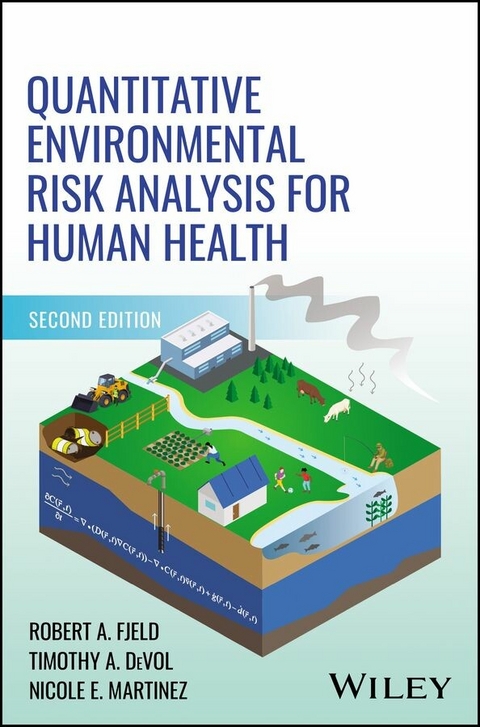
Quantitative Environmental Risk Analysis for Human Health (eBook)
John Wiley & Sons (Verlag)
978-1-119-67540-2 (ISBN)
An updated edition of the foundational guide to environmental risk analysis
Environmental risk analysis is a systematic process essential for the evaluation, management, and communication of the human health risk posed by the release of contaminants to the environment. Performed correctly, risk analysis is an essential tool in the protection of the public from the health hazards posed by chemical and radioactive contaminants. Cultivating the quantitative skills required to perform risk analysis competently is a critical need.
Quantitative Environmental Risk Analysis for Human Health meets this need with a thorough, comprehensive coverage of the fundamental knowledge necessary to assess environmental impacts on human health. It introduces readers to a robust methodology for analyzing environmental risk, as well as to the fundamental principles of uncertainty analysis and the pertinent environmental regulations. Now updated to reflect the latest research and new cutting-edge methodologies, this is an essential contribution to the practice of environmental risk analysis.
Readers of the second edition of Quantitative Environmental Risk Analysis for Human Health will also find:
- Detailed treatment of source and release characterization, contaminant migration, exposure assessment, and more
- New coverage of computer-based analytical methods
- A new chapter of case studies providing actual, real-world examples of environmental risk assessments
Quantitative Environmental Risk Analysis for Human Health is must-have for graduate and advanced undergraduate students in civil engineering, environmental engineering, and environmental science, as well as for risk analysis practitioners in industry, environmental consultants, and regulators.
Robert A. Fjeld, PhD, is an Emeritus Professor and Dempsey Chair of Environmental Engineering, Department of Environmental Engineering and Earth Sciences, Clemson University, USA. He is a pioneering researcher of quantitative human health risk assessment and the author of numerous related publications.
Timothy A. DeVol, PhD, CHP, is Toshiba Professor of Nuclear Engineering and Director of the Nuclear Environmental Engineering Sciences and Radioactive Waste Management Center at Clemson University. His research interests are on radioactive material detection and environmental health physics.
Nicole E. Martinez, PhD, CHP, is an Associate Professor of Environmental Engineering and Earth Sciences, Clemson University with a Joint Faculty Appointment at Oak Ridge National Laboratory. Her research focuses on dosimetric modeling and the transport and effects of environmental contaminants.
Robert A. Fjeld, PhD, is an Emeritus Professor and Dempsey Chair of Environmental Engineering, Department of Environmental Engineering and Earth Sciences, Clemson University, USA. He is a pioneering researcher of quantitative human health risk assessment and the author of numerous related publications. Timothy A. DeVol, PhD, CHP, is Toshiba Professor of Nuclear Engineering and Director of the Nuclear Environmental Engineering Sciences and Radioactive Waste Management Center at Clemson University. His research interests are on radioactive material detection and environmental health physics. Nicole E. Martinez, PhD, CHP, is an Associate Professor of Environmental Engineering and Earth Sciences, Clemson University with a Joint Faculty Appointment at Oak Ridge National Laboratory. Her research focuses on dosimetric modeling and the transport and effects of environmental contaminants.
1. Introduction
2. Fundamental Aspects of Environmental Modeling
3. Release Assessment
4. Environmental Transport Theory
5. Surface Water Transport
6. Surface Water Transport
7. Atmospheric Transport
8. Food Chain Transport
9. Exposure Assessment
10. Exposure Assessment
11. Dose-Response and Risk Characterization
12. Uncertainty and Sensitivity Analyses
13. Screening and Computational Resources
14. Case Studies
15. Ethics, Stakeholder Involvement, and Risk Communication
16. Environmental Risk Management
17. Environmental Laws and Regulations
LIST OF VARIABLES WITH COMMON EXAMPLE UNITS
| α | ≡ | dispersivity, m |
| αF | ≡ | soil‐to‐skin adherence factor, mgs/cm2 |
| αL | ≡ | longitudinal dispersivity, m |
| αflow | ≡ | first‐order rate constants for contaminant flow out of a volume, 1/s |
| αsettling | ≡ | first‐order rate constant for removal by settling, 1/s |
| A | ≡ | radioactivity, Bq or decays/s |
| A | ≡ | total cross‐sectional area of the medium, m2 |
| Askin | ≡ | area of skin exposed, cm2 |
| Bfish | ≡ | bioaccumulation factor for fish, L/kgfish |
| Bv | ≡ | bioaccumulation factor, kgs/kgv,wet |
| C | ≡ | contaminant concentration, |
| ≡ | average concentration, μg/m3 |
| Ca | ≡ | contaminant concentration in air, |
| Cbeef | ≡ | contaminant concentration in beef, mgc/kgbeef |
| Cfish | ≡ | contaminant concentration in food, mgc/kgfish |
| Cfood | ≡ | contaminant concentration in food, mgc/kgfood |
| Cg,n | ≡ | Gaussian plume concentration for the nth set of hourly meteorological |
| measurements, μg/m3 |
| Cmax | ≡ | maximum contaminant concentration, μg/m3 |
| Cmedium | ≡ | contaminant concentration in medium, mgc/kgmedium or, mgc/Lmedium |
| Cmilk | ≡ | contaminant concentration in milk, mgc/Lmilk |
| Corganism | ≡ | contaminant concentration in organism, mgc/kgorganism |
| ≡ | sector‐averaged concentration, μg/m3 |
| Cs | ≡ | contaminant concentration in solid (or soil) phase, mgc/kgs |
| Cs,ext | ≡ | extractable soil concentration, mgc/kgs |
| Css | ≡ | steady‐state contaminant concentration, |
| CT | ≡ | total contaminant concentration, |
| Cv | ≡ | contaminant concentration in vegetation, mgc/kgv,wet |
| ≡ | contaminant concentration in vegetation due to deposition on foliage, |
| mgc/kgv,wet |
| ≡ | contaminant concentration in vegetation due to uptake from the soil, mgc/kgv,wet |
| Cw | ≡ | contaminant concentration in the aqueous phase, mgc/Lw |
| ≡ | time‐integrated concentration, |
| ≡ | contaminant destruction rate density, mgc/(Lw s) |
| ≡ | settling rate density, mgc/(Lw s) |
| dm | ≡ | representative grain size (diameter), μm |
| D | ≡ | absorbed dose (radiation), Gy = J/kg |
| D | ≡ | dispersion coefficient, m2/s |
| ≡ | dose rate, mg/(kg d) |
| ≡ | true average daily dose rate, mg/(kg d) |
| ≡ | lifetime average daily dose rate, mg/(kg d) |
| DH | ≡ | mechanical dispersion coefficient, m2/s |
| DM | ≡ | molecular diffusion coefficient, m2/s |
| DT | ≡ | turbulent dispersion coefficient, m2/s |
| DL | ≡ | longitudinal dispersion coefficient, m2/s |
| DM | ≡ | effective molecular diffusion coefficient for porous media, m2/s |
| Ds | ≡ | stack diameter, m |
| DT | ≡ | total dose, mg/kg |
| DT,R | ≡ | absorbed dose to organ or tissue (T) from radiation (R), Gy = J/kg |
| ε | ≡ | removal efficiency |
| E | ≡ | effective dose (radiation), Sv |
| ≡ | effective dose rate, Sv/s |
| ET | ≡ | total effective dose (radiation), Sv |
| Ex | ≡ | (surface water) longitudinal dispersion coefficient, m2/s |
| fabs | ≡ | dermal absorption fraction |
| fi,j | ≡ | fraction of time that winds blow into the given sector under stability j |
| fv | ≡ | fraction of the contaminant that is intercepted by the vegetation |
| fmilk | ≡ | fraction of contaminant transferred to milk |
| fox | ≡ | fraction of sulfur oxidized to SO2 in the combustion process |
| fs | ≡ | fraction sorbed |
| fs | ≡ | fraction (by weight) of sulfur in the coal, kgS/kgcoal |
| F | ≡ | buoyancy flux, m4/s3 |
| Fbeef | ≡ | beef transfer factor, d/kgbeef |
| Fmilk | ≡ | milk transfer factor, d/kgmilk |
| ≡ | contaminant generation rate density, mgc/(L s) |
| ≡ | total (aqueous and solid phase) contaminant generation rate density, mgc/(L s) |
| g | ≡ | acceleration due to gravity, m2/s |
| h | ≡ | stack height, m |
| he | ≡ | effective release height, m |
| hpr | ≡ | plume rise height, m |
| hs | ≡ | physical release height, m |
| H | ≡ | hydraulic head, m |
| H | ≡ | height, m |
| I | ≡ | contaminant inventory, kg |
| I | ≡ | total amount of radioactivity taken into the body during the exposure, Bq |
| ≡ | irrigation rate, m/yr |
| ≡ | contaminant intake rate, mgc/d (for chemicals) or Bq/d (for... |
| Erscheint lt. Verlag | 29.8.2023 |
|---|---|
| Sprache | englisch |
| Themenwelt | Naturwissenschaften ► Chemie |
| Schlagworte | Angewandte Wahrscheinlichkeitsrechnung u. Statistik • Applied Probability & Statistics • Arbeitssicherheit • Arbeitssicherheit u. Umweltschutz i. d. Chemie • Cancer • Chemical and Environmental Health and Safety • Chemical Toxicity • Chemie • Chemistry • Computational tools • Contaminant concentration • Dose • Environmental Analysis • Exposure routes • Gaussian Plume Model • Laplace Transforms • Monte Carlo uncertainty propagation • radiation effects • risk driver • Stakeholder • Statistics • Statistik • Transport pathways • Umweltanalytik |
| ISBN-10 | 1-119-67540-5 / 1119675405 |
| ISBN-13 | 978-1-119-67540-2 / 9781119675402 |
| Informationen gemäß Produktsicherheitsverordnung (GPSR) | |
| Haben Sie eine Frage zum Produkt? |
 EPUB (Adobe DRM)
Kopierschutz: Adobe-DRM
Adobe-DRM ist ein Kopierschutz, der das eBook vor Mißbrauch schützen soll. Dabei wird das eBook bereits beim Download auf Ihre persönliche Adobe-ID autorisiert. Lesen können Sie das eBook dann nur auf den Geräten, welche ebenfalls auf Ihre Adobe-ID registriert sind.
Details zum Adobe-DRM
Dateiformat: EPUB (Electronic Publication)
EPUB ist ein offener Standard für eBooks und eignet sich besonders zur Darstellung von Belletristik und Sachbüchern. Der Fließtext wird dynamisch an die Display- und Schriftgröße angepasst. Auch für mobile Lesegeräte ist EPUB daher gut geeignet.
Systemvoraussetzungen:
PC/Mac: Mit einem PC oder Mac können Sie dieses eBook lesen. Sie benötigen eine
eReader: Dieses eBook kann mit (fast) allen eBook-Readern gelesen werden. Mit dem amazon-Kindle ist es aber nicht kompatibel.
Smartphone/Tablet: Egal ob Apple oder Android, dieses eBook können Sie lesen. Sie benötigen eine
Geräteliste und zusätzliche Hinweise
Buying eBooks from abroad
For tax law reasons we can sell eBooks just within Germany and Switzerland. Regrettably we cannot fulfill eBook-orders from other countries.
aus dem Bereich