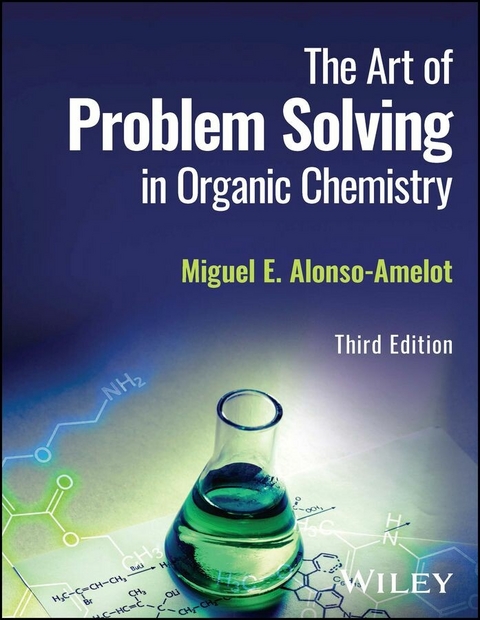
The Art of Problem Solving in Organic Chemistry (eBook)
John Wiley & Sons (Verlag)
978-1-119-90068-9 (ISBN)
The new edition of the classic textbook that has helped thousands of students understand and solve the complex mechanistic problems posed by organic reactions
The Art of Problem Solving in Organic Chemistry is a must-have handbook for students and professionals alike, offering step-by-step guidance on applying proven strategies and logical techniques to solve complex reaction mechanism problems. With a straightforward approach and conversational style, this highly practical resource provides fully worked organic reaction problems that increase in difficulty from basic to advanced. Organized by specific analysis technique, the problems include complete and accurate discussions of the mechanisms, alternative pathways, comparisons with related reactions, data from quantum chemical calculations, critical reviews of current methods, real-world research and reaction schemes, and illustrated examples.
Now in its third edition, The Art of Problem Solving in Organic Chemistry retains the structure of previous editions, previously rated among the 30 best organic chemistry books of all time by BookAuthority. More than 50 revised organic reaction mechanism problems are complemented by an entirely new set of problems, additional concepts and techniques, expanded coverage of applications in contemporary organic chemistry, embedded cases of the existing reaction pool taken from recent literature, and much more.
- Describes the principles, methods, tools, and problem analysis techniques required to solve organic reaction problems
- Extends the logic and strategy of the mechanistic approach beyond specific reactions and facts
- Discusses practical methods for improved problem solving for organic reaction mechanisms
- Explains tested strategies for analyzing the possibilities of reaction mechanisms between reactants and products
- Contains detailed appendices with definitions and examples of principles, reactions, mechanisms, and reagents
The Art of Problem Solving in Organic Chemistry, Third Edition is an essential volume for advanced undergraduates, graduate students, lecturers, and professionals looking to improve their performance in finding solutions to organic reaction problems. It is an ideal textbook for courses on organic reactions and problem analysis, as well as an excellent supplement for courses covering reactive intermediates and mechanisms of molecular transformations.
Miguel E. Alonso-Amelot is Professor Emeritus of Organic and Ecological Chemistry at The University of the Andes (Universidad de Los Andes) in Mérida, Venezuela. He received his PhD from the Department of Chemistry at Indiana University and has more than 45 years of teaching experience in the United States, Europe, and Latin America. He is the author of over 110 research articles and book chapters and four books, including the first two editions of The Art of Problem Solving in Organic Chemistry.
Miguel E. Alonso-Amelot is Professor Emeritus of Organic and Ecological Chemistry at The University of the Andes (Universidad de Los Andes) in Mérida, Venezuela. He received his PhD from the Department of Chemistry at Indiana University and has more than 45 years of teaching experience in the United States, Europe, and Latin America. He is the author of over 110 research articles and book chapters and four books, including the first two editions of The Art of Problem Solving in Organic Chemistry.
Preface ix
Acknowledgements xiii
Where Does This Book Level Start, How Far Does It Take You? xv
Part I The Toolbox 1
1 Introduction to Problem Analysis in Advanced Organic Reaction Mechanism 3
1.1 Overview, 3
1.2 The First Three Steps in Problem Analysis, 4
1.3 Moving Beyond the Primary Answers, 7
1.4 Drawing a Preliminary Outline for Guidance, 7
1.5 Intuition and Problem Solving, 8
1.6 Summing Up, 9
1.7 Solution to the 14 --> 16 Conversion in Scheme I.5, 10
References and Notes, 10
2 Electron Flow in Organic Reactions 11
2.1 Overview, 11
2.2 Introduction, 12
2.2.1 A Word or Two on Notation, 13
2.3 Electrons in Covalent Bonding and Redeployment, 14
2.4 Practical Rules Governing Electron Redeployment, 15
2.5 Summing Up, 84
2.6 Organized Problem Analysis with the Tools Described so Far, 85
2.7 Supplementary Schemes: Solutions to Problems Embedded in this Chapter, 86
Notes, 89
3 Stereochemistry and Mechanism of Molecular Transformations 93
3.1 Overview, 93
3.2 Introduction, 94
3.3 Measuring Steric Hindrance, 102
3.4 Applications to Stereochemically Competent Reaction Mechanisms, 127
3.5 Stereochemistry in Bimolecular Reactions: Cycloadditions, 131
3.6 The Ultimate Stereo- and Enantio-Control: Oriented External Electric Fields (OEEFS), 139
3.7 Summing Up, 144
3.8 Supplementary Schemes, 145
Notes, 146
References, 146
4 Additional Techniques to Postulate Organic Reaction Mechanisms 149
4.1 Overview, 149
4.2 Take Your Time, 150
4.3 Use Clear and Informative Molecular Renderings, 150
4.4 Element and Bond Budgets, 150
4.5 Looking at Molecules From Different Perspectives, 152
4.6 Redraw Reactants Such That They Resemble Products, 155
4.7 Fragmentation Analysis (Fa): Dissecting Products in Terms of Reactants, 157
4.8 Oxidation Levels and Mechanism, 163
4.9 The Functionality Number (FN), 164
4.10 Combining Fragmentation Analysis and Functionality Numbers, 169
4.11 A Flowchart to Orderly Exploit the Strategies of this Chapter, 170
4.12 Summing Up, 171
4.13 Supplementary Reaction Schemes, 171
4.14 Solution to Problems Embedded in this Chapter, 172
References, 172
Part II The Problem Chest 173
Subject Index 389
Graphical Index 391
WHERE DOES THIS BOOK LEVEL START, HOW FAR DOES IT TAKE YOU?
1 OVERVIEW
You may wish to learn that the second edition of this series earned a high position in 2020 among the “The 90 Best Organic Chemistry Books of All Times in the World” (twenty-ninth echelon), according to BookAuthority [1].
This third edition embraces the tradition of the previous two editions (1986 and 2014) but offers additional concepts, techniques, and updated examples. These concepts expand the previous editions to new limits of problem solving as a tool for advanced organic chemistry. The approach continues to focus on the multiple purpose of developing problem-solving skills to fasten the rules of nature and reactivity of organic compounds in your knowledge baggage and create a state of mind to face the challenges of finding solutions to the wide scope of problems found in student and professional life.
The Art of Problem Solving in Organic Chemistry, now in its third edition was designed to be a useful participant of the chemical space constituted by organic reactions, reactive intermediates, and mechanisms of molecular transformations; that is, a complimentary source for courses aimed at covering these subjects, a demanding workbook for individual or group study to gain expertise and competitive skills, and a self-contained textbook for courses on organic reactions and problem analysis at intermediate and advanced levels. It can also be used as text for a one semester course covering advanced electron redeployment in organic reactions and stereochemistry to be applied to specific problem-solving strategies presented exclusively in this workbook.
Problems have existed for people to solve since the epoch of early humans living in bivouacs in trees. Eons later, organic chemistry began creating its own sort of problems since the middle of the nineteenth century when it faced the classic question: What in the world is benzene? When top scientists of the 1850s jumped on the bandwagon, they had learned just a few years earlier that carbon atoms had four valences and could be bonded to other carbon atoms to form compounds. They also knew that the composition of the tar fraction at the 60 ºC boiling point, called benzene, had a C6H6 composition but nothing else. Heated debate around benzene’s molecular structure continued until Kekulé produced his famous hexagon (1865), which remains a continuing research subject.
If you happened to be a research chemist in the 1860s and wished to participate in this brawl with a brilliant display of imagination, you might have ended up with 217 different perfectly valid C6H6 combinations, as Professor Nagendrappa collected in 2001 [2]. Obviously, our chemical reasoning has changed enormously along with problem complexity.
2 THE TWO WAYS TO PROBLEM SOLVING OF ADVANCED ORGANIC REACTION MECHANISMS
Approaches to problem solving have been a widespread discussion among theoreticians of chemical education for a long time. A central aspect is this:
When facing a given chemical reaction, the brain apparently switches from one state to another depending on whether the target product is shown or not [3]. This switch completely changes the student’s perception of the problem.
If no structural details of the product are provided (see Scheme I.3 of Chapter 1), the subject applies the chemical principles they are familiar with, which depend on the accumulated knowledge, to devise a pushing-forward attitude toward possible products. Chemical education researchers admit that the applied reasoning may lead to misconceptions and mistakes, but the problem solvers at least attempted to apply what they knew in search of a solution. Therefore, an educational end is satisfied [3, 4].
In comparison, when the target product is shown the student “dramatically” changes the solving strategy to a “domain-general” type. This means focusing attention on the target product and then working backward to the reagents in search of the one mechanism that will justify the product, which these researchers contend is a tunnel-like approach [3, 4]. Accordingly, the students do not shake up their knowledge basket to examine other possibilities. Hence, this strategy “may not be the most effective at assessing mechanistic reasoning, because it can limit the student’s thought processes” [4]. I disagree and show this point of view throughout this book referencing non-elementary reaction-mechanism design. Science is, after all, propelled by disagreement and rational discussion.
3 THE VASTNESS OF ORGANIC CHEMISTRY: THE FIRST CHALLENGE
The scope of organic chemistry is so immense that defining its limits is hardly possible. To cope with this, the central question is cognitive memory retrieval versus intelligent use of correlative lines of thought. This book is intended to provide the skills necessary to turn this branch of science into a more accessible field through correlation judgment by way of specific problem-analysis strategies as a framework for applying the concepts that support every reaction-mechanism proposal.
This view is applicable from the simple problems of molecular transformation to very complex riddles. The learning process involved when coming across intelligent problem solving from accessible to challenging arenas inevitably advances the reader to an enhanced proficiency and response capacity to the variety of problems posed by advanced studies and career practice.
Because this book is meant to be read and get deeply involved in, by way of the many examples and questions, its basic design fits the model of a workbook for the individual reader and discussion group alike: A reading instrument in company with paper/pencil or chalk/blackboard and a great deal of organized thinking.
It may also become a cherished addition to a personal collection, along with the first and second editions; a valuable source for the lecturer to retrieve definitions and examples of principles, reactions, mechanisms, reagents, and so forth, described in the detailed indexes at the end of the book.
The present section seeks to shed light on the bottom line. Because this book is based on a large collection of reactions to illustrate principles entrenched in increasingly advanced concepts, the following case (Scheme 0.1) illustrates the starting level of difficulty. Difficulty is inversely proportional to the study level and the fraction of knowledge readers retain, in addition to practice, perception, and association thinking. Therefore, advanced masters’ and PhD students may find this first problem somewhat elementary, whereas college seniors and non-major chemistry students may feel a bit challenged. It is up to you to find your place in this scale when you try it.
SCHEME 0.1 Adapted from [5] and [6].
4 ASSESSING YOUR COGNITIVE LEVEL: A FIRST TEST
Imagine that one morning you are walking down the hall at your favorite university and a couple of students in your class, Jack and Helen, approach you as the more advanced student (or dependable lecturer) you are, with a question. Jack wants to know whether there is a mistake in product 3 of Scheme 0.1 or not. The reaction appeared in the chemical literature, but Jack is not sure he copied it correctly from the abstract, the internet service is under maintenance, the library is closed for repairs, and he needs a quick answer. Would you be able to help Jack?
A memory-gifted chemist may have recognized remnants of the Reissert indole synthesis (Scheme 0.2) [7]. If you did, you might probably proceed to scan your memory bank for a pre-established mechanism stored previously in the “Reissert module” of your gray matter. The core (dashed block of Scheme 0.2) emerges as a quite elementary and unchallenging mechanism.
SCHEME 0.2 The basic Reissert indole synthesis discovered in the late nineteenth century
This manner of solving problems (association with a reaction stored fresh in your memory) is not rational, artful reasoning but simple memory search and rescue very much like computers do effortlessly in a hum; a time-efficient ice-cold response, but devoid of the pizzazz and learning power of creative chemistry. The latter is the result of a balanced combination of educated intuition, imagination, and solid chemistry principles. This is what this book intends to develop or enhance in the reader. By the way, the basic Reissert mechanism will not satisfy Jack’s question. The only way is to sort out the reaction mechanism anew.
If you did not pick up the Reissert reaction at first, you are bound to walk along a far more interesting mind adventure: Creativity. “Imagination is more important than knowledge” Albert Einstein was once quoted. Your chalk and blackboard analysis may go like this:
Firstly, after a birds-eye look at reactants and product in Scheme 0.1:
- You recognize the furan carbons on the right appendage of indole 3.
- Therefore, the reaction involves a well-known acid-catalyzed coupling of furan and the secondary carbinol 1. The product of this typical electrophilic addition may be stable enough to be isolated.
- Next, ring opening of the furan elicited by strong acid and heat.
- Further closing to the indole with previous, acid-catalyzed removal of the tosylate protecting group on N.
- Some final touches… finish the sequence...
| Erscheint lt. Verlag | 22.8.2023 |
|---|---|
| Sprache | englisch |
| Themenwelt | Naturwissenschaften ► Chemie ► Organische Chemie |
| Schlagworte | catalysis • Chemie • Chemistry • Katalyse • Organic Chemistry • organic chemistry problems guide • organic chemistry problem solving • organic chemistry problems strategies • organic mechanism problem solving • organic reactions problem analysis • organic reactions problem solving • Organische Chemie • solve organic chemistry problems |
| ISBN-10 | 1-119-90068-9 / 1119900689 |
| ISBN-13 | 978-1-119-90068-9 / 9781119900689 |
| Informationen gemäß Produktsicherheitsverordnung (GPSR) | |
| Haben Sie eine Frage zum Produkt? |
 EPUB (Adobe DRM)
Kopierschutz: Adobe-DRM
Adobe-DRM ist ein Kopierschutz, der das eBook vor Mißbrauch schützen soll. Dabei wird das eBook bereits beim Download auf Ihre persönliche Adobe-ID autorisiert. Lesen können Sie das eBook dann nur auf den Geräten, welche ebenfalls auf Ihre Adobe-ID registriert sind.
Details zum Adobe-DRM
Dateiformat: EPUB (Electronic Publication)
EPUB ist ein offener Standard für eBooks und eignet sich besonders zur Darstellung von Belletristik und Sachbüchern. Der Fließtext wird dynamisch an die Display- und Schriftgröße angepasst. Auch für mobile Lesegeräte ist EPUB daher gut geeignet.
Systemvoraussetzungen:
PC/Mac: Mit einem PC oder Mac können Sie dieses eBook lesen. Sie benötigen eine
eReader: Dieses eBook kann mit (fast) allen eBook-Readern gelesen werden. Mit dem amazon-Kindle ist es aber nicht kompatibel.
Smartphone/Tablet: Egal ob Apple oder Android, dieses eBook können Sie lesen. Sie benötigen eine
Geräteliste und zusätzliche Hinweise
Buying eBooks from abroad
For tax law reasons we can sell eBooks just within Germany and Switzerland. Regrettably we cannot fulfill eBook-orders from other countries.
aus dem Bereich