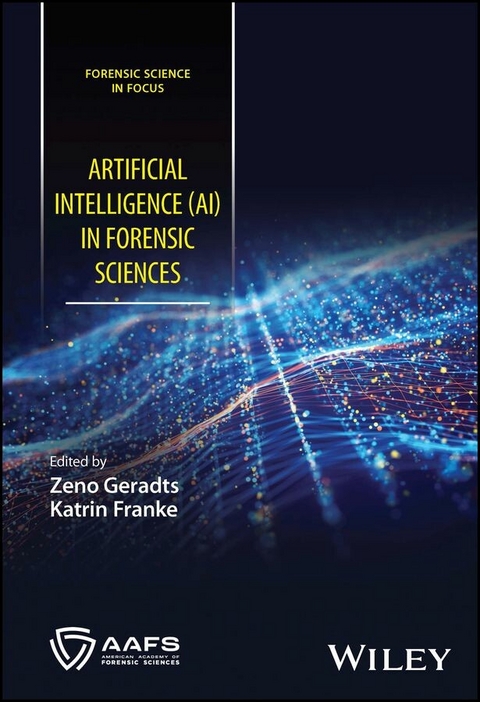
Artificial Intelligence (AI) in Forensic Sciences (eBook)
John Wiley & Sons (Verlag)
978-1-119-81333-0 (ISBN)
ARTIFICIAL INTELLIGENCE (AI) IN FORENSIC SCIENCES
Foundational text for teaching and learning within the field of Artificial Intelligence (AI) as it applies to forensic science
Artificial Intelligence (AI) in Forensic Sciences presents an overview of the state-of-the-art applications of Artificial Intelligence within Forensic Science, covering issues with validation and new crimes that use AI; issues with triage, preselection, identification, argumentation and explain ability; demonstrating uses of AI in forensic science; and providing discussions on bias when using AI.
The text discusses the challenges for the legal presentation of AI data and interpretation and offers solutions to this problem while addressing broader practical and emerging issues in a growing area of interest in forensics. It builds on key developing areas of focus in academic and government research, providing an authoritative and well-researched perspective.
Compiled by two highly qualified editors with significant experience in the field, and part of the Wiley - AAFS series 'Forensic Science in Focus', Artificial Intelligence (AI) in Forensic Sciences includes information on:
- Cyber IoT, fundamentals on AI in forensic science, speaker and facial comparison, and deepfake detection
- Digital-based evidence creation, 3D and AI, interoperability of standards, and forensic audio and speech analysis
- Text analysis, video and multimedia analytics, reliability, privacy, network forensics, intelligence operations, argumentation support in court, and case applications
- Identification of genetic markers, current state and federal legislation with regards to AI, and forensics and fingerprint analysis
Providing comprehensive coverage of the subject, Artificial Intelligence (AI) in Forensic Sciences is an essential advanced text for final year undergraduates and master's students in forensic science, as well as universities teaching forensics (police, IT security, digital science and engineering), forensic product vendors and governmental and cyber security agencies.
Edited by
Zeno Geradts, is a senior forensic scientist at the Forensic Digital Biometrics Traces Department at the Netherlands Forensic Institute, Ministry of Justice and Security, The Hague, The Netherlands.
Katrin Franke is Professor of Computer Science at the Department of Information Security and Communication Technology at NTNU in Gjøvik, Norway. She has over 25 years' experience in basic and applied research for financial services and law enforcement agencies (LEAs), working closely with banks and LEAs in Europe, North America and Asia.
ARTIFICIAL INTELLIGENCE (AI) IN FORENSIC SCIENCES Foundational text for teaching and learning within the field of Artificial Intelligence (AI) as it applies to forensic science Artificial Intelligence (AI) in Forensic Sciences presents an overview of the state-of-the-art applications of Artificial Intelligence within Forensic Science, covering issues with validation and new crimes that use AI; issues with triage, preselection, identification, argumentation and explain ability; demonstrating uses of AI in forensic science; and providing discussions on bias when using AI. The text discusses the challenges for the legal presentation of AI data and interpretation and offers solutions to this problem while addressing broader practical and emerging issues in a growing area of interest in forensics. It builds on key developing areas of focus in academic and government research, providing an authoritative and well-researched perspective. Compiled by two highly qualified editors with significant experience in the field, and part of the Wiley AAFS series Forensic Science in Focus , Artificial Intelligence (AI) in Forensic Sciences includes information on: Cyber IoT, fundamentals on AI in forensic science, speaker and facial comparison, and deepfake detection Digital-based evidence creation, 3D and AI, interoperability of standards, and forensic audio and speech analysis Text analysis, video and multimedia analytics, reliability, privacy, network forensics, intelligence operations, argumentation support in court, and case applications Identification of genetic markers, current state and federal legislation with regards to AI, and forensics and fingerprint analysis Providing comprehensive coverage of the subject, Artificial Intelligence (AI) in Forensic Sciences is an essential advanced text for final year undergraduates and master s students in forensic science, as well as universities teaching forensics (police, IT security, digital science and engineering), forensic product vendors and governmental and cyber security agencies.
Edited by Zeno Geradts, is a senior forensic scientist at the Forensic Digital Biometrics Traces Department at the Netherlands Forensic Institute, Ministry of Justice and Security, The Hague, The Netherlands. Katrin Franke is Professor of Computer Science at the Department of Information Security and Communication Technology at NTNU in Gjøvik, Norway. She has over 25 years' experience in basic and applied research for financial services and law enforcement agencies (LEAs), working closely with banks and LEAs in Europe, North America and Asia.
| Erscheint lt. Verlag | 22.8.2023 |
|---|---|
| Reihe/Serie | Forensic Science in Focus | Forensic Science in Focus |
| Sprache | englisch |
| Themenwelt | Naturwissenschaften ► Chemie |
| Schlagworte | AI • ai court • Analytische Chemie / Forensik • Artificial Intelligence • Biowissenschaften • Chemie • Chemistry • child age estimation • Computer Science • cyber security • Deepfakes • explainability • fingerprint analysis • Forensic Data Science • Forensics • Forensic Science • forensics legislation • Forensik • Informatik • KI • Künstliche Intelligenz • Life Sciences • Multimedia • Natural Language Processing • privacy • Reliability • Validation |
| ISBN-10 | 1-119-81333-6 / 1119813336 |
| ISBN-13 | 978-1-119-81333-0 / 9781119813330 |
| Informationen gemäß Produktsicherheitsverordnung (GPSR) | |
| Haben Sie eine Frage zum Produkt? |
 PDF (Adobe DRM)
Kopierschutz: Adobe-DRM
Adobe-DRM ist ein Kopierschutz, der das eBook vor Mißbrauch schützen soll. Dabei wird das eBook bereits beim Download auf Ihre persönliche Adobe-ID autorisiert. Lesen können Sie das eBook dann nur auf den Geräten, welche ebenfalls auf Ihre Adobe-ID registriert sind.
Details zum Adobe-DRM
Dateiformat: PDF (Portable Document Format)
Mit einem festen Seitenlayout eignet sich die PDF besonders für Fachbücher mit Spalten, Tabellen und Abbildungen. Eine PDF kann auf fast allen Geräten angezeigt werden, ist aber für kleine Displays (Smartphone, eReader) nur eingeschränkt geeignet.
Systemvoraussetzungen:
PC/Mac: Mit einem PC oder Mac können Sie dieses eBook lesen. Sie benötigen eine
eReader: Dieses eBook kann mit (fast) allen eBook-Readern gelesen werden. Mit dem amazon-Kindle ist es aber nicht kompatibel.
Smartphone/Tablet: Egal ob Apple oder Android, dieses eBook können Sie lesen. Sie benötigen eine
Geräteliste und zusätzliche Hinweise
Buying eBooks from abroad
For tax law reasons we can sell eBooks just within Germany and Switzerland. Regrettably we cannot fulfill eBook-orders from other countries.
aus dem Bereich