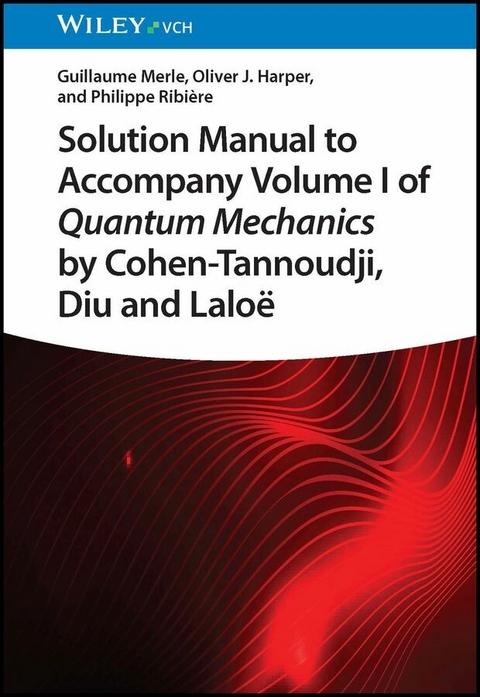
Solution Manual to Accompany Volume I of Quantum Mechanics by Cohen-Tannoudji, Diu and Laloë (eBook)
Grasp the fundamentals of quantum mechanics with this essential set of solutions
Quantum mechanics, with its counter-intuitive premises and its radical variations from classical mechanics or electrodynamics, is both among the most important components of a modern physics education and one of the most challenging. It demands both a theoretical grounding and a grasp of mathematical technique that take time and effort to master. Students working through quantum mechanics curricula generally practice by working through increasingly difficult problem sets, such as those found in the seminal Quantum Mechanics volumes by Cohen-Tannoudji, Diu and Laloë.
This solution manual accompanies Volume I and offers the long-awaited detailed solutions to all 69 problems in this text. Its accessible format provides explicit explanations of every step, focusing on both the physical theory and the formal mathematics, to ensure students grasp all pertinent concepts. It also includes guidance for transferring the solution approaches to comparable problems in quantum mechanics.
Readers also benefit from:
- Approximately 70 figures to clarify key steps and concepts
- Detailed explanations of problems concerning quantum mechanics postulates, mathematical tools, properties of angular momentum, and more
This solution manual is a must-have for students in physics, chemistry, or the materials sciences looking to master these challenging problems, as well as for instructors looking for pedagogical approaches to the subject.
Guillaume Merle is Associate Professor at the Beihang Sino-French Engineering School, Beihang University, Beijing, China, and in charge of the quantum physics course.
Philippe Ribière is Professor and Head of Physics Department at the Beihang Sino-French Engineering School, Beihang University, Beijing, China.
Oliver J. Harper is Researcher at the Beihang Sino-French Engineering School, Beihang University, Beijing, China.
Guillaume Merle, PhD, is Professeur agrégé of Mechanics at Beihang Sino-French Engineer School, Beihang University, Beijing, China, where he supervises the Engineering Science Department and is in charge of the Engineering Science, Engineering Thermodynamics, and Quantum Physics courses. Oliver J. Harper, PhD, is Professeur agrégé of Physics at Lycée Saint Lambert, Paris, France, where he teaches physics and chemistry in the Preparatory Classes for the French "Grandes Écoles". Philippe Ribière, PhD, is Professeur agrégé of Physics at Beihang Sino-French Engineer School, Beihang University, Beijing, China, where he supervises the Physics Department and is in charge of the Statistical Physics course.
Cover 1
Title Page 3
Copyright 4
Contents 5
Chapter 1 Solutions to the Exercises of Chapter I (Complement KI). Waves and Particles. Introduction to the Fundamental Ideas of Quantum Mechanics 9
1.1 Interference and Diffraction with a Beam of Neutrons 9
1.2 Bound State of a Particle in a “Delta Function Potential” 11
1.3 Transmission of a “Delta Function” Potential Barrier 17
1.4 Bound State of a Particle in a “Delta Function Potential”, Fourier Analysis 21
1.5 Well Consisting of Two Delta Functions 32
1.6 Bound State in a Square Potential 46
1.7 The Piecewise Constant Lennard–Jones Potential 51
1.8 Two?Dimensional Potential 55
Chapter 2 Solutions to the Exercises of Chapter II (Complement HII). The Mathematical Tools of Quantum Mechanics 63
Dirac Notation. Commutators. Eigenvectors and Eigenvalues 63
2.1 A First Approach 63
2.2 Diagonalization, Orthonormal Basis, Closure Relation 66
2.3 Superposition of States 72
2.4 A Ket?Bra Operator 74
2.5 Orthogonal Projector 75
2.6 ?x Matrix 76
2.7 ?y Matrix 78
2.8 Hamiltonian H of a Particle in a One?Dimensional Problem 80
2.9 Toward the Virial Theorem in Quantum Mechanics 82
2.10 Operators X and P 85
Complete Sets of Commuting Observables, C.S.C.O. 86
2.11 A C.S.C.O. of a Three?State System 86
2.12 A C.S.C.O. of Two Operators 89
Chapter 3 Solutions to the Exercises of Chapter III (Complement LIII). The Postulates of Quantum Mechanics 93
3.1 Analysis of a One?Dimensional Wave Function 93
3.2 Probability and One?Dimensional Wave Function 96
3.3 Wave Function Defined Using Momenta 98
3.4 Spreading of a Free Wave Packet 104
3.5 Particle Subjected to a Constant Force 108
3.6 Three?Dimensional Wave Function 111
3.7 Generic Three?Dimensional Wave Function 114
3.8 Probability Current 116
3.9 Complete Description of a Quantum State Using the Probability Density and Probability Current 120
3.10 Virial Theorem 123
3.11 Two?Particle Wave Function 127
3.12 Infinite One?Dimensional Well 131
3.13 Infinite Two?Dimensional Well (cf. Complement GII) 134
3.14 Temporal Evolution Within a Coupled Three?Level System 141
3.15 Interaction Picture 146
3.16 Correlations Between Two Particles 151
3.17 Introduction to the Density Matrix (or Density Operator) 165
3.18 Temporal Evolution of the Density Matrix 168
3.19 Two?Particle Density Matrix 169
References 172
Chapter 4 Solutions to the Exercises of Chapter IV (Complement JIV). Application of the Postulates to Simple Cases: Spin 1/2 and Two?Level Systems 173
4.1 First Approach to Spin States and Quantum Precession 173
4.2 Continuation of the First Approach with a Nonstationary Magnetic Field 178
4.3 Continuation of the First Approach with a Magnetic Field with Two Components 182
4.4 Density Matrix and Spin Measurements 186
4.5 Evolution Operator of a Spin 1/2 (cf. Complement FIII) 194
4.6 Study of the Spin State of Two Particles Described by a Single Wave Function 198
4.7 Continuation of the Study of the Two?Particle Spin State Described by a Single Wave Function 204
4.8 Linear Triatomic Molecule 210
4.9 Hexagonal Molecule 217
Reference 225
Chapter 5 Solutions to the Exercises of Chapter V (Complement MV). The One?Dimensional Harmonic Oscillator 227
5.1 One?Dimensional Harmonic Oscillator 228
5.2 Anisotropic Three?Dimensional Harmonic Oscillator 233
5.3 Harmonic Oscillator: Two Particles, Part I 240
5.4 Harmonic Oscillator: Two Particles, Part II 248
5.5 Harmonic Oscillator: Two Particles, Part III 257
5.6 Charged Harmonic Oscillator in a Variable Electric Field 263
5.7 A Fourier?Like Operator Applied to a One?Dimensional Harmonic Oscillator 274
5.8 The Time Evolution Operator Applied to a One?Dimensional Harmonic Oscillator 277
Chapter 6 Solutions to the Exercises of Chapter VI (Complement FVI). General Properties of Angular Momentum in Quantum Mechanics 291
6.1 Mean Value of a Magnetic Moment for a Given State 291
6.2 Magnetic Moment Measurement in a Four?Dimensional Space 294
6.3 Link Between the Classical Angular Momentum and the Corresponding Quantum Operator 301
6.4 Rotation of a Polyatomic Molecule 303
6.5 Study of the Angular Part of a Wave Function 318
6.6 An Electric Quadrupole in an Electric Field Gradient 322
6.7 On Rotational Matrices 330
6.8 Rotation and Angular Momentum 334
6.9 Fluctuations and Angular Momentum Measurements 338
6.10 Heisenberg?Type Relations for Angular Momenta 348
6.11 State Minimizing Angular Momentum Fluctuations 352
Reference 361
Chapter 7 Solutions to the Exercises of Chapter VII (Complement GVII). Particle in a Central Potential. The Hydrogen Atom 363
7.1 Particle in a Cylindrically Symmetric Potential 363
7.2 Three?Dimensional Harmonic Oscillator in a Uniform Magnetic Field 369
Bibliography 385
EULA 387
| Erscheint lt. Verlag | 18.7.2023 |
|---|---|
| Sprache | englisch |
| Themenwelt | Naturwissenschaften ► Physik / Astronomie ► Theoretische Physik |
| Schlagworte | Angular momentum • Chemie • Chemistry • Classical electrodynamics • classical mechanics • Hydrogen atoms • Materials Science • Materialwissenschaften • Mathematics • one-dimensional harmonic oscillator • particles • Physics • Physik • Quantenchemie • Quantenmechanik • Quantenphysik • Quantenphysik u. Feldtheorie • Quantum Chemistry • Quantum Physics • Quantum Physics & Field Theory • quantum postulates • Waves |
| ISBN-10 | 3-527-84292-6 / 3527842926 |
| ISBN-13 | 978-3-527-84292-6 / 9783527842926 |
| Informationen gemäß Produktsicherheitsverordnung (GPSR) | |
| Haben Sie eine Frage zum Produkt? |
 PDF (Adobe DRM)
Kopierschutz: Adobe-DRM
Adobe-DRM ist ein Kopierschutz, der das eBook vor Mißbrauch schützen soll. Dabei wird das eBook bereits beim Download auf Ihre persönliche Adobe-ID autorisiert. Lesen können Sie das eBook dann nur auf den Geräten, welche ebenfalls auf Ihre Adobe-ID registriert sind.
Details zum Adobe-DRM
Dateiformat: PDF (Portable Document Format)
Mit einem festen Seitenlayout eignet sich die PDF besonders für Fachbücher mit Spalten, Tabellen und Abbildungen. Eine PDF kann auf fast allen Geräten angezeigt werden, ist aber für kleine Displays (Smartphone, eReader) nur eingeschränkt geeignet.
Systemvoraussetzungen:
PC/Mac: Mit einem PC oder Mac können Sie dieses eBook lesen. Sie benötigen eine
eReader: Dieses eBook kann mit (fast) allen eBook-Readern gelesen werden. Mit dem amazon-Kindle ist es aber nicht kompatibel.
Smartphone/Tablet: Egal ob Apple oder Android, dieses eBook können Sie lesen. Sie benötigen eine
Geräteliste und zusätzliche Hinweise
Buying eBooks from abroad
For tax law reasons we can sell eBooks just within Germany and Switzerland. Regrettably we cannot fulfill eBook-orders from other countries.
aus dem Bereich