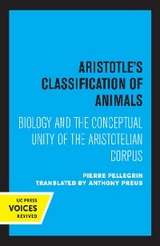
Aristotle's Classification of Animals (eBook)
256 Seiten
University of California Press (Verlag)
9780520330412 (ISBN)
Moreover, Aristotle’s classificatory efforts differ fundamentally from later biological taxonomies in their conceptual basis and purpose. Modern commentators, including Georges Cuvier, acknowledge Aristotle’s influence on fields like comparative anatomy but note that Aristotle did not apply a structured taxonomic system as his successors did. Instead, Aristotle’s categories were flexible, reflecting his ideas on the “essence” and “form” of living beings rather than any fixed biological grid. This distinction becomes crucial when interpreting Aristotle’s work: rather than regarding it as an incomplete taxonomy, we might view it as a philosophical framework that integrates observations with conceptual exploration of life’s diversity and order. This approach, which seeks to understand each organism within a broader natural order, is less about classifying individual species and more about investigating the fundamental nature of life.
This title is part of UC Press's Voices Revived program, which commemorates University of California Press’s mission to seek out and cultivate the brightest minds and give them voice, reach, and impact. Drawing on a backlist dating to 1893, Voices Revived makes high-quality, peer-reviewed scholarship accessible once again using print-on-demand technology. This title was originally published in 1986.
Contents
Translator's Note
Preface
Abbreviations
Introduction
1. DIVISION AND DEFINITION IN ARISTOTLE
The Meaning and Limits of the Critique of Platonism
2. GENUS, SPECIES, AND SPECIFIC DIFFERENCE
From Logic to Zoology
3. THE STATUS AND FUNCTIONS OF ARISTOTLE'S ZOOLOGICAL CLASSIFICATIONS
Conclusion
Notes
Bibliography
General Index
Index of Passages Cited from Aristotle's Works
| Erscheint lt. Verlag | 28.7.2023 |
|---|---|
| Sprache | englisch |
| Themenwelt | Naturwissenschaften ► Biologie ► Ökologie / Naturschutz |
| ISBN-13 | 9780520330412 / 9780520330412 |
| Informationen gemäß Produktsicherheitsverordnung (GPSR) | |
| Haben Sie eine Frage zum Produkt? |
 EPUB (Adobe DRM)
Kopierschutz: Adobe-DRM
Adobe-DRM ist ein Kopierschutz, der das eBook vor Mißbrauch schützen soll. Dabei wird das eBook bereits beim Download auf Ihre persönliche Adobe-ID autorisiert. Lesen können Sie das eBook dann nur auf den Geräten, welche ebenfalls auf Ihre Adobe-ID registriert sind.
Details zum Adobe-DRM
Dateiformat: EPUB (Electronic Publication)
EPUB ist ein offener Standard für eBooks und eignet sich besonders zur Darstellung von Belletristik und Sachbüchern. Der Fließtext wird dynamisch an die Display- und Schriftgröße angepasst. Auch für mobile Lesegeräte ist EPUB daher gut geeignet.
Systemvoraussetzungen:
PC/Mac: Mit einem PC oder Mac können Sie dieses eBook lesen. Sie benötigen eine
eReader: Dieses eBook kann mit (fast) allen eBook-Readern gelesen werden. Mit dem amazon-Kindle ist es aber nicht kompatibel.
Smartphone/Tablet: Egal ob Apple oder Android, dieses eBook können Sie lesen. Sie benötigen eine
Geräteliste und zusätzliche Hinweise
Buying eBooks from abroad
For tax law reasons we can sell eBooks just within Germany and Switzerland. Regrettably we cannot fulfill eBook-orders from other countries.
aus dem Bereich