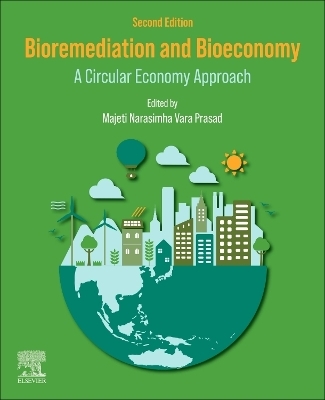
Bioremediation and Bioeconomy
Elsevier - Health Sciences Division (Verlag)
978-0-443-16120-9 (ISBN)
On the other hand, the volume of contaminated substrates (water, soil, and air) is increasing due to anthropogenic and technogenic sources of organic and inorganic contaminants. This book addresses the bottlenecks and solutions to existing limitations in field scale, along with the relevant techniques.
Dr. Prasad is Emeritus Professor, School of Life Sciences, University of Hyderabad (India). He has made outstanding contributions to the fields of bioremediation, bioresources, biomass energy sources, bioeconomy, and to the broad field of environmental biotechnology, all of which are his main areas of expertise. Dr. Prasad has served the Government of India’s Ministry of Environment, Forests and Climate Change as a member of various advisory committees on biodiversity conservation, ecosystem services, pollution control and abatement, environmental information systems and bioremediation of contaminated sites. He is an active visiting scientist for several international universities.
Preface
Section I. Bioproducts from contaminated soil and water
1. Integrating the Bioremediation, Bioeconomy, circular economy as strategic sustainability
2. Biorefinery, bioeconomy and circular economy accelerate carbon neutrality - Insights from life cycle assessment.
3. Trace element contaminated agrocenoses in Ukraine for production of biodiesel
4. Aromatic, medicinal and energy plantations on metalliferous/contaminated soil - bioremediation and bioeconomy
5. Prosopis juliflora (Sw) DC - potential for bioremediation and biobased economy
6. Giant reed (Arundo donax L.): a multipurpose crop bridging phytoremediation with sustainable bio- economy
Section II. Biomass Energy and Biofuel from contaminated substrates
7. Energy recovery from phytoremediated phytomass of aquatic plants via gasification
8. Jatropha curcas L. cultivation on constrained land - Exploring the potential for economic growth and environmental protection
Section III. Ornamentals and Tree crops for contaminated substrates
9. POTENTIAL OF ORNAMENTAL PLANTS FOR PHYTOREMEDIATION AND INCOME GENERATION
10. Native Trees on Abandoned Mine Land: From Environmental Remediation to Bioeconomy
11. Rice plants for cleanup of trace elements - Bioeconomic perspectives
12. Duckweed – Bioremediation and biorefinery
13. Cultivation of sweet sorghum on heavy metal contaminated soils by phytoremediation approach for production of sweet fuel
14. Production of Biodiesel/ Biocomposites from sunflower cultivated on contaminated soil
Section IV. Brownfield development for smart bioeconomy
15. Chrysopogon zizanoides (Vetiver grass) for phytoremediation and restoration: co-generation of economical products
16. Mulberry (Morus) for phytostabilizaion of coal mine over burden: co-generation of economic products
17. Utilization of contaminated lands for cultivation plant resources for production of dyes
18. Bioeconomy and Circular Economy Approaches for the Greening of Urban Wastelands - Focus on Biodiversity to Achieve Sustainability
19. Biological Recultivation of Fly Ash Dumps Strengthening Bioeconomy and Circular Economy in the Ural Region of Russia
Section V. Algal bioproducts, biofuels, biorefinery for business opportunities
20. Phycoremediation and business prospects
21. Algae based bioremediation: Bioproducts and biofuels for biobusiness
Section VI. Bioprocesses, Bioengineering for boosting biobased economy
22. Building circular bio-based economy through sustainable waste management
Section VII. Case studies
23. Bioremediation in Brazil: recent evolutions and remaining challenges to boost up the bioeconomy
24. Phytomanagement of polycyclic aromatic hydrocarbons and heavy metals contaminated sites in assam, north eastern state of india for boosting bio-economy
Section VIII. New Biology
25. From preservation of aquatic ecosystems to ecocatalysis
26. Synthetic Biology: An Emerging Field for Developing Economies
| Erscheinungsdatum | 17.11.2023 |
|---|---|
| Verlagsort | Philadelphia |
| Sprache | englisch |
| Maße | 191 x 235 mm |
| Gewicht | 1620 g |
| Themenwelt | Naturwissenschaften ► Biologie ► Ökologie / Naturschutz |
| ISBN-10 | 0-443-16120-8 / 0443161208 |
| ISBN-13 | 978-0-443-16120-9 / 9780443161209 |
| Zustand | Neuware |
| Informationen gemäß Produktsicherheitsverordnung (GPSR) | |
| Haben Sie eine Frage zum Produkt? |
aus dem Bereich