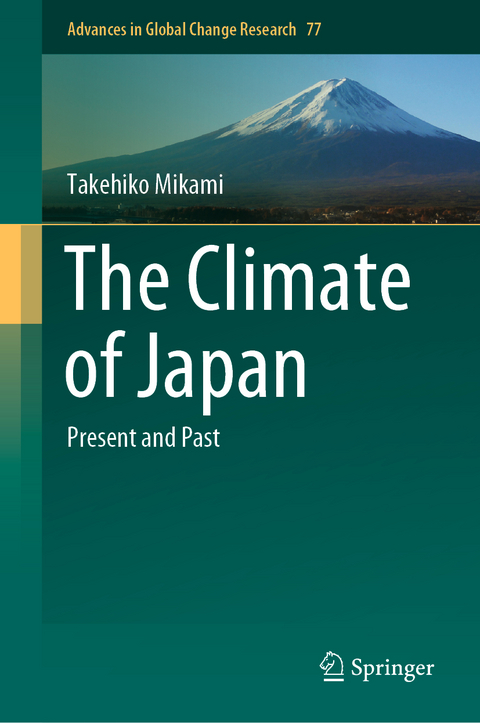
The Climate of Japan
Springer Verlag, Singapore
978-981-99-5157-4 (ISBN)
lt;p>This book clarifies the climatic variations in Japan from the historical period to the present based on documentary sources and meteorological data. Japanese society has suffered from various kinds of natural disasters since ancient times, such as floods and high tides caused by torrential rainfall and strong winds. They were described in large numbers of historical documents including official local weather diaries. However, all these documents were written in Japanese or Chinese languages, which prevents non-readers of those languages from accessing them. Also, Japan is a Far Eastern island country, and the unique features of Japanese climate and natural disasters would be unfamiliar and unimaginable to them without being able to read those documents. How is the climate of Japan, and how was the climate during the Little Ice Age in Japan as compared with conditions in Europe and America? When did meteorological observations start, and who (which country) introduced them to Japan? Why did so many natural disasters occur in Japan, and what caused them? This book answers these questions as specifically and objectively as possible using both figures and photographs, which are beneficial to students and the general public who are interested in historical and current climatic change in Japan, as well as professional climate scientists.
Takehiko Mikami is a professor emeritus in the Department of Geography at Tokyo Metropolitan University, Japan. He has been leading pioneering research activities in the field of historical climatology in the world. He organized several international conferences and symposiums on climatic changes, including the International Symposium on the Little Ice Age Climate (LIAC,1991) and the International Conference on Climate Change and Variability (CCV, 1999), among others. His main research interests are historical climatic changes in Japan based on the large amount of documentary sources and meteorological data. Also, he has organized several heat island research projects in the Tokyo metropolitan area and has published a number of research results. He is an international editorial board member of the International Journal of Climatology (UK Royal Meteorological Society) and a fellow of Japan Geoscience Union (JpGU).
lt;br>1.Introduction
2. Climate and Weather in Japan2.1 Japan's Climate with Large Regional Differences2.1.1 Japan's Climate from a Global Perspective2.1.2 Major Air Masses Affecting the Climate of Japan2.1.3 Mean Annual Temperature, Precipitation and Sunshine Duration2.1.4 Annual Variations in Mean Monthly Temperature and Precipitation2.2 Seasonal Variations in the Climate of Japan2.2.1 Main Seasons and Temperature and Precipitation Distributions in Japan2.2.2 Winter2.2.3 Spring2.2.4 Rainy Season in Early Summer2.2.5 Midsummer Season2.2.6 Autumn Rainy Season2.2.7 Late Autumn2.3 Extreme Weather and Teleconnection Patterns2.3.1 Cold and warm winters2.3.2 Cool and Hot Summers
3. Climate Change in Japan since the 20th Century3.1 Official Meteorological Observation System in Japan3.1.1 Relocation of JMA Tokyo Meteorological Observatory and Its Effect3.2 Climate Variations in Japan since the 20th Century3.2.1 Temperature Variations since the 20th Century3.2.2 Precipitation Variations since the 20th Century3.2.3 Flood Disasters and Climate Change3.2.3.1 Flood Disasters in Japan and Their Characteristics3.2.3.2 Nagasaki Floods (July 1982)3.2.3.3 West Japan Floods (July 2018)3.2.3.4 Long-term Trends in Heavy Rainfall Disasters3.3 Climate Change in the Mega-city Tokyo3.3.1 Temperature Variations since the 20th Century3.3.2 Precipitation Variations since the 20th Century3.3.3 Aridification of Tokyo Due to Urbanization3.4 Urban Heat Islands in Tokyo Metropolis3.4.1 High-Resolution Temperature Observation System in Tokyo Metropolis3.4.2 Summer Temperature Distributions in Tokyo3.4.2.1 High-Density Temperature Observation System in Tokyo Metropolitan Area3.4.2.2 Effects of Sea Breeze on Summer Temperature Patterns in Tokyo3.4.3 Anthropogenic Energy Consumption in Tokyo3.4.4 Artificial Urban Surfaces in Tokyo
4. Climate Information from Pre-19th Century Data and Documents4.1 Early Meteorological Observations in the 19th Century4.1.1 Early Meteorological Observations in Nagasaki4.1.1.1 Japan's Earliest Meteorological Observations in the 18th Century4.1.1.2 Meteorological Observations by Dutch Medical Doctors in the 19th Century4.1.2 Early Meteorological Observations in Tokyo and Yokohama4.1.2.1 Early Meteorological Observations in Tokyo4.1.2.2 Early Meteorological Observations in Yokohama and Yokosuka4.1.2.3 Early Meteorological Observations in Osaka and Kobe4.1.2.4 Reconstruction of Long-term Temperature Series (1820-2000) for West Japan4.1.3 Early Meteorological Observations at the Russian Consulate in Hakodate4.1.4 Mid-19th Century Temperature Observations by a Merchant of the Mito Domain4.1.5 Meteorological Observations in Naha (Okinawa) in the Mid-19th Century4.1.6 Lighthouse Meteorological Observations in Japan4.2 Diary Weather Records since the 17th Century4.2.1 Location and Duration of Diary Weather Records4.2.2 Weather Records of the Two-Century Hirosaki Doman Diary and the Database Thereof4.2.3 Historical Weather Database (HWDB)4.3 Long-term Records of Lake Ice Freeze-up/Break-up Dates4.3.1 Records of Freeze-up and Ice Pressure Ridge at Lake Suwa since 14444.3.2 Records of Ice Freeze-up/Break-up at Lake Jusan during 1705-1860
5. Climate Reconstructions for Historical Periods5.1 Attempts to Reconstruct Typhoon Tracks and Intensity from Early Weather and Meteorological Records5.1.1 Reconstruction of the 1882 Typhoon Weather Map Using Lighthouse Observation Data5.1.2 Reconstruction of the Intensity and Track of the 1828 Siebold Typhoon5.1.2.1 Siebold Incident5.1.2.2 Meteorological Observation by von Siebold5.1.2.3 Changes in the Air Pressure Before and After the Typhoon Landfall5.1.2.4 Reconstruction of the Siebold Typhoon Track5.1.3 Variability of Typhoons that Hit Japan after the Mid-19th Century5.2 Climate Reconstructions from Diary Weather Records since the 18th Century5.2.1 Winter Temperature Reconstruction Based on the Snowfall Ratio Obtained from Diary Weather Records5.2.2 Winter Monsoon Climate Reconstructions from the 1840s-1850s Based on Early Meteorological Data and Historical Documentary Records5.2.3 Summer Temperature Variations Reconstructed from Precipitation Frequency: The Cases of Tokyo and Hiroshima5.2.3.1 Tokyo: 1721-20205.2.3.2 Hiroshima: 1779-20155.2.4 Meteorological Disasters from the 17th to 19th century5.2.4.1 Storm Disasters and Great Famines in Summer5.2.4.2 Heavy Snowfall in Edo (Tokyo)5.2.5 Great Famines and Climate Change in the 1780s5.3 Climate Reconstruction from Records of Full-flowering Dates for Cherry Trees over the Past 1,200 Years5.4 Climate Reconstructions from Pollen in the Highland Moors in Central Japan over the Past 7600 Years
6. Conclusions
| Erscheinungsdatum | 10.09.2023 |
|---|---|
| Reihe/Serie | Advances in Global Change Research |
| Zusatzinfo | 118 Illustrations, color; 44 Illustrations, black and white |
| Verlagsort | Singapore |
| Sprache | englisch |
| Maße | 155 x 235 mm |
| Themenwelt | Naturwissenschaften ► Biologie ► Ökologie / Naturschutz |
| Naturwissenschaften ► Geowissenschaften ► Geografie / Kartografie | |
| Naturwissenschaften ► Geowissenschaften ► Meteorologie / Klimatologie | |
| Schlagworte | Climate of Japan • Climatic Change • Extreme weather events • global warming • historical documents • natural disaster |
| ISBN-10 | 981-99-5157-7 / 9819951577 |
| ISBN-13 | 978-981-99-5157-4 / 9789819951574 |
| Zustand | Neuware |
| Informationen gemäß Produktsicherheitsverordnung (GPSR) | |
| Haben Sie eine Frage zum Produkt? |
aus dem Bereich