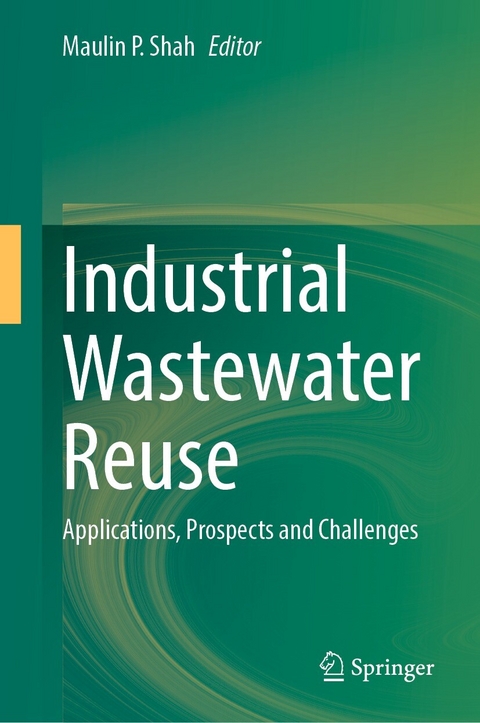
Industrial Wastewater Reuse (eBook)
526 Seiten
Springer Nature Singapore (Verlag)
978-981-99-2489-9 (ISBN)
The application of sustainable technologies can eliminate or minimize micro-contaminants in wastewater. Several organizations focus on the potential impacts to humans and their environments by wastewater reuse. This book gathers new research and reviews work from researchers and scientists to identify the main barriers and limitations that will need to be overcome, so that wastewater reuse strategies gain more momentum and will be adopted more efficiently worldwide.
The book is designed for engineers, scientists, and other professionals who are seeking an excellent introduction to and basic knowledge of the principles of environmental bioremediation technologies.This book identifies emerging technologies that allow the reuse and regeneration of industrial wastewater with innovative and applied approaches throughout the wastewater treatment cycle. Today, it is increasingly clear that treated urban wastewater, whose reuse has become an important component of long-term water management worldwide, is a key source of chemical pollutants and emerging biological concerns. Current water-quality guidelines for reclaimed wastewater predominantly address the risks associated with the presence of microbial organisms and chemical parameters such as biological oxygen demand, chemical oxygen demand, E. coli and worms, and in some cases heavy metals; however, they are insufficient for the full evaluation of risks. The global growth of population is concentrated in urban areas; therefore, most of the challenges and solutions related to wastewater reside in urban treatment plants. Unless wastewater management and wastewater governance processesare significantly improved within a decade, it is likely that our societies will face severe and prolonged water insecurity and urban floods.The application of sustainable technologies can eliminate or minimize micro-contaminants in wastewater. Several organizations focus on the potential impacts to humans and their environments by wastewater reuse. This book gathers new research and reviews work from researchers and scientists to identify the main barriers and limitations that will need to be overcome, so that wastewater reuse strategies gain more momentum and will be adopted more efficiently worldwide.The book is designed for engineers, scientists, and other professionals who are seeking an excellent introduction to and basic knowledge of the principles of environmental bioremediation technologies.
| Erscheint lt. Verlag | 19.6.2023 |
|---|---|
| Zusatzinfo | VI, 526 p. 56 illus., 44 illus. in color. |
| Sprache | englisch |
| Themenwelt | Naturwissenschaften ► Biologie ► Ökologie / Naturschutz |
| Naturwissenschaften ► Geowissenschaften ► Hydrologie / Ozeanografie | |
| Technik ► Bauwesen | |
| Technik ► Umwelttechnik / Biotechnologie | |
| Schlagworte | biodegradation • nanotechnology • Pollutants • wastewater reuse • Wastewater Treatment |
| ISBN-10 | 981-99-2489-8 / 9819924898 |
| ISBN-13 | 978-981-99-2489-9 / 9789819924899 |
| Informationen gemäß Produktsicherheitsverordnung (GPSR) | |
| Haben Sie eine Frage zum Produkt? |
 PDF (Wasserzeichen)
DRM: Digitales Wasserzeichen
Dieses eBook enthält ein digitales Wasserzeichen und ist damit für Sie personalisiert. Bei einer missbräuchlichen Weitergabe des eBooks an Dritte ist eine Rückverfolgung an die Quelle möglich.
Dateiformat: PDF (Portable Document Format)
Mit einem festen Seitenlayout eignet sich die PDF besonders für Fachbücher mit Spalten, Tabellen und Abbildungen. Eine PDF kann auf fast allen Geräten angezeigt werden, ist aber für kleine Displays (Smartphone, eReader) nur eingeschränkt geeignet.
Systemvoraussetzungen:
PC/Mac: Mit einem PC oder Mac können Sie dieses eBook lesen. Sie benötigen dafür einen PDF-Viewer - z.B. den Adobe Reader oder Adobe Digital Editions.
eReader: Dieses eBook kann mit (fast) allen eBook-Readern gelesen werden. Mit dem amazon-Kindle ist es aber nicht kompatibel.
Smartphone/Tablet: Egal ob Apple oder Android, dieses eBook können Sie lesen. Sie benötigen dafür einen PDF-Viewer - z.B. die kostenlose Adobe Digital Editions-App.
Buying eBooks from abroad
For tax law reasons we can sell eBooks just within Germany and Switzerland. Regrettably we cannot fulfill eBook-orders from other countries.
aus dem Bereich