


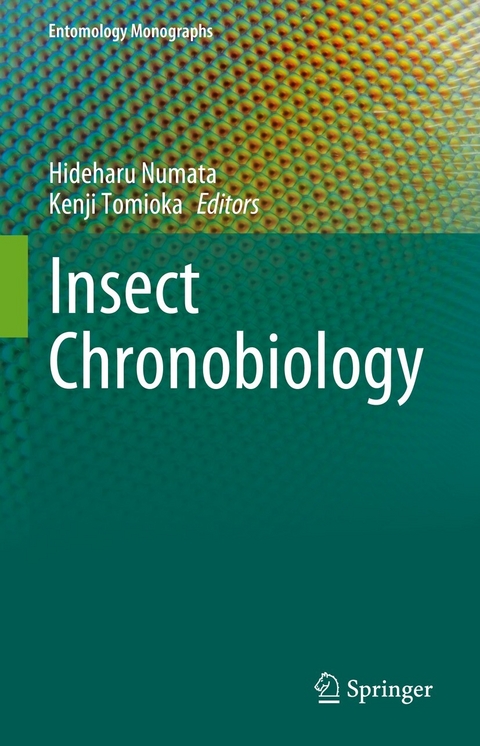
Insect Chronobiology (eBook)
357 Seiten
Springer Nature Singapore (Verlag)
978-981-99-0726-7 (ISBN)
In the history of chronobiology, insects provided important examples of diverse clocks. The first report of animal photoperiodism was in an aphid, and the time-compensated celestial navigation was first shown in the honeybee. The circadian clock was first localized in the brain of a cockroach. These diverse insect clocks also have some common features which deserve to be reviewed in a single book. The central molecular mechanism of the circadian clock, i.e., the negative feedback loop of clock genes, was proposed in Drosophila melanogaster in the 1990s and later became the subject of the Nobel Prize in Physiology or Medicine in 2017. Thereafter, researches on the molecular and neural mechanisms in diverse insect clocks other than the Drosophila circadian clock also advanced appreciably. Various new methods including RNAi, NGS, and genome editing with CRISPR-Cas9 have become applicable in these researches.
This book reviews the physiological mechanisms of diverse insect clocks, including circadian clock, lunar clock, tidal clock, photoperiodism, circannual rhythms and others. It explains the commonality and diversity of insect clocks, focusing on the recent advances in their molecular and neural mechanisms. In the history of chronobiology, insects provided important examples of diverse clocks. The first report of animal photoperiodism was in an aphid, and the time-compensated celestial navigation was first shown in the honeybee. The circadian clock was first localized in the brain of a cockroach. These diverse insect clocks also have some common features which deserve to be reviewed in a single book. The central molecular mechanism of the circadian clock, i.e., the negative feedback loop of clock genes, was proposed in Drosophila melanogaster in the 1990s and later became the subject of the Nobel Prize in Physiology or Medicine in 2017. Thereafter, researches on the molecular and neural mechanisms in diverse insect clocks other than the Drosophila circadian clock also advanced appreciably. Various new methods including RNAi, NGS, and genome editing with CRISPR-Cas9 have become applicable in these researches. This book comprehensively reviews the physiological mechanisms in diverse insect clocks in the last two decades, which have received less attention than the Drosophila circadian clock. The book is intended for researchers, graduate students, and highly motivated undergraduate students in biological sciences, especially in entomology and chronobiology.
| Erscheint lt. Verlag | 17.4.2023 |
|---|---|
| Reihe/Serie | Entomology Monographs | Entomology Monographs |
| Zusatzinfo | XIV, 357 p. 1 illus. |
| Sprache | englisch |
| Themenwelt | Naturwissenschaften ► Biologie ► Zellbiologie |
| Naturwissenschaften ► Biologie ► Zoologie | |
| Schlagworte | Biological Clock • central nervous system • Circadian Rhythm • Circalunar rhythm • Circannual rhythm • Circatidal rhythm • Clock gene • photoperiodism |
| ISBN-10 | 981-99-0726-8 / 9819907268 |
| ISBN-13 | 978-981-99-0726-7 / 9789819907267 |
| Informationen gemäß Produktsicherheitsverordnung (GPSR) | |
| Haben Sie eine Frage zum Produkt? |
 PDF (Wasserzeichen)
DRM: Digitales Wasserzeichen
Dieses eBook enthält ein digitales Wasserzeichen und ist damit für Sie personalisiert. Bei einer missbräuchlichen Weitergabe des eBooks an Dritte ist eine Rückverfolgung an die Quelle möglich.
Dateiformat: PDF (Portable Document Format)
Mit einem festen Seitenlayout eignet sich die PDF besonders für Fachbücher mit Spalten, Tabellen und Abbildungen. Eine PDF kann auf fast allen Geräten angezeigt werden, ist aber für kleine Displays (Smartphone, eReader) nur eingeschränkt geeignet.
Systemvoraussetzungen:
PC/Mac: Mit einem PC oder Mac können Sie dieses eBook lesen. Sie benötigen dafür einen PDF-Viewer - z.B. den Adobe Reader oder Adobe Digital Editions.
eReader: Dieses eBook kann mit (fast) allen eBook-Readern gelesen werden. Mit dem amazon-Kindle ist es aber nicht kompatibel.
Smartphone/Tablet: Egal ob Apple oder Android, dieses eBook können Sie lesen. Sie benötigen dafür einen PDF-Viewer - z.B. die kostenlose Adobe Digital Editions-App.
Buying eBooks from abroad
For tax law reasons we can sell eBooks just within Germany and Switzerland. Regrettably we cannot fulfill eBook-orders from other countries.


