


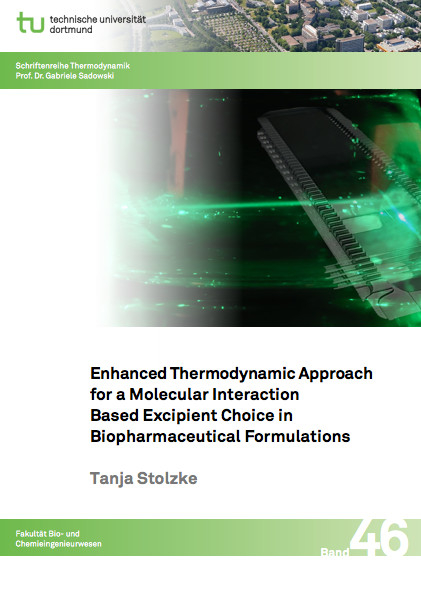
Enhanced Thermodynamic Approach for a Molecular Interaction Based Excipient Choice in Biopharmaceutical Formulations
Seiten
2023
Dr. Hut (Verlag)
978-3-8439-5250-7 (ISBN)
Dr. Hut (Verlag)
978-3-8439-5250-7 (ISBN)
- Keine Verlagsinformationen verfügbar
- Artikel merken
The design of high-concentration protein formulations is often based on heuristics and high-throughput screening approaches, which may lead to “working” but not optimal protein formulations. Especially the selection of excipients, excipient mixtures and their corresponding concentration is challenging.
Within this work, a thermodynamic-based approach was enhanced to ensure the selection of excipients/excipient mixtures for high concentrated protein formulations by means of identification of excipient concentration dependent molecular interactions. The identification of promising solubilization conditions for the protein is based on the water activity coefficient and osmolality via the ePC-SAFT equation of state. The conformational stability of the protein is determined by the unfolding temperature of the protein. The colloidal protein stability is identified by the second osmotic virial coefficient which is determined both experimentally and by application of the extended mxDLVO model.
This research demonstrates that the combination of protein-specific experiments and their model-based studies offers both resource-efficient selection of excipient mixtures and the possibility of transferability to different proteins. Thus, this enhanced and innovative approach promotes the efficient design of aqueous highly concentrated protein formulations.
Within this work, a thermodynamic-based approach was enhanced to ensure the selection of excipients/excipient mixtures for high concentrated protein formulations by means of identification of excipient concentration dependent molecular interactions. The identification of promising solubilization conditions for the protein is based on the water activity coefficient and osmolality via the ePC-SAFT equation of state. The conformational stability of the protein is determined by the unfolding temperature of the protein. The colloidal protein stability is identified by the second osmotic virial coefficient which is determined both experimentally and by application of the extended mxDLVO model.
This research demonstrates that the combination of protein-specific experiments and their model-based studies offers both resource-efficient selection of excipient mixtures and the possibility of transferability to different proteins. Thus, this enhanced and innovative approach promotes the efficient design of aqueous highly concentrated protein formulations.
| Erscheinungsdatum | 13.04.2023 |
|---|---|
| Reihe/Serie | Thermodynamik |
| Verlagsort | München |
| Sprache | englisch |
| Maße | 148 x 210 mm |
| Gewicht | 290 g |
| Themenwelt | Naturwissenschaften ► Physik / Astronomie ► Thermodynamik |
| Technik | |
| Schlagworte | biopharmaceuticals • Protein stability • Second osmotic virial coefficient |
| ISBN-10 | 3-8439-5250-7 / 3843952507 |
| ISBN-13 | 978-3-8439-5250-7 / 9783843952507 |
| Zustand | Neuware |
| Informationen gemäß Produktsicherheitsverordnung (GPSR) | |
| Haben Sie eine Frage zum Produkt? |
Mehr entdecken
aus dem Bereich

aus dem Bereich
zur Materialproblematik der modernen Elektronik
Buch | Hardcover (2025)
Alfred Kröner Verlag
CHF 27,85
Von Energie und Entropie zu Wärmeübertragung und Phasenübergängen
Buch | Softcover (2023)
De Gruyter Oldenbourg (Verlag)
CHF 83,90


