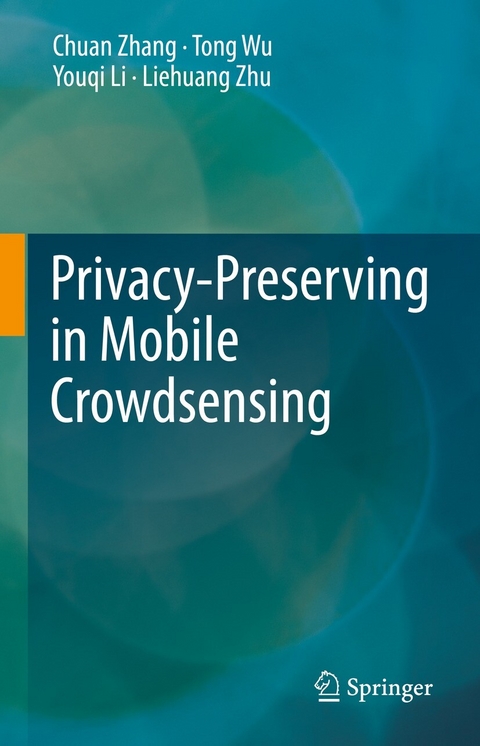
Privacy-Preserving in Mobile Crowdsensing (eBook)
197 Seiten
Springer Nature Singapore (Verlag)
978-981-19-8315-3 (ISBN)
Mobile crowdsensing is a new sensing paradigm that utilizes the intelligence of a crowd of individuals to collect data for mobile purposes by using their portable devices, such as smartphones and wearable devices. Commonly, individuals are incentivized to collect data to fulfill a crowdsensing task released by a data requester. This “sensing as a service” elaborates our knowledge of the physical world by opening up a new door of data collection and analysis. However, with the expansion of mobile crowdsensing, privacy issues urgently need to be solved.
In this book, we discuss the research background and current research process of privacy protection in mobile crowdsensing. In the first chapter, the background, system model, and threat model of mobile crowdsensing are introduced. The second chapter discusses the current techniques to protect user privacy in mobile crowdsensing. Chapter three introduces the privacy-preserving content-based task allocation scheme. Chapter fourfurther introduces the privacy-preserving location-based task scheme. Chapter five presents the scheme of privacy-preserving truth discovery with truth transparency. Chapter six proposes the scheme of privacy-preserving truth discovery with truth hiding. Chapter seven summarizes this monograph and proposes future research directions.
In summary, this book introduces the following techniques in mobile crowdsensing: 1) describe a randomizable matrix-based task-matching method to protect task privacy and enable secure content-based task allocation; 2) describe a multi-clouds randomizable matrix-based task-matching method to protect location privacy and enable secure arbitrary range queries; and 3) describe privacy-preserving truth discovery methods to support efficient and secure truth discovery. These techniques are vital to the rapid development of privacy-preserving in mobile crowdsensing.
Mobile crowdsensing is a new sensing paradigm that utilizes the intelligence of a crowd of individuals to collect data for mobile purposes by using their portable devices, such as smartphones and wearable devices. Commonly, individuals are incentivized to collect data to fulfill a crowdsensing task released by a data requester. This "e;sensing as a service"e; elaborates our knowledge of the physical world by opening up a new door of data collection and analysis. However, with the expansion of mobile crowdsensing, privacy issues urgently need to be solved.In this book, we discuss the research background and current research process of privacy protection in mobile crowdsensing. In the first chapter, the background, system model, and threat model of mobile crowdsensing are introduced. The second chapter discusses the current techniques to protect user privacy in mobile crowdsensing. Chapter three introduces the privacy-preserving content-based task allocation scheme. Chapter fourfurther introduces the privacy-preserving location-based task scheme. Chapter five presents the scheme of privacy-preserving truth discovery with truth transparency. Chapter six proposes the scheme of privacy-preserving truth discovery with truth hiding. Chapter seven summarizes this monograph and proposes future research directions.In summary, this book introduces the following techniques in mobile crowdsensing: 1) describe a randomizable matrix-based task-matching method to protect task privacy and enable secure content-based task allocation; 2) describe a multi-clouds randomizable matrix-based task-matching method to protect location privacy and enable secure arbitrary range queries; and 3) describe privacy-preserving truth discovery methods to support efficient and secure truth discovery. These techniques are vital to the rapid development of privacy-preserving in mobile crowdsensing.
| Erscheint lt. Verlag | 24.3.2023 |
|---|---|
| Zusatzinfo | XVII, 197 p. 1 illus. |
| Sprache | englisch |
| Themenwelt | Informatik ► Datenbanken ► Data Warehouse / Data Mining |
| Informatik ► Netzwerke ► Sicherheit / Firewall | |
| Mathematik / Informatik ► Informatik ► Programmiersprachen / -werkzeuge | |
| Informatik ► Software Entwicklung ► Mobile- / App-Entwicklung | |
| Informatik ► Theorie / Studium ► Kryptologie | |
| Informatik ► Theorie / Studium ► Künstliche Intelligenz / Robotik | |
| Mathematik / Informatik ► Informatik ► Web / Internet | |
| Mathematik / Informatik ► Mathematik ► Statistik | |
| Naturwissenschaften | |
| Schlagworte | Data Analysis • data collection • mobile crowdsensing • Privacy Protection • task allocation • Truth Discovery |
| ISBN-10 | 981-19-8315-1 / 9811983151 |
| ISBN-13 | 978-981-19-8315-3 / 9789811983153 |
| Informationen gemäß Produktsicherheitsverordnung (GPSR) | |
| Haben Sie eine Frage zum Produkt? |
 PDF (Wasserzeichen)
DRM: Digitales Wasserzeichen
Dieses eBook enthält ein digitales Wasserzeichen und ist damit für Sie personalisiert. Bei einer missbräuchlichen Weitergabe des eBooks an Dritte ist eine Rückverfolgung an die Quelle möglich.
Dateiformat: PDF (Portable Document Format)
Mit einem festen Seitenlayout eignet sich die PDF besonders für Fachbücher mit Spalten, Tabellen und Abbildungen. Eine PDF kann auf fast allen Geräten angezeigt werden, ist aber für kleine Displays (Smartphone, eReader) nur eingeschränkt geeignet.
Systemvoraussetzungen:
PC/Mac: Mit einem PC oder Mac können Sie dieses eBook lesen. Sie benötigen dafür einen PDF-Viewer - z.B. den Adobe Reader oder Adobe Digital Editions.
eReader: Dieses eBook kann mit (fast) allen eBook-Readern gelesen werden. Mit dem amazon-Kindle ist es aber nicht kompatibel.
Smartphone/Tablet: Egal ob Apple oder Android, dieses eBook können Sie lesen. Sie benötigen dafür einen PDF-Viewer - z.B. die kostenlose Adobe Digital Editions-App.
Buying eBooks from abroad
For tax law reasons we can sell eBooks just within Germany and Switzerland. Regrettably we cannot fulfill eBook-orders from other countries.
aus dem Bereich