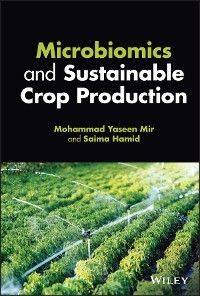
Microbiomics and Sustainable Crop Production (eBook)
336 Seiten
John Wiley & Sons (Verlag)
978-1-119-79933-7 (ISBN)
Microbiomics and Sustainable Crop Production presents an overview of the current state of the art in microbiome research, discussing many new technologies and approaches in order to bridge knowledge gaps between field and lab experimental systems. New and emerging strategies to improve the survival and activity of microbial inoculants are covered, including the use of selected indigenous microbes, optimizing microbial delivery methods, and taking advantage of modern gene editing tools to engineer microbial inoculants.
The two highly qualified authors address new molecular tools and powerful biotechnological advances, providing readers with knowledge of the complex chemical and biological interactions that occur in the rhizosphere and ensuring that strategies to engineer the rhizosphere are safe, beneficial to productivity, and result in improvements to the sustainability of agricultural systems. The relationship between phyllosphere microbial communities and functional traits of plants is also explored. Finally, approaches and priority areas for future research on phyllosphere microbiology are suggested.
Topics covered in this comprehensive resource include:
* Transmission modes of bacteria and fungi and the nature of their interactions in the endosphere
* Characteristics of 'core microbiomes& #8217, which may be deployed to organize otherwise uncontrollable dynamics of resident microbiomes
* Model microbiome-plant systems, as well as the stability, resilience, and assembly of agricultural microbiomes
* Engineering and management of agricultural microbiomes for improving crop health, including reasons to modify plant microbiomes
* Microbiome research in the omics era and new efforts and challenges in assigning functions to microbes
For students of plant biotechnology, agricultural sciences, and agricultural engineering, along with researchers working in related fields, Microbiomics and Sustainable Crop Production is an important resource to understand many complex modern ideas related to the subject and how they can be applied to practical applications.
Dr Mohammad Yaseen Mir, Centre of Research for Development, University of Kashmir, India. Dr. Mir& #8217s research interest is in studying the ecology, molecular biology, conservation, and management of plant resources. Dr Saima Hamid, Researcher, Department of Environmental Sciences, University of Kashmir, India. Dr. Hamid researches plant stress biology, genetic diversity of high altitudinal medicinal plants, and more.
Preface xi
About the Authors xii
1 Agricultural Microbiomes: Functional and Mechanistic Aspects 1
1.1 Introduction 2
1.2 Model Microbiome--Plant Systems 2
1.3 Stability, Resilience, and Assembly of Agricultural Microbiomes 11
1.4 Core Plant Microbiome and Metagenome 13
1.5 Interactions Among the Microbes, Environment, and Management 14
1.6 Microbiome Innovation in Agriculture: Insect Pest Management 21
2 Engineering and Management of Agricultural Microbiomes for Improving Crop Health 66
2.1 Why to Modify Plant Microbiome? 67
2.2 Methods for Detecting Endophytes Within the Plant 69
2.3 Engineering of the Plant Microbiome 79
2.4 In Situ Harnessing of Agricultural Microbiome 82
2.5 Future Perspective of Agricultural Microbiome Engineering 86
3 Approaches and Challenges in Agricultural Microbiome Research 97
3.1 Microbiome Research in the Omics Era 97
3.2 New Efforts and Challenges in Assigning Function to Microbes 99
3.3 Characterization of Complex Microbial Communities 101
3.4 AdvancedFundamental Research on Microbe--Microbe and Plant--Microbe Interactions : Bridging the Lab--Field Gap 102
4 Perceptive of Rhizosphere Microbiome 111
4.1 Introduction 112
4.2 Multiple Levels of Selection in the Plant Rhizosphere 113
4.3 Engineering Microbial Populations and Plant--Microbe Interactions 127
4.4 Emerging Approaches in Rhizoremediation 128
4.5 Heritability of Rhizosphere Microbiome 137
4.6 Future Course of Orientations 139
5 Microbial Communities in Phyllosphere 154
5.1 Introduction 154
5.2 Diversity of Microbes in Phyllospheric Environment 156
5.3 Microbial Adaptation to the Phyllosphere 160
5.4 Relationship between Phyllosphere Microbial Communities and Functional Traits of Plants 163
5.5 Metabolic Dynamics of Phyllosphere Microbiota 166
5.6 Impact of Phyllospheric Microorganisms on Plant--Plant, Plant--Insect, and Plant Atmosphere Chemical Exchanges 167
5.7 Quorum Sensing in Phyllosphere 169
5.8 Applications for Phyllosphere Microbiology 171
6 Endosphere and Endophyte Communities 193
6.1 Reproduction and Transmission Modes of Microbes 194
6.2 Vertical Transmission 196
6.3 Endophyte Genomes and Metagenomes 207
6.4 Bacteria and Fungi in Mixed Biofilms in Plants 213
6.5 Conclusion and Future Perspectives 216
7 Core Microbiomes: For Sustainable Agroecosystems 240
7.1 Core Microbiome for Agriculture: A Taxonomic and Functional Aspect 241
7.2 Core Microorganisms and Priority Effects in Initial Assembly 249
7.3 Informatics of Microbial Networks 255
7.4 Designing Core Microbiomes 257
7.5 Management of Agroecosystems with Core Microbiomes 260
8 Microbiome Mediated: Stress Alleviation in Agroecosystems 272
8.1 Effect of Biotic and Abiotic Stresses on Plants 273
8.2 Molecular and Physiological Responses of Plants Against Stresses 285
8.3 Microbiome Mediated Mitigation of Stress Conditions 288
8.4 Multi-Omics Strategies to Address Stress Alleviation 293
References 303
Index 320
| Erscheint lt. Verlag | 21.3.2023 |
|---|---|
| Sprache | englisch |
| Themenwelt | Naturwissenschaften ► Biologie ► Ökologie / Naturschutz |
| Schlagworte | Agriculture • Biowissenschaften • crops • Feldfrüchte • Landwirtschaft • Life Sciences • microbial ecology • Ökologie • Ökologie / Mikroben |
| ISBN-10 | 1-119-79933-3 / 1119799333 |
| ISBN-13 | 978-1-119-79933-7 / 9781119799337 |
| Informationen gemäß Produktsicherheitsverordnung (GPSR) | |
| Haben Sie eine Frage zum Produkt? |
 PDF (Adobe DRM)
Kopierschutz: Adobe-DRM
Adobe-DRM ist ein Kopierschutz, der das eBook vor Mißbrauch schützen soll. Dabei wird das eBook bereits beim Download auf Ihre persönliche Adobe-ID autorisiert. Lesen können Sie das eBook dann nur auf den Geräten, welche ebenfalls auf Ihre Adobe-ID registriert sind.
Details zum Adobe-DRM
Dateiformat: PDF (Portable Document Format)
Mit einem festen Seitenlayout eignet sich die PDF besonders für Fachbücher mit Spalten, Tabellen und Abbildungen. Eine PDF kann auf fast allen Geräten angezeigt werden, ist aber für kleine Displays (Smartphone, eReader) nur eingeschränkt geeignet.
Systemvoraussetzungen:
PC/Mac: Mit einem PC oder Mac können Sie dieses eBook lesen. Sie benötigen eine
eReader: Dieses eBook kann mit (fast) allen eBook-Readern gelesen werden. Mit dem amazon-Kindle ist es aber nicht kompatibel.
Smartphone/Tablet: Egal ob Apple oder Android, dieses eBook können Sie lesen. Sie benötigen eine
Geräteliste und zusätzliche Hinweise
Buying eBooks from abroad
For tax law reasons we can sell eBooks just within Germany and Switzerland. Regrettably we cannot fulfill eBook-orders from other countries.
aus dem Bereich