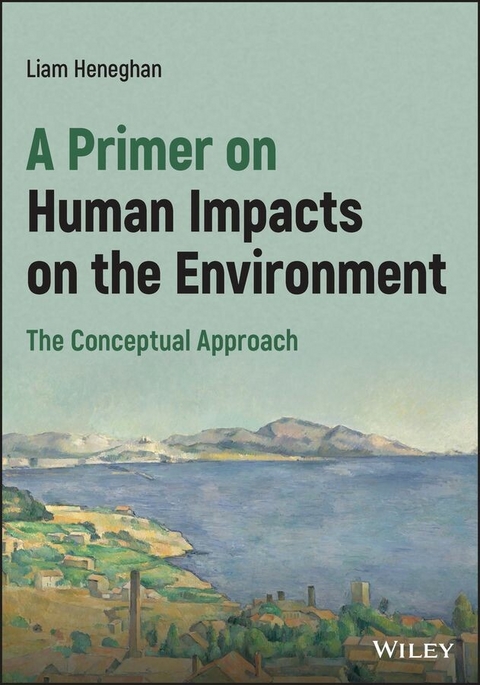
A Primer on Human Impacts on the Environment (eBook)
John Wiley & Sons (Verlag)
978-1-119-64261-9 (ISBN)
An insightful and illuminating discussion of the impact humans have had on Earth
In A Primer on Human Impacts on the Environment: The Conceptual Approach, distinguished environmental scientist Liam Heneghan explores the intricate relationships between humanity and Earth in an accessible and engaging style. Replete with real-world examples and drawing from classic and contemporary scholarship, the author adapts the fundamental conceptual models of the environmental disciplines to assess the risks human beings are taking with their home planet. The conceptual approach of this primer challenges readers to think across multiple disciplines to reveal the 'big picture' that is all too often lost in the details of contemporary environmental studies.
Readers will also find:
- A thorough introduction to conceptual modeling, showing how systems models can be adapted and applied in a rapidly changing world
- Comprehensive explorations of the human impact on the Earth, including an examination of possible ecological limits and planetary boundaries
- In-depth evaluations of environmental risks, especially, though not limited to, climate change and biodiversity loss
- A guide to contemplating catastrophic risk and the potential for societal collapse without inducing unnecessary anxiety
- An interdisciplinary focus, emphasizing the role of the natural and social sciences, as well as the arts and humanistic disciplines in safeguarding the future
Perfect for students of environmental science and environmental studies, A Primer on Human Impacts on the Environment will also earn a place in the libraries of graduate students working on environmental themes and practicing professionals in the environmental management community.
Liam Heneghan, PhD, is Professor of Environmental Science and Studies at DePaul University in Chicago, Illinois, USA. His research is focused on invasive species and the efficacy of ecological restoration.
An insightful and illuminating discussion of the impact humans have had on Earth In A Primer on Human Impacts on the Environment: The Conceptual Approach, distinguished environmental scientist Liam Heneghan explores the intricate relationships between humanity and Earth in an accessible and engaging style. Replete with real-world examples and drawing from classic and contemporary scholarship, the author adapts the fundamental conceptual models of the environmental disciplines to assess the risks human beings are taking with their home planet. The conceptual approach of this primer challenges readers to think across multiple disciplines to reveal the 'big picture' that is all too often lost in the details of contemporary environmental studies. Readers will also find: A thorough introduction to conceptual modeling, showing how systems models can be adapted and applied in a rapidly changing world Comprehensive explorations of the human impact on the Earth, including an examination of possible ecological limits and planetary boundaries In-depth evaluations of environmental risks, especially, though not limited to, climate change and biodiversity loss A guide to contemplating catastrophic risk and the potential for societal collapse without inducing unnecessary anxiety An interdisciplinary focus, emphasizing the role of the natural and social sciences, as well as the arts and humanistic disciplines in safeguarding the future Perfect for students of environmental science and environmental studies, A Primer on Human Impacts on the Environment will also earn a place in the libraries of graduate students working on environmental themes and practicing professionals in the environmental management community.
Liam Heneghan, PhD, is Professor of Environmental Science and Studies at DePaul University in Chicago, Illinois, USA. His research is focused on invasive species and the efficacy of ecological restoration.
Preface
Chapter 1 A Manifesto for Conceptual Thinking in Environmental Disciplines
Chapter 2 A Conceptual Approach to Environmental Science
Chapter 3 A Short Chapter on the Definition of Definitions
Chapter 4
Everything is connected (but some things are more connected than are others)
Chapter 5 Complex Environmental Systems
Chapter 6 All or nothing? Or, what, exactly, is an environment?
Chapter 7 Life and environment: the indissoluble link
Chapter 8 Gaia, the Noösphere, and the Anthropocene
Chapter 9 The Anthropocene and the Concept of Limits
Chapter 10 Limited and limiting models
Chapter 11 Collapse and the Anthropocene
Chapter 12 How to conceive a (climate) crisis
Chapter 13 Risking Life: Basics of Biological Diversity
Chapter 14 Risking life: Is the Sixth Extinction Catastrophic?
Chapter 15 Conceiving a Future: the need for interdisciplinarity
Chapter 16 The Three Futures
Index
Preface: A Roadmap to the Book
It is time to change from a society based on conquest to a society based on survival.
Winona LaDuke 1992 [1]
In the autumn quarter of 2015, I instituted changes in a course that I had been teaching continuously since the beginning of the millennium. Human Impacts on the Environment was developed for college students majoring primarily in environmental disciplines. The course had initially taken a survey approach to the topic. In it we enumerated, as best as could be managed in a single 10‐week quarter, all the major influences that humans – that most ubiquitous of primates – have had on life, atmosphere, water, rocks and soil, that is, upon the functioning of this planet Earth. After a decade and a half of pursuing an exhaustive approach to the material, five things had become apparent to me. Reflecting upon these resulted in a new presentation of the material.
This planet earth is the home upon which we rely for our sustenance, but it also serves as a sink for our wastes: both personal waste and the by‐products of our economic activity. The fragility of the planet and of the human situation in the face of stresses of our own making has long been a subject of rumination in literature, the arts, and in scientific investigation. (Detail from The Garden of Earthly Delights (c.1500) by Hieronymus Bosch. Bosch's painting is from a triptych found in the Museo del Prado, Madrid, Spain).
Source: Blankfaze / Wikimedia Commons / Public Domain.
As I will describe in more detail in the next chapter, the five considerations that refined my approach to thinking and teaching recognize that…
- … what we know about the human impact on the biophysical processes of the planet is so extensive that taking a conceptual approach to teaching and thinking about global environmental problems is both an efficient way of presenting the material, but may be the only feasible way of learning about these issues in introductory courses;
- …in addition to what we already know about human impacts on the planet, new information concerning the damage to earth systems accumulates so rapidly that you, as a student, will benefit from practice in applying fundamental concepts to novel aspects of environmental change. The priorities that you will likely encounter during the course of your career may change, but many of the conceptual frameworks will endure;
- …the active role played by environmental scientists in policy and resource management decisions necessitates that you familiarize yourself with both the ecological and social context of environmental issues;
- …furthermore your responsibilities as a future collaborator obligate you to cultivate excellent interdisciplinary skills. The problems presented by global environmental problems are larger than any one discipline;
- …because of a growing consensus that the consequences of environmental change are potentially catastrophic – and that these consequences become ever more calamitous if solutions are not prioritized – a student will need a grounding in understanding and applying risk assessment frameworks.
Making the necessary changes provoked by these fivefold interrelated factors not only transformed my teaching, but this reflection has also resulted in this book. Although the book you are reading has evolved largely out of my experiences of teaching environmental science over more than two decades, it is written, nonetheless, to serve the needs of students taking a variety of courses. This primer is designed for those studying the fundamentals of environmental science and studies. It should also be helpful as a supplement for courses focused on ecological restoration, green architecture and design, as well as on environmental management and urban planning. Finally, the book will provide useful background for students in the environmental humanities. The book aims at providing a versatile text for students learning about the environment in both formal and informal settings, as well as being suitable for early career environmental professionals, those who wish to become engaged in environmental work in an avocational way, and even for all those desiring to become well‐informed global citizens.
1 What to Expect in this Book
In this book, we proceed as follows. In the first chapter of Section 1, the general philosophy adopted in this book – that is, placing the focus on concepts – will be justified (Chapter 1: A Manifesto for Conceptual Thinking in Environmental Disciplines). What, precisely, does it means to be conceptual in our thinking about the environment – how do conceptual models help frame the major problems, interrogate environmental mechanisms, and assist in envisioning solutions? These questions form the topics for Chapter 2: A Conceptual Approach to Environmental Science. Recognizing that much of the conceptual work that we plan to accomplish in this volume seeks to operationalize environmental concepts by defining them, the first section of the book concludes with Chapter 3: A Short Chapter on the Definition of Definitions.
This initial validation of a conceptual framing for the discipline is followed by a section presenting an overview of our basic models. Section 2 introduces the uniquely versatile and interdisciplinary tool of systems modeling. A variety of such models are applied in diverse fields (from economics, computer science, the social sciences to engineering, and, of course, they are widely used in environmental disciplines). We will introduce the general terms of these models in Chapter 4: Everything is Connected: the First Rule of Ecology. In this chapter we also evaluate the supposed central axiom of ecology that “everything is connected” and amend it. The specific details of the more significant environmental systems models are then assessed in Chapter 5: Complex Environmental Systems.
Although the term “environment,” as we shall see, has been criticized as vague and hard to operationalize – how can or should this term be used? – in Section 3 we examine a sequence of increasingly sophisticated models that make something more concrete of this concept. Chapter 6: All or Nothing? Or, What, Exactly, is an Environment? introduces the basic concept of the environment. Chapter 7: Life and Environment: the Indissoluble Link illustrates how no organism can adequately be understood without consideration of how it is shaped by an environment, as well as, simultaneously, how it reciprocally shapes an environment. A final chapter in this section (Chapter 8: Gaia, the Noösphere and the Anthropocene) presents one very significant contemporary environmental model – that is, the notion of the Anthropocene (a term used to describe the most recent period in Earth's history when humans have had a marked impact on planetary functioning). The chapter also discusses how this model is both related to and different from other similar‐seeming environmental models. These relatives of the concept of the “Anthropocene” are sometimes brushed aside as having little contemporary relevance; however, their utility may not have been fully exhausted. I try to show how they remain useful; we return to this theme in the final chapter of the book.
The idea of a “limit” is an especially important element of many environmental models. Section 4 of this book explores the concept of limits over the course of two chapters. The first of these chapters scrutinizes the consistent invocation of the notion of “limits” in environmental models (Chapter 9: The Anthropocene and the Concept of Limits). Positing a limit implies that in a finite world both population and economic growth must be bounded in some manner. Infinite growth, from this perspective, is not possible in a materially closed system. Several models propose that our contemporary global environmental problems emerge from our collective human enterprise now bumping up against the biophysical limits of the planet. This is the topic of Chapter 10: Modeling the Limits.
Will the breaching of environmental limits be catastrophic for humans and for the rest of nature? This is the topic of Section 5, which is the longest section of the book. The first of the four chapters in this section (Chapter 11: Collapse and the Anthropocene: Learning from the Past) examines the scholarship on the historical collapse of civilization(s). If there is an environmental component to the collapse of ancient civilizations, can this provide clues to our potential social vulnerabilities in the Anthropocene? Chapter 12: How to Conceive of a (Climate) Crisis illustrates the relevance of catastrophic risk assessment models for evaluating the potential consequences of global environmental problems. This chapter illustrates how risk models can be helpful in assessing problems associated with climate change. Risk models (both catastrophic and noncatastrophic) are regularly invoked in the work of The Intergovernmental Panel on Climate Change (IPCC), that is, the international body convened under the United Nations that collates scientific information on the causes and consequences of climate change,...
| Erscheint lt. Verlag | 14.3.2023 |
|---|---|
| Sprache | englisch |
| Themenwelt | Naturwissenschaften ► Biologie ► Ökologie / Naturschutz |
| Naturwissenschaften ► Geowissenschaften | |
| Schlagworte | Agriculture • Agriculture & Ecology • Biodiversity Loss • climate change • earth sciences • Ecology • environmental conceptual modeling • Environmental Science • environmental solutions • Environmental Studies • Environmental Systems • Geowissenschaften • global resource management • global warming • Landwirtschaft • Landwirtschaft u. Ökologie • Resource Management • Soil Loss • Umweltforschung |
| ISBN-10 | 1-119-64261-2 / 1119642612 |
| ISBN-13 | 978-1-119-64261-9 / 9781119642619 |
| Informationen gemäß Produktsicherheitsverordnung (GPSR) | |
| Haben Sie eine Frage zum Produkt? |
 EPUB (Adobe DRM)
Kopierschutz: Adobe-DRM
Adobe-DRM ist ein Kopierschutz, der das eBook vor Mißbrauch schützen soll. Dabei wird das eBook bereits beim Download auf Ihre persönliche Adobe-ID autorisiert. Lesen können Sie das eBook dann nur auf den Geräten, welche ebenfalls auf Ihre Adobe-ID registriert sind.
Details zum Adobe-DRM
Dateiformat: EPUB (Electronic Publication)
EPUB ist ein offener Standard für eBooks und eignet sich besonders zur Darstellung von Belletristik und Sachbüchern. Der Fließtext wird dynamisch an die Display- und Schriftgröße angepasst. Auch für mobile Lesegeräte ist EPUB daher gut geeignet.
Systemvoraussetzungen:
PC/Mac: Mit einem PC oder Mac können Sie dieses eBook lesen. Sie benötigen eine
eReader: Dieses eBook kann mit (fast) allen eBook-Readern gelesen werden. Mit dem amazon-Kindle ist es aber nicht kompatibel.
Smartphone/Tablet: Egal ob Apple oder Android, dieses eBook können Sie lesen. Sie benötigen eine
Geräteliste und zusätzliche Hinweise
Buying eBooks from abroad
For tax law reasons we can sell eBooks just within Germany and Switzerland. Regrettably we cannot fulfill eBook-orders from other countries.
aus dem Bereich