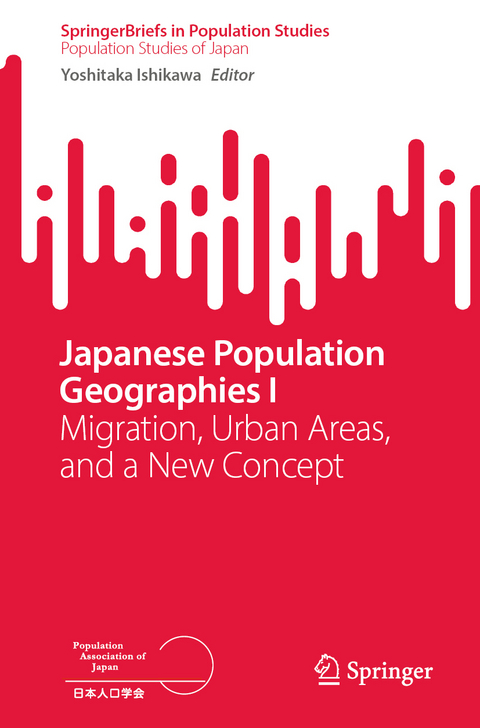
Japanese Population Geographies I
Springer Verlag, Singapore
978-981-99-2034-1 (ISBN)
The first volume analyzes the postwar transition of internal migration, examining the structural changes of population in urban areas, and proposes a new measure different from the traditional resident population. This volume also presents an investigation of the retirement migration of baby boomers as well as displacement migration due to the 2011 Great East Japan Earthquake.
The second volume’s contents examine the residential choicesof minority populations such as foreign residents and sexual minorities. It also discusses future prospects associated with mono-polar concentration into Tokyo, regional forecasting using population projections based on small-area units, and the importance of a politico–economic perspective in the future research.
Taken as a whole, this anthology offers the following two significant contributions. First, the excellent achievements obtained in Japan, which is experiencing serious demographic trends, reflect key developments within the context of the world's population geography. The second contribution is that the book brings the latest insights and important policy implications to countries that are facing various issues associated with decreasing fertility, aging population, and declining population.
Dr. Yoshitaka Ishikawa is a professor emeritus of Kyoto University, Kyoto, Japan. He received his D.Litt. in geography from the Graduate School of Letters, Kyoto University, in 1994. He is a leading Japanese population geographer who has contributed to international geography through publishing many books and papers on such research topics as internal/international migration and foreign residents as ethnic minorities. His research activities have also extended to investigating geographical disparities between the Tokyo metropolitan area and the rest of the country. His publications include International migrants in Japan: Contributions in an era of population decline (Trans Pacific Press, 2015) and Ethnic enclaves in contemporary Japan (Springer, 2021). He served on the editorial board of the journal Population, Space and Place (formerly International Journal of Population Geography) for 20 years from 1995. He won the IGU (International Geographical Union) Lauréat d’honneur for the year 2020.
Internal Migration in the Post-demographic Transition Period.- Internal Retirement Migration in Japan Revisited.- Characteristics of Residential Mobility after the Great East Japan Earthquake: Focusing on Affected Prefectures of the Tohoku Region, Japan.- Spatial-cycle Model Phases and Differential Urbanization of Cities in the Era of National Population Decline: Japanese Cities 1980–2015.- Significance and Possibilities of the New Concept of “Relationship Population” in Japan’s Population Decline Society.
| Erscheinungsdatum | 17.06.2023 |
|---|---|
| Reihe/Serie | Population Studies of Japan | SpringerBriefs in Population Studies |
| Zusatzinfo | 7 Illustrations, color; 17 Illustrations, black and white |
| Verlagsort | Singapore |
| Sprache | englisch |
| Maße | 155 x 235 mm |
| Themenwelt | Naturwissenschaften ► Geowissenschaften ► Geografie / Kartografie |
| Sozialwissenschaften ► Soziologie ► Empirische Sozialforschung | |
| Sozialwissenschaften ► Soziologie ► Spezielle Soziologien | |
| Schlagworte | Migration • minority population • Population decline • Population Geographies |
| ISBN-10 | 981-99-2034-5 / 9819920345 |
| ISBN-13 | 978-981-99-2034-1 / 9789819920341 |
| Zustand | Neuware |
| Informationen gemäß Produktsicherheitsverordnung (GPSR) | |
| Haben Sie eine Frage zum Produkt? |
aus dem Bereich