Basics of Analytical Chemistry and Chemical Equilibria (eBook)
John Wiley & Sons (Verlag)
9781119707387 (ISBN)
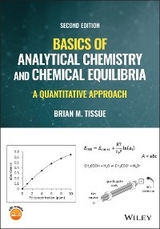
Familiarize yourself with the fundamentals of analytical chemistry with this easy-to-follow textbook
Analytical chemistry is the study of chemical composition, concerned with analyzing materials to discover their constituent substances, the amounts in which these substances are present, and more. Since materials exist in different states and undergo reactions, analytical chemistry is also concerned with chemical equilibria, the state at which various reactants and substances will undergo no observable chemical change without outside stimulus. This field has an immense range of practical applications in both industry and research and is a highly desirable area of expertise for the next generation of chemists.
Basics of Analytical Chemistry and Chemical Equilibria provides an introduction to this foundational subject, ideal for specialized courses. It introduces not only the core concepts of analytical chemistry but cultivates mastery of various instrumental methods by which students and researchers can undertake their own analyses. Now updated to include the latest research and expanded coverage, Basics of Analytical Chemistry and Chemical Equilibria promises to situate a new generation of readers in this growing field.
Readers of the second edition of Basics of Analytical Chemistry and Chemical Equilibria will also find:
- A new chapter on structure determination
- Revised and expanded descriptions of chemical instrumentation
- 'You-try-it' exercises throughout to further develop practical student knowledge
- Compannion website of associated materials including end-of-chapter solutions, spreadsheets for student use, and more
Basics of Analytical Chemistry and Chemical Equilibria is an ideal textbook for students in chemistry, biochemistry, and environmental science, as well as students in related fields, including chemical engineering and materials science, for whom analytical chemistry offers a useful toolset.
Brian M. Tissue, PhD is an Associate Professor of Chemistry at Virginia Tech, Blacksburg, VA, USA. He teaches instrumental analysis and his awards and honors include an NSF Career Award and a Cottrell Scholar Award from the Research Corporation for Science Advancement.
BASICS OF ANALYTICAL CHEMISTRY AND CHEMICAL EQUILIBRIA Familiarize yourself with the fundamentals of analytical chemistry with this easy-to-follow textbook Analytical chemistry is the study of chemical composition, concerned with analyzing materials to discover their constituent substances, the amounts in which these substances are present, and more. Since materials exist in different states and undergo reactions, analytical chemistry is also concerned with chemical equilibria, the state at which various reactants and substances will undergo no observable chemical change without outside stimulus. This field has an immense range of practical applications in both industry and research and is a highly desirable area of expertise for the next generation of chemists. Basics of Analytical Chemistry and Chemical Equilibria provides an introduction to this foundational subject, ideal for specialized courses. It introduces not only the core concepts of analytical chemistry but cultivates mastery of various instrumental methods by which students and researchers can undertake their own analyses. Now updated to include the latest research and expanded coverage, Basics of Analytical Chemistry and Chemical Equilibria promises to situate a new generation of readers in this growing field. Readers of the second edition of Basics of Analytical Chemistry and Chemical Equilibria will also find: A new chapter on structure determination Revised and expanded descriptions of chemical instrumentation You-try-it exercises throughout to further develop practical student knowledge Compannion website of associated materials including end-of-chapter solutions, spreadsheets for student use, and more Basics of Analytical Chemistry and Chemical Equilibria is an ideal textbook for students in chemistry, biochemistry, and environmental science, as well as students in related fields, including chemical engineering and materials science, for whom analytical chemistry offers a useful toolset.
Brian M. Tissue, PhD is an Associate Professor of Chemistry at Virginia Tech, Blacksburg, VA, USA. He teaches instrumental analysis and his awards and honors include an NSF Career Award and a Cottrell Scholar Award from the Research Corporation for Science Advancement.
CHAPTER 1
MAKING MEASUREMENTS
Learning Outcomes
- Describe aspects of good laboratory practice (GLP).
- Use correct terms to describe analytical measurements and data.
- Calculate analyte concentration from measurement results.
- Use statistical formulas to express the precision of analytical measurements.
- Use calibration methods to obtain accurate results.
1.1 INTRODUCTION
There are few areas in our modern life in which the quantity of substances is not important. Industries and government agencies spend substantial resources to determine and monitor the safe levels of chemicals in foods, pharmaceuticals, and the environment. Setting permissible levels of contaminants is based on quantitative results from toxicological studies and raising or lowering a level has significant costs and consequences. Similarly, companies compete for sales by providing high-quality goods at the lowest price. Optimizing industrial processes depends on making decisions based on analytical measurements. Poor measurements or incorrect data interpretation will lead to poor decisions.
You might not make many measurements yourself, but you probably rely on data and quantitative results to make decisions. You’ve probably read the ingredients or nutritional information on a product label to choose one product over another. I certainly want manufacturers to perform quality checks on the contents of the products that I buy. I’m also expecting an independent agency, say the FDA or USDA,1 to check that there is not too much of a mineral, or contaminants such as Pb or rat poison, that could make the food unhealthy. Think about the last time that you had a medical checkup. Did the doctor determine your health by just looking at you? At the least you had a quantitative measure of pulse rate and blood pressure. Modern medicine relies on a variety of technological tools and clinical analyses. At some time, you might need to make a significant decision such as beginning daily doses of a cholesterol-lowering drug. We all hope that doctors and clinical technicians analyzing our samples were paying attention when they took an analytical chemistry course!
When you make a measurement, or you need to make a decision based on someone else’s measurement, do you trust the value? This chapter introduces the terminology and statistical tools to describe and assess quantitative results. Some of the details will be new to you, but they all fit into a framework for collecting and reporting quantitative measurements. Table 1.1 begins building our vocabulary of measurement science and data-handling concepts by defining general terms. Many of these terms are used rather loosely in the scientific and manufacturer literature. You might need to dig into the details to know exactly what is meant when a procedure refers to the sample, the signal, etc. It is also common that a given term will have a different definition for different instruments or techniques. Resolving power is a measure of selectivity in mass spectrometry. However, resolving power and the related term resolution have different meanings when discussing a spectrum, a microscope image, or the separation of components in a mixture.
TABLE 1.1 Measurement Terms
| Term | Definition |
| Sample | v. To collect one or more samples. |
| Sample | n. Substance of interest. Assumed to be representative of remaining substance that is not collected. May refer to an unprocessed field sample or to a laboratory sample that has undergone one or more sample preparation steps. Test portion is the preferred term for laboratory samples. |
| Unknown | n. A sample, the source of which is usually known. Calling a sample an “unknown” indicates that the identity of the substance or the analyte concentration in the sample is unknown and to be determined. |
| Test portion | n. A portion of a collected sample that is processed and measured. |
| Test solution | n. Analogous to test portion but specific for a liquid solution. |
| Analyte | n. The chemical species to be identified or quantitated. It might exist as a pure substance or as one constituent of a multicomponent sample. |
| Qualitative analysis | n. Making measurements to determine the identity, structure, or physical properties of a substance. |
| Quantitative analysis | n. Making measurements to determine the amount of an analyte in a sample. |
| Detector | n. Device that responds to the presence of analyte, usually generating an electrical output. |
| Signal | n. The detector output that is displayed or recorded. |
| Sensitivity | n. The change in detector signal versus change in analyte concentration. |
| Selectivity | n. The discrimination of an analyte versus other components in the sample. |
In quantitative analysis, we want a measurement or detector signal that we can relate to an analyte concentration. Doing so can be quite involved, and Chapter 2 discusses various sample preparation methods to isolate an analyte from interferences so that it can be measured. What mechanisms are available to detect an analyte? I can think of only three general strategies to detect and quantitate an analyte:
- measuring a physical property,
- using electromagnetic radiation, called spectroscopy, and
- measuring an electric charge or current.
Table 1.2 lists some examples in each of these categories. We will discuss most of these methods, so do not worry if they are unfamiliar. Chapter 3 discusses classical methods that rely on physical measurements and Part III of the text introduces instrumental methods based on electrochemistry, spectroscopy, and mass spectrometry.
TABLE 1.2 Measurement Strategies
| Physical Property | Spectroscopy | Electric Charge or Current |
| Mass or volume | Absorption | Electrical conductivity |
| Density | Emission | Electrical potential, for example, pH meter |
| Refractive index | Scattering | Voltammetry (reduction and oxidation current) |
| Freezing point depression | Mass spectrometry (ion current) |
| Thermal conductivity |
Although I list only three general detection strategies, each of these general categories encompass a multitude of specific analytical techniques. For example, spectroscopic methods have been developed to use most of the electromagnetic spectrum, including X-ray, ultraviolet (UV), visible (Vis), infrared, and radio waves. The different regions of the electromagnetic spectrum interact with matter differently and provide different types of information. This text concentrates on quantitative methods for analytes in aqueous solution. There are numerous other spectroscopic techniques to make quantitative measurements of solids and to determine physical properties of materials.
These general categories vary in sensitivity and selectivity. Measurements based on a physical property are usually less sensitive than spectroscopic or charge-based instrumental methods. The methods based on physical methods are useful when analyte concentrations are relatively high and when preparing standards to calibrate instrumental methods. When coupled with a separation column, detectors based on physical methods are the most universal and capable of detecting all analytes in the sample. Spectroscopic and electroanalytical methods can be extremely sensitive and selective for specific analytes. Selecting from one of these three general strategies for a given analytical problem depends on the nature of the analyte, the expected concentration, and the sample matrix.
New analytical methods and instruments are developed continuously. The breadth of research and development in analytical chemistry is too extensive to convey through just a few examples. For an overview of current research topics in analytical sciences, browse the Technical or Preliminary Programs of upcoming analytical chemistry conferences.2
1.1.1 Concentration Units
Most of the quantitative methods that we will discuss are aimed toward determining the concentration of an analyte in a sample. Concentration is the quantity of one substance, the analyte, divided by the total quantity of all substances in the sample. Concentration is different from an amount, in moles, mass, or volume, and we often interconvert between the two. Table 1.3 lists the SI base units that are used to derive other units.3 In addition to these units, we drop or add the prefixes listed in Table 1.4 to indicate numerical factors. Common units that we work with in addition to the mole and kg are mmol (millimole), mg (milligram), and g (gram). The purpose of the prefixes is to simply express results in convenient values rather than...
| Erscheint lt. Verlag | 2.3.2023 |
|---|---|
| Sprache | englisch |
| Themenwelt | Naturwissenschaften ► Chemie ► Analytische Chemie |
| Schlagworte | Analytical Chemistry • Analytische Chemie • Biochemie • biochemistry • Biowissenschaften • Chemie • Chemistry • Life Sciences • Organic Chemistry • Organische Chemie |
| ISBN-13 | 9781119707387 / 9781119707387 |
| Informationen gemäß Produktsicherheitsverordnung (GPSR) | |
| Haben Sie eine Frage zum Produkt? |
 EPUB (Adobe DRM)
Kopierschutz: Adobe-DRM
Adobe-DRM ist ein Kopierschutz, der das eBook vor Mißbrauch schützen soll. Dabei wird das eBook bereits beim Download auf Ihre persönliche Adobe-ID autorisiert. Lesen können Sie das eBook dann nur auf den Geräten, welche ebenfalls auf Ihre Adobe-ID registriert sind.
Details zum Adobe-DRM
Dateiformat: EPUB (Electronic Publication)
EPUB ist ein offener Standard für eBooks und eignet sich besonders zur Darstellung von Belletristik und Sachbüchern. Der Fließtext wird dynamisch an die Display- und Schriftgröße angepasst. Auch für mobile Lesegeräte ist EPUB daher gut geeignet.
Systemvoraussetzungen:
PC/Mac: Mit einem PC oder Mac können Sie dieses eBook lesen. Sie benötigen eine
eReader: Dieses eBook kann mit (fast) allen eBook-Readern gelesen werden. Mit dem amazon-Kindle ist es aber nicht kompatibel.
Smartphone/Tablet: Egal ob Apple oder Android, dieses eBook können Sie lesen. Sie benötigen eine
Geräteliste und zusätzliche Hinweise
Buying eBooks from abroad
For tax law reasons we can sell eBooks just within Germany and Switzerland. Regrettably we cannot fulfill eBook-orders from other countries.
aus dem Bereich