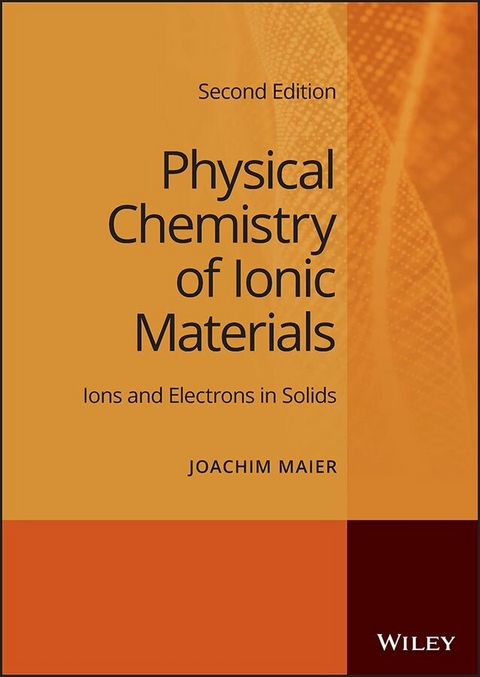
Physical Chemistry of Ionic Materials (eBook)
John Wiley & Sons (Verlag)
978-1-119-79912-2 (ISBN)
Discover the physical chemistry of charge carriers in the second edition of this popular textbook
Ionic and electronic charge carriers are critical to the kinetic and electrochemical properties of ionic solids. These charge carriers are point defects and are decisive for electrical conductivity, mass transport, and storage phenomena. Generally, defects are deviations from the perfect structure, and if higher-dimensional, also crucial for the mechanical properties. The study of materials science and energy research therefore requires a thorough understanding of defects, in particular the charged point defects, their mobilities, and formation mechanisms.
Physical Chemistry of Ionic Materials is a comprehensive introduction to these charge carrier particles and the processes that produce, move, and activate them. Covering both core principles and practical applications, it discusses subjects ranging from chemical bonding and thermodynamics to solid-state kinetics and electrochemical techniques. Now in an updated edition with numerous added features, it promises to be the essential textbook on this subject for a new generation of materials scientists.
Readers of the 2nd Edition of Physical Chemistry of Ionic Materials will also find:
- Two new chapters on solid state electrochemistry and another on nanoionics
- Novel brief sections on photoelectrochemistry, bioelectrochemistry, and atomistic modelling put the treatment into a broader context
- Discussion of the working principles required to understand electrochemical devices like sensors, batteries, and fuel cells
- Real laboratory measurements to ground basic principles in practical experimentation
Physical Chemistry of Ionic Materials is a valuable reference for chemists, physicists, and any working researchers or advanced students in the materials sciences.
Joachim Maier, PhD, is Director of the Max Planck Institute for Solid State Research, Stuttgart, Germany, a position he has held since 1991. He has lectured at elite universities in both Europe and the United States, and his work in pioneering the field of nanoionics has earned him numerous international awards and distinctions.
Joachim Maier, PhD, is Director of the Max Planck Institute for Solid State Research, Stuttgart, Germany, a position he has held since 1991. He has lectured at elite universities in both Europe and the United States, and his work in pioneering the field of nanoionics has earned him numerous international awards and distinctions.
1
Introduction
1.1 Motivation
It may seem odd to ask the reader in the first sentence of the book he or she has just opened to put it down for a moment (naturally with the intention of picking it up and reading it again with greater motivation). Consider, however, your environment objectively for a moment. The bulk of it is (as we ourselves are to a large degree) made up of solid matter. This does not just apply to the materials, from which the house in which you live is built or the chair in which you may be seated is made, it also applies to the many technical products which make your life easier, and in particular to the key components that are hidden from your eyes, such as the silicon chip in the television set, the electrodes in lithium‐based batteries powering mobile phones or enabling electrotraction and the oxide ceramics in the oxygen sensors of automobiles. It is the rigidity of solids which endows them with characteristic, advantageous properties: The enduring structure of our world is inconceivable without solid matter, with its low diffusion coefficients at least for one component (the reader may like to consider for a moment his or her surroundings being in spatial equilibrium, i.e. with all diffusion barriers having been removed). In addition and beyond the mere mechanical functionality, solids offer the possibility of subtly and reproducibly tailoring chemical, electric, magnetic and thermal functions.
The proportion of functional materials and, in particular, electrical ceramics in daily life is going to increase enormously in the future: Chemical, optical or acoustic sensors will analyse the environment for us, actuators will help us influence it. More or less autonomous systems perceiving the environment by sensors and influencing it by actuators, controlled by computers and powered by an autarchic energy supply (battery) or by an ‘electrochemical metabolism’ (fuel cell) are by no means visions for the distant future. Wherever it is possible, attempts are being made to replace fluid systems by solid ones, for instance, liquid electrolytes by solid ion conductors. In short: The importance of (inorganic or organic) solids can hardly be overestimated (even if we ignore the crowning functionality of biopolymers, as (almost)1 done in this book). Furthermore, solid state reactions were not only of importance for and during the creation of our planet, but also constitute a large portion of processes taking place, nowadays, in nature and in the laboratory.
Perhaps you are a chemistry student in the midst of your degree course or a chemistry graduate already with a complete overview of the syllabus. You will then certainly agree that the greater part of a chemist's education is concerned with liquids and, in particular, with water and aqueous solutions. Solids, when they are considered, are almost always considered from a naive ‘outer’ point of view, i.e. as chemically invariant entities: Interest is chiefly concerned with the perfect structure and chemical bonding; in aqueous solutions it either precipitates or dissolves. Only the surface is considered as a site of chemical reactions. The concept of a solid having an ‘internal chemical life’, which makes it possible for us to tailor the properties of a solid, in the same manner that we can those properties of aqueous solutions, sounds – even now – somewhat adventurous.
On the other hand, solid state physicists have influenced the properties of semiconductors such as silicon, germanium or gallium arsenide by defined doping in a very subtle way. If the reader is a physicist, I believe he or she would agree that the role of composition as a parameter is not sufficiently appreciated in physics. Even though internal chemical equilibria are sometimes considered and doping effects are generally taken into account, concentration is still too strongly focused on singular compositions and electronic carriers. In fact, a large number of functional materials are based on binary or multinary compounds, for which stoichiometric effects play an enormous role.
Lastly this text is addressed to materials scientists for whom the mechanical properties frequently and traditionally are of prime interest. Electrochemical aspects are generally not sufficiently considered with respect to their importance for the preparation and durability of the material and optimization of its function. Thus, the fields of electroceramics and more generally of solids for energy applications are addressed.
The chemistry and physics of defects play a key role in the following text [1, 2]. After all, in the classical examples of water in chemistry and silicon in physics, it is not so much the knowledge of the structure or of the chemical bonding that has made it possible to carry out subtle and controllable tuning of properties, but rather the phenomenological knowledge of the nature of relevant particles, such as ions, ions or foreign ions in water that determine its acid‐base and redox chemistry. In the case of silicon the relevant particles are conduction electrons and electron holes, which, on account of their properties, determine the (redox) chemistry and the electronic properties.
Focusing on such relevant particles leads to the generalized concept of defect chemistry that permits the treatment of internal chemical processes within the solid state (in this context Figure 1.1 is illustrative). In processes, in which the structure of the phase does not alter, the perfect state can be regarded as invariant and all the chemical occurrences can then be reduced to the behaviour of the defects, that is, the deviations from the perfect state. The foundation stone of defect chemistry was laid by Frenkel, Schottky and Wagner [1, 2] as early as the 1930s; there is an extensive technical literature covering the field [3–14], but in chemistry and physics it has not yet become an adequate and generally accepted component of our training. In this sense this text is intended to motivate the chemist to deal with the internal chemistry of solid bodies. I hope that the effort will be rewarded with a density of ‘aha experiences’ that will be adequate to compensate for the trouble caused by the physical language which is sometimes necessary. The physicist should be stimulated by the text to examine the internal equilibria of solid materials, changes in their composition and, in particular, the properties of more complex materials. The motivation here ought to be the fact that the formalism of defect chemistry is largely material independent, at least as long as the defect concentrations are sufficiently low, and that it offers a universal phenomenological description in such cases. Finally the text is intended to help the materials scientist to optimize the functional properties of materials, but also to understand the preparation and degradation of structural materials.
Figure 1.1 In the same way as the treatment of ideal gases is simple – since the particles are dilute and uncorrelated (l.h.s.) –, the treatment of the solid state becomes equally simple from the viewpoint of the (dilute) defects (r.h.s.). (The portion of matter increases from the left to the right, while the portion of vacancies correspondingly decreases.)
If this attempt at motivation is an ‘attack on open doors’, then the sentences I have written may at least act as a guide for the path ahead.
The text concentrates on ionic materials and on electrical and electrochemical properties in order to keep the contents within bounds. On the whole, we will refer to a ‘mixed conductor’, for which ion and electron transport are both important and with regard to which the pure electronic conductor and the pure ionic conductor represent special cases. We will specifically address material transport with respect to its significance for electrochemistry and reaction kinetics. Whenever necessary, indications of the generality of the concepts are interspersed. In order to make the treatment reasonably complete, references are given whenever a detailed consideration is beyond the scope of the book.
We start with an extensive introduction to the perfect solid, its bonding and its vibrational properties, knowledge of which is necessary for understanding the physical chemistry of the processes involved. In order not to lose sight of the purpose of the book these sections have been kept as simple as possible (but as precise as necessary). The same applies to the general thermodynamic and kinetic sections, which also serve to introduce the formal aspects. Nevertheless, in view of the heterogeneity of the potential readership, this detailed mode of presentation has been chosen deliberately in order to be able to assume a uniform degree of knowledge when discussing defect chemistry. Some material may be repeated later in the text and this is intended to ensure that some chapters can be omitted by the advanced readers without loss of internal consistency.
The text will have fulfilled its purpose in an ideal manner, if it not only conveys to the reader the elegance and power of the defect concept, when it not only puts him or her in the position of being able to recognize the common aspects of different properties and processes such as doping and neighbouring phase effects, ionic and electronic conductivity, passivation and corrosion of metals, diffusion and reaction processes, synthesis kinetics and sintering kinetics in solids, electrode reactions and catalysis, sensor processes and battery processes;...
| Erscheint lt. Verlag | 8.2.2023 |
|---|---|
| Sprache | englisch |
| Themenwelt | Naturwissenschaften ► Chemie ► Physikalische Chemie |
| Schlagworte | Actuators • bonding aspect • charge carriers • Chemie • Chemistry • Electrochemistry • Elektrochemie • energy conversion • Festkörperchemie • ions • Irreversible Thermodynamics • Kinetics • Materialien f. Energiesysteme • Materials for Energy Systems • Materials Science • Materialwissenschaften • Measurement Technique • Nanoionics • Nanoparticle • perfect solid • Phonon • Physical Chemistry • Physikalische Chemie • real solid • sensors • Solid-state Electrochemistry |
| ISBN-10 | 1-119-79912-0 / 1119799120 |
| ISBN-13 | 978-1-119-79912-2 / 9781119799122 |
| Informationen gemäß Produktsicherheitsverordnung (GPSR) | |
| Haben Sie eine Frage zum Produkt? |
 EPUB (Adobe DRM)
Kopierschutz: Adobe-DRM
Adobe-DRM ist ein Kopierschutz, der das eBook vor Mißbrauch schützen soll. Dabei wird das eBook bereits beim Download auf Ihre persönliche Adobe-ID autorisiert. Lesen können Sie das eBook dann nur auf den Geräten, welche ebenfalls auf Ihre Adobe-ID registriert sind.
Details zum Adobe-DRM
Dateiformat: EPUB (Electronic Publication)
EPUB ist ein offener Standard für eBooks und eignet sich besonders zur Darstellung von Belletristik und Sachbüchern. Der Fließtext wird dynamisch an die Display- und Schriftgröße angepasst. Auch für mobile Lesegeräte ist EPUB daher gut geeignet.
Systemvoraussetzungen:
PC/Mac: Mit einem PC oder Mac können Sie dieses eBook lesen. Sie benötigen eine
eReader: Dieses eBook kann mit (fast) allen eBook-Readern gelesen werden. Mit dem amazon-Kindle ist es aber nicht kompatibel.
Smartphone/Tablet: Egal ob Apple oder Android, dieses eBook können Sie lesen. Sie benötigen eine
Geräteliste und zusätzliche Hinweise
Buying eBooks from abroad
For tax law reasons we can sell eBooks just within Germany and Switzerland. Regrettably we cannot fulfill eBook-orders from other countries.
aus dem Bereich