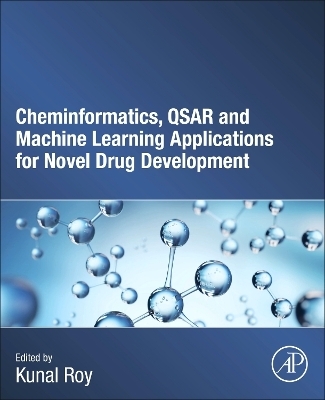
Cheminformatics, QSAR and Machine Learning Applications for Novel Drug Development
Academic Press Inc (Verlag)
978-0-443-18638-7 (ISBN)
The first part of the content is devoted to establishing the foundations of the area. Here recent trends in computational modeling of drugs are presented. Other topics present in this part include QSAR in medicinal chemistry, structure-based methods, chemoinformatics and chemometric approaches, and machine learning methods in drug design. The second part focuses on methods and case studies including molecular descriptors, molecular similarity, structure-based based screening, homology modeling in protein structure predictions, molecular docking, stability of drug receptor interactions, deep learning and support vector machine in drug design. The third part of the book is dedicated to special topics, including dedicated chapters on topics ranging from de design of green pharmaceuticals to computational toxicology. The final part is dedicated to present the available tools and databases, including QSAR databases, free tools and databases in ligand and structure-based drug design, and machine learning resources for drug design. The final chapters discuss different web servers used for identification of various drug candidates.
Dr. Kunal Roy is Professor & Ex-Head in the Department of Pharmaceutical Technology, Jadavpur University, Kolkata, India (https://sites.google.com/site/kunalroyindia). He has been a recipient of Commonwealth Academic Staff Fellowship (University of Manchester, 2007) and Marie Curie International Incoming Fellowship (University of Manchester, 2013) and a former visiting scientist of Istituto di Ricerche Farmacologiche "Mario Negri" IRCCS, Milano. Italy. The field of his research interest is Quantitative Structure-Activity Relationship (QSAR) and Molecular Modeling with application in Drug Design, Property Modeling and Predictive Ecotoxicology. Dr. Roy has published more than 450 research articles (ORCID: http://orcid.org/0000-0003-4486-8074) in refereed journals (current SCOPUS h index 57; total citations to date more than 17500). He has also coauthored three QSAR-related books (Academic Press and Springer), edited thirteen QSAR books (Springer, Academic Press, and IGI Global), and published twenty five book chapters. Dr. Roy is the Co-Editor-in-Chief of Molecular Diversity (Springer Nature) and an Associate Editor of Computational and Structural Biotechnology Journal (Elsevier). Dr. Roy serves on the Editorial Boards of several International Journals including (1) European Journal of Medicinal Chemistry (Elsevier); (2) Journal of Molecular Graphics and Modelling (Elsevier); (3) Chemical Biology and Drug Design (Wiley); (4) Expert Opinion on Drug Discovery (Informa). Apart from this, Prof. Roy is a regular reviewer for QSAR papers in different journals. Prof. Roy has been a participant in the EU funded projects nanoBRIDGES and IONTOX apart from several national Government funded projects (UGC, AICTE, CSIR, ICMR, DBT, DAE). Prof. Roy has recently been placed in the list of the World's Top 2% science-wide author database (whole career data) (World rank 52 in the subfield of Medicinal & Biomolecular Chemistry) (Ioannidis, John P.A. (2025), "August 2025 data-update for "Updated science-wide author databases of standardized citation indicators", Elsevier Data Repository, V8, link: http://doi.org/10.17632/btchxktzyw.8).
Section I: Introduction
1. Quantitative structure-activity relationships (QSARs) in medicinal chemistry
2. Computer-aided Drug Design – An overview
3. Structure-based virtual screening in Drug Discovery
4. The impact of Artificial Intelligence methods on drug design
Section 2. Methods and Case studies
5. Graph Machine Learning in Drug Discovery
6. Support Vector Machine in Drug Design
7. Understanding protein-ligand interactions using state-of-the-art computer simulation methods
8. Structure-based methods in drug design
9. Structure-based virtual screening
10. Deep learning in drug design
11. Computational methods in the analysis of viral-host interactions
12. Chemical space and Molecular Descriptors for QSAR studies
13. Machine learning methods in drug design
14. Deep learning methodologies in drug design
15. Molecular dynamics in predicting stability of drug receptor interactions
Section 3. Special topics
16. Towards models for bioaccumulation suitable for the pharmaceutical domain
17. Machine Learning as a Modeling Approach for the Account of Nonlinear Information in MIA-QSAR Applications: A Case Study with SVM Applied to Antimalarial (Aza)aurones
18. Deep Learning using molecular image of chemical structure
19. Recent Advances in Deep Learning Enabled Approaches for Identification of Molecules of Therapeutics Relevance
20. Computational toxicology of pharmaceuticals
21. Ecotoxicological QSAR modelling of pharmaceuticals
22. Computational modelling of drugs for neglected diseases
23. Modelling ADMET properties based on Biomimetic Chromatographic Data
24. A systematic chemoinformatic analysis of chemical space, scaffolds and antimicrobial activity of LpxC inhibitors
Section 4. Tools and databases
25. Tools and Software for Computer Aided Drug Design and Discovery
26. Machine learning resources for drug design
27. Building Bioinformatics Web Applications with Streamlit
28. Free tools and databases in ligand and structure-based drug design
| Erscheinungsdatum | 10.07.2023 |
|---|---|
| Verlagsort | San Diego |
| Sprache | englisch |
| Maße | 191 x 235 mm |
| Gewicht | 1590 g |
| Themenwelt | Medizin / Pharmazie ► Medizinische Fachgebiete ► Pharmakologie / Pharmakotherapie |
| Medizin / Pharmazie ► Pharmazie | |
| Naturwissenschaften ► Chemie | |
| Technik | |
| ISBN-10 | 0-443-18638-3 / 0443186383 |
| ISBN-13 | 978-0-443-18638-7 / 9780443186387 |
| Zustand | Neuware |
| Informationen gemäß Produktsicherheitsverordnung (GPSR) | |
| Haben Sie eine Frage zum Produkt? |
aus dem Bereich