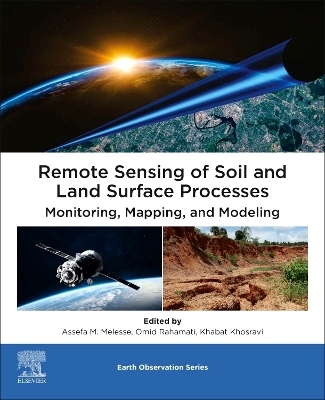
Remote Sensing of Soil and Land Surface Processes
Elsevier - Health Sciences Division (Verlag)
978-0-443-15341-9 (ISBN)
This book offers postgraduates, researchers and academics the latest techniques in remote sensing and geoinformation technologies to monitor soil and surface processes.
Dr. Assefa M. Melesse is a Distinguished University Professor of Water Resources Engineering at Florida International University. He earned his ME (2000) and PhD (2002) from the University of Florida in Agricultural Engineering. His areas of research and experience include climate change impact modeling, watershed modeling, ecohydrology, sediment transport, surface and groundwater interactions modeling, water–energy–carbon fluxes coupling and simulations, remote sensing hydrology, river basin management, and land cover change detection and scaling. Dr. Melesse is a registered Professional Engineer (PE), Board Certified Enviromental Engineer (BCEE) and also a Board Certified Water Resources Engineer (BC.WRE) with over 30 years of teaching and research experience, and has authored/edited 11 books, over 230 journal articles, and over 100 book chapters. Dr. Omid Rahmati is a geo-environmental researcher and Assistant Professor at the Agricultural Research, Education, and Extension Organization (AREEO) in Iran. His research focuses on applying machine learning models to natural hazard mitigation and watershed management. He has authored and co-authored over 70 articles in international peer-reviewed journals, as well as several books and book chapters. Dr. Rahmati’s publications have been cited more than 12,500 times (H-index: 56), and he has been recognized as a Highly Cited Researcher. He is ranked among the World’s Top 1% of Scientists by Web of Science (Clarivate, 2021–2022) and listed in Stanford University’s “World’s Top 2% Scientists from 2021 to 2025. His publications over the past decade reflect a broad and significant influence in his field. Dr. Khabat Khosravi is a Postdoctoral Researcher at Florida International University. His research areas are watershed hydrology, flood modeling, river engineering and bed-load sediment transport modeling, and the application of RS?GIS and machine learning models in water/soil science and natural hazard assessment. In 2020, 2021, and 2022, he was in the world’s top 2% scientists list based on Stanford University data. In addition, he is an Associate Editor in Natural Hazards, Acta Geophysica, and Earth Science Informatics journals.
1. Introduction to soil and sediment. 2. DInSAR-based assessment of groundwater-induced land subsidence zonation map. 3. Remotely sensed prediction of soil organic carbon employing multivariate regression and factor analysis approaches. 4. Conceptual of soil moisture based on remote sensing and reanalysis dataset. 5. Dust-source monitoring using remote sensing techniques. 6. Land Surface temperature and related issues. 7. Unraveling the changes in soil properties availed by UAV-derivative data in an arid floodplain: lessons learned and things to fathom. 8. Investigating the land use changes effects on the surface temperature using Landsat satellite data. 9. The application of remote sensing on wetlands Spatio-temporal change detection. 10. Machine learning modeling of wind-erodible fractions of soils. 11. Application of remote sensing techniques for evaluating land surfaces vegetation. 12. A Brief Review of Digital Soil Mapping in Iran. 13. Impact of land use and land cover changes on soil erosion. 14. Road-side Slope Erosion using MLS and Remote Sensing. 15. Suspended sediment load and machine learning. 16. Soil Erosion and Sediment Change Detection Using UAV Technology. 17. Monitoring and detection of land subsidence. 18. Drought mapping, modeling and remote sensing. 19. Predictive pedometric mapping of soil texture in small watersheds: Application of the integrated computer-assisted digital maps, machine learning, and limited soil data. 20. Object-based image analysis (OBIA) for gully erosion identification. 21. Landslide detection and monitoring using remote sensing approach. 22. Classification algorithms for remotely sensed images. 23. Spatial analysis of sediment connectivity and its applications. 24. Soil properties mapping using Google Earth Engine Platform. 25. Supportive role of remote sensing techniques for landslide susceptibility modeling. 26. An overview of remotely sensed fuel variables for the prediction of wildfires. 27. Improving landslide susceptibility mapping using integration of ResU-Net technique and optimized machine learning algorithms.
| Erscheinungsdatum | 03.11.2023 |
|---|---|
| Reihe/Serie | Earth Observation |
| Verlagsort | Philadelphia |
| Sprache | englisch |
| Maße | 191 x 235 mm |
| Gewicht | 960 g |
| Themenwelt | Naturwissenschaften ► Geowissenschaften ► Geophysik |
| ISBN-10 | 0-443-15341-8 / 0443153418 |
| ISBN-13 | 978-0-443-15341-9 / 9780443153419 |
| Zustand | Neuware |
| Informationen gemäß Produktsicherheitsverordnung (GPSR) | |
| Haben Sie eine Frage zum Produkt? |
aus dem Bereich