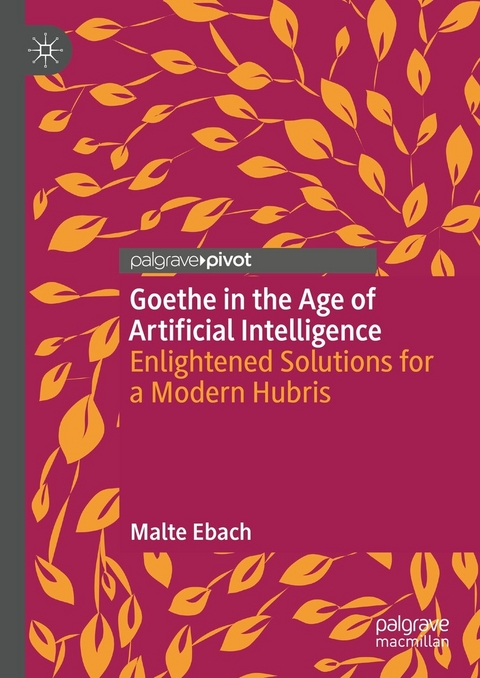
Goethe in the Age of Artificial Intelligence (eBook)
130 Seiten
Springer Nature Singapore (Verlag)
978-981-19-6741-2 (ISBN)
Inside you lies a precise scientific instrument – the ability to observe Nature and recall past experiences. You were born with it and you use it every day. You can be trained to use it more effectively to, for example, compare and discover new species of organisms or new minerals. Our senses do have limitations, and we often use microscopes, telescopes and other tools to aid our observation. However, we benefit from knowing their limitations and the impact they have on our ability to combine our observations and our experience to make decisions. Once these tools replace our direct observation and our experience we ourselves become disconnected from Nature. Scientific practice turns into well-meant opinions out-weighing empirical evidence. This is happening now in the current age of big data and artificial intelligence. The author calls this the Modern Hubris and it is slowly corroding science. To combat the Modern Hubris and to reconnect with Nature, scientists need to change the way they practise observation. To do so may require the scientist to transform themself. One person who successfully did this was Johann Wolfgang von Goethe. His journey demonstrates how one man attempted to take on the Modern Hubris by transforming his life and how he saw Nature. Following Goethe’s transformation teaches us how we can also reconnect ourselves with Nature and Natural science.
Inside you lies a precise scientific instrument - the ability to observe Nature and recall past experiences. You were born with it and you use it every day. You can be trained to use it more effectively to, for example, compare and discover new species of organisms or new minerals. Our senses do have limitations, and we often use microscopes, telescopes and other tools to aid our observation. However, we benefit from knowing their limitations and the impact they have on our ability to combine our observations and our experience to make decisions. Once these tools replace our direct observation and our experience we ourselves become disconnected from Nature. Scientific practice turns into well-meant opinions out-weighing empirical evidence. This is happening now in the current age of big data and artificial intelligence. The author calls this the Modern Hubris and it is slowly corroding science. To combat the Modern Hubris and to reconnect with Nature, scientists need to change the way they practise observation. To do so may require the scientist to transform themself. One person who successfully did this was Johann Wolfgang von Goethe. His journey demonstrates how one man attempted to take on the Modern Hubris by transforming his life and how he saw Nature. Following Goethe's transformation teaches us how we can also reconnect ourselves with Nature and Natural science.
| Erscheint lt. Verlag | 24.1.2023 |
|---|---|
| Zusatzinfo | XXII, 130 p. 25 illus. |
| Sprache | englisch |
| Themenwelt | Geisteswissenschaften ► Geschichte |
| Geisteswissenschaften ► Philosophie ► Erkenntnistheorie / Wissenschaftstheorie | |
| Naturwissenschaften | |
| Sozialwissenschaften ► Ethnologie | |
| Sozialwissenschaften ► Soziologie ► Spezielle Soziologien | |
| Schlagworte | Big Data • Goethe • machine learning • Metaphysics • Natural Philosophy • natural world • reductionism • Science and Technology Studies • Scientific Method • Scientific Writing • STS |
| ISBN-10 | 981-19-6741-5 / 9811967415 |
| ISBN-13 | 978-981-19-6741-2 / 9789811967412 |
| Informationen gemäß Produktsicherheitsverordnung (GPSR) | |
| Haben Sie eine Frage zum Produkt? |
 PDF (Wasserzeichen)
DRM: Digitales Wasserzeichen
Dieses eBook enthält ein digitales Wasserzeichen und ist damit für Sie personalisiert. Bei einer missbräuchlichen Weitergabe des eBooks an Dritte ist eine Rückverfolgung an die Quelle möglich.
Dateiformat: PDF (Portable Document Format)
Mit einem festen Seitenlayout eignet sich die PDF besonders für Fachbücher mit Spalten, Tabellen und Abbildungen. Eine PDF kann auf fast allen Geräten angezeigt werden, ist aber für kleine Displays (Smartphone, eReader) nur eingeschränkt geeignet.
Systemvoraussetzungen:
PC/Mac: Mit einem PC oder Mac können Sie dieses eBook lesen. Sie benötigen dafür einen PDF-Viewer - z.B. den Adobe Reader oder Adobe Digital Editions.
eReader: Dieses eBook kann mit (fast) allen eBook-Readern gelesen werden. Mit dem amazon-Kindle ist es aber nicht kompatibel.
Smartphone/Tablet: Egal ob Apple oder Android, dieses eBook können Sie lesen. Sie benötigen dafür einen PDF-Viewer - z.B. die kostenlose Adobe Digital Editions-App.
Buying eBooks from abroad
For tax law reasons we can sell eBooks just within Germany and Switzerland. Regrettably we cannot fulfill eBook-orders from other countries.
aus dem Bereich