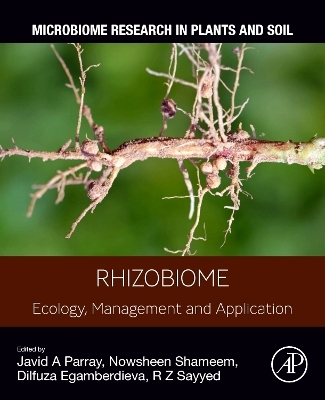
Rhizobiome
Academic Press Inc (Verlag)
978-0-443-16030-1 (ISBN)
Microbial-root associations are essential to assist plants under abiotic and biotic stresses and are necessary and beneficial to enhancing agricultural crop production. Numerous studies have enhanced our vision of the complex interactions between the plant, the associated microbial communities, and the environment. Further, microbe – microbe interactions allow the simulation microbial community interactions naturally, and is one of the many modern methods for the development of novel and effective metabolites.
Javid A. Parray holds a master’s degree in Environmental Science and completed his MPhil and PhD from the University of Kashmir, and qualified for the prestigious JKSLET exam. He also conducted post-doctoral research at Kashmir University and received a Fast Track Young Scientist Project by the Science and Engineering Research Board of the Government of India. He currently teaches at the Department of Environmental Science, GDC Eidgah Srinagar, affiliated with Cluster University Srinagar. His research interests include ecological and agricultural microbiology, climate change, microbial biotechnology, and environmental microbiomes. He is a prolific author and editor of numerous papers and books and serves on the editorial boards of several high-impact journals. A member of various scientific organizations, he received the “Emerging Scientist of the Year Gold Medal in 2018. Currently, he is the national coordinator for a Swayam Moocs program on Environmental Science. Recently, he was appointed series editor for Microbiome Research in Plants and Soil by Elsevier and serves as the Executive Editor in Chief for the open-access journal Micro Environer. Nowsheen Shameem presently works as an assistant professor in the Department of Environmental Science Cluster University Srinagar, Jammu and Kashmir, India. She worked as project associate in a DBT Sanctioned project entitled “Spawn Production for the Entrepreneurs of Kashmir Valley at CORD, University of Kashmir. Dr. Shameem has a strong interest in studying mushroom biology, bioactivity, and medicinal chemistry. She has dealt with bioactivities of endemic/threatened medicinal plants of Kashmir valley and other applied microbiology aspects, and has published many research articles in reputed, referred, international and national journals. Dilfuza Egamberdieva is a Research Associate at the Leibniz Centre of Agricultural Landscape Research, Germany, and head of the Joint Uzbek-China Key Lab of Ecobiomes of Arid Lands at the National University of Uzbekistan. Her research focuses on microbial ecology, plant-microbe interactions, plant nutrition, stress tolerance, and biological disease control. She holds an MSc in Microbiology and Chemistry from the National University of Uzbekistan and a PhD in Agricultural Biotechnology from Humboldt University of Berlin. Her postdoctoral studies included positions at Helsinki University, Florence University, Manchester Metropolitan University, and Leiden University. She has received numerous awards, including the 2019 SCOPUS Top Scientist of the Year, the 2013 TWAS Award in Agricultural Sciences, the 2006 L'OREAL-UNESCO Fellowship, and the 2005 UNESCO-Man and Biosphere Award, among others. She served on the UN’s HLPE on Food Security and Nutrition (2018-2019), is an elected member of the Global Young Academy of the American Society of Microbiology, and is a prolific book author and volume editor. Recently, she was appointed series editor for Microbiome Research in Plants and Soil by Elsevier and serves as the Co-editor in Chief for the open-access journal Micro Environer. Prof. Riyaz Z Sayyed is a Professor at University of Nizwa, Oman. He has over 20 years of teaching and research experience in Microbiology and Biotechnology and 17 years of administrative experience as Head of the Dept. He is Associate Editor of of various journals. He has authored over 350 research papers in high IF international journals and edited 34 books with Springer, Elsevier, Wiley, and CRC Press. Clarivate has listed him as a Top 1% of Highly Cited Researcher (2024) among 6,886 researchers worldwide. He has trained several graduates, postgraduates (over 100), and research students under his guidance. Prof. Sayyed has successfully organized 07 International conferences in the country and abroad and has been an invited speaker at many international conferences in India and many Southeast Asian and European countries. Prof. Sayyed has been the recipient of many prestigious national and international awards.
1. Diversity of various symbiotic associations between microbes and host plants
2. Amelioration of biotic stress by using rhizobacteria for Sustainable crop produce
3. Microbes: Salient Tools in Achieving Ecosystem Approaches
4. The role of rhizobacterial volatile compounds in increasing plant tolerance to biological and non-biological stresses
5. Bioremediation Potential of Rhizosphere microbes: current perspectives
6. Plant growth-promoting rhizobacteria (PGPR): their potential as antagonists and biological control agents
7. Rhizospheric microbiome: Organization and bioinformatics studies
8. Microbiome Biodiversity- current advancement and applications
9. Microbial Consortium with multifunctional plant growth-promoting attributes: Future Perspective in Agriculture
10. Nutrition and cultivation strategies of core Rhizosphere Microorganisms
11. Bioengineering of rhizobiome towards sustainable agricultural production
12. Rhizosphere Spatiotemporal analysis: a comprehensive study
13. Azospirillum, a free-living nitrogen-fixing bacterium: Smart Agriculture and Sustainable Exploitation
14. Plant-microbe interactions: Different perspectives in promoting plant growth and health
15. Rhizosphere ecology and management for improving nutrient use efficiency and crop productivity
16. Recent advances in discovery of new drugs from plant associated microbes
17. Plant Health: feedback effect of root exudates and rhizobiome interactions
18. Ecotypic adaption of plants and role of microbiota to ameliorate the environmental extremes using contemporary approaches
19. Ecological and structural attributes of soil rhizobiome affecting plant soil feedbacks under biotic stress
20. Bioinformatics study of role of rhizobiome to biologically control the pathogens of Vegetables
21. Multi omics analysis of rhizosphere and plant Health
22. Chemical profiling of metabolites of Bacillus Sps: A case study
23. Achievements of Prof. Hiltner vis a vis the contributions towards rhizopshere science
| Erscheinungsdatum | 03.08.2023 |
|---|---|
| Reihe/Serie | Microbiome Research in Plants and Soil |
| Verlagsort | San Diego |
| Sprache | englisch |
| Maße | 191 x 235 mm |
| Gewicht | 1020 g |
| Themenwelt | Naturwissenschaften ► Biologie ► Botanik |
| ISBN-10 | 0-443-16030-9 / 0443160309 |
| ISBN-13 | 978-0-443-16030-1 / 9780443160301 |
| Zustand | Neuware |
| Informationen gemäß Produktsicherheitsverordnung (GPSR) | |
| Haben Sie eine Frage zum Produkt? |
aus dem Bereich