


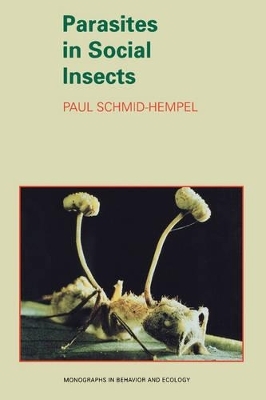
Parasites in Social Insects
Seiten
1998
Princeton University Press (Verlag)
978-0-691-05924-2 (ISBN)
Princeton University Press (Verlag)
978-0-691-05924-2 (ISBN)
Analyzes how parasites shape the biology of social insects: the ants, wasps, bees, and termites. This book places the issues such as division of labor, genetics, immunology, and epidemiology in a common framework to examine two of the most successful adaptations of life: parasitism and sociality.
This book analyzes for the first time how parasites shape the biology of social insects: the ants, wasps, bees, and termites. Paul Schmid-Hempel provides an overview of the existing knowledge of parasites in social insects. Current ideas are evaluated using a broad database, and the role of parasites for the evolution and maintenance of the social organization and biology of insects is carefully scrutinized. In addition, the author develops new insights, especially in his examination of the intricate relationships between parasites and their social hosts through the rigorous use of evolutionary and ecological concepts. Schmid-Hempel identifies gaps in our knowledge about parasites in social insects and uses models to develop new questions for future research. In addition, issues that are usually considered separately--such as division of labor, genetics, immunology, and epidemiology--are placed in a common framework to analyze two of the most successful adaptations of life: parasitism and sociality.
This work will appeal not only to practitioners in the fields of behavioral ecology and sociobiology, but also to others interested in host-parasite relationships or in social organisms, such as apiculturists struggling to overcome the problems arising from mite infestations of honeybee colonies.
This book analyzes for the first time how parasites shape the biology of social insects: the ants, wasps, bees, and termites. Paul Schmid-Hempel provides an overview of the existing knowledge of parasites in social insects. Current ideas are evaluated using a broad database, and the role of parasites for the evolution and maintenance of the social organization and biology of insects is carefully scrutinized. In addition, the author develops new insights, especially in his examination of the intricate relationships between parasites and their social hosts through the rigorous use of evolutionary and ecological concepts. Schmid-Hempel identifies gaps in our knowledge about parasites in social insects and uses models to develop new questions for future research. In addition, issues that are usually considered separately--such as division of labor, genetics, immunology, and epidemiology--are placed in a common framework to analyze two of the most successful adaptations of life: parasitism and sociality.
This work will appeal not only to practitioners in the fields of behavioral ecology and sociobiology, but also to others interested in host-parasite relationships or in social organisms, such as apiculturists struggling to overcome the problems arising from mite infestations of honeybee colonies.
Paul Schmid-Hempel is Professor of Experimental Ecology at ETH in Zyrich, Switzerland, and the head of a research group on the evolutionary ecology of host-parasite interactions.
Preface and Acknowledgments1The Biology of Social Insects32The Parasites and Their Biology243Breaking into the Fortress774Parasites and the Organization of the Colony1195Breeding Strategies and Parasites1636Host-Parasite Dynamics2047Virulence and Resistance2378Social Evolution273App. 1: Glossary287App. 2The Parasites of Social Insects291References325Subject Index381Host Taxonomic Index386Parasite Taxonomic Index393Author Index399
| Erscheint lt. Verlag | 22.11.1998 |
|---|---|
| Reihe/Serie | Monographs in Behavior and Ecology |
| Zusatzinfo | 8 halftones 67 line drawings 34 tables |
| Verlagsort | New Jersey |
| Sprache | englisch |
| Maße | 197 x 254 mm |
| Gewicht | 567 g |
| Themenwelt | Naturwissenschaften ► Biologie ► Mikrobiologie / Immunologie |
| Naturwissenschaften ► Biologie ► Zoologie | |
| ISBN-10 | 0-691-05924-1 / 0691059241 |
| ISBN-13 | 978-0-691-05924-2 / 9780691059242 |
| Zustand | Neuware |
| Informationen gemäß Produktsicherheitsverordnung (GPSR) | |
| Haben Sie eine Frage zum Produkt? |
Mehr entdecken
aus dem Bereich



aus dem Bereich
Mikroskopisch kleine Multitalente
Buch | Hardcover (2025)
Schweizerbart'sche, E. (Verlag)
CHF 41,85


