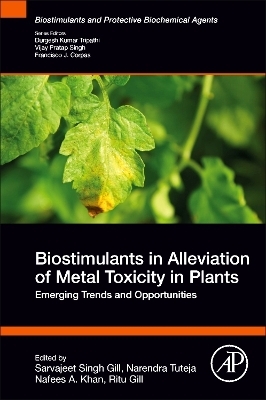
Biostimulants in Alleviation of Metal Toxicity in Plants
Academic Press Inc (Verlag)
978-0-323-99600-6 (ISBN)
Once inside a plant system, toxic metals may initiate a variety of physiological alterations in plants, including adversely impacted seed germination, root and shoot growth, chloroplasts ultrastructure and photosynthesis, nutrients assimilation, carbohydrates metabolism, and plant hormonal status which, collectively, results in reduced plants yields. In addition to several naturally occurring physiological and metabolic re-programing responses, plants may also modify their root and shoot systems in order to dilute entered amount of toxic metals. As an additional tool biostimulants have emerged as one of the important plant protectors under adverse conditions.
Sarvajeet Singh Gill is an Associate Professor at the Centre for Biotechnology, Maharshi Dayanand University, Rohtak, India. His research areas include agricultural plant biotechnology, biotic and abiotic stress biology, plant microbe interaction, and in-silico understanding of plant genomes. He has 12 years of research and 10 years of teaching experience. Dr. Gill has written over 50 book chapters and published over 100 peer reviewed publications in reputed SCI journals and edited around 30 books published by International publishers such Springer-Verlag, Wiley-Blackwell, CRC Press, and Elsevier, among others. He has carried out four R&D projects funded by prominent National funding agencies as Principal Investigator. An elected fellow of numerous national and international academies, Dr. Narendra Tuteja is currently Professor and head at Amity Institute of Microbial Technology, NOIDA, India, and visiting Scientist at International Centre for Genetic Engineering & Biotechnology (ICGEB), New Delhi, India. He has made significant contributions to crop improvement under adverse conditions, reporting the first helicase from plant and human cells and demonstrating new roles of Ku autoantigen, nucleolin and eIF4A as DNA helicases. Furthermore, he discovered novel functions of helicases, G-proteins, CBL-CIPK and LecRLK in plant stress tolerance, and PLC and MAP-kinase as effectors for Gα and Gβ G-proteins. Narendra Tuteja also reported several high salinity stress tolerant genes from plants and fungi and developed salt/drought tolerant plants. Prof. Nafees A. Khan is a distinguished Professor of Plant Physiology in the Department of Botany at Aligarh Muslim University (AMU). Holding both a PhD and a DSc from AMU, he is internationally renowned for his pioneering research on abiotic stress tolerance in plants, phytohormone signaling, and sustainable agricultural practices. A Highly Cited Researcher (Clarivate Analytics, 2019–23), he has received prestigious awards, including the UGC-Research and Mid-Career Awards, the Teaching Excellence Award, and the Research Excellence Citation Award 2023 (Clarivate Analytics). He is also a fellow of several esteemed academies, including the National Academy of Sciences, the National Academy of Agricultural Sciences, the Linnean Society of London, the Indian Botanical Society, and the Indian Society for Plant Physiology. His groundbreaking research integrates nutrient-use efficiency with stress resistance mechanisms, making substantial contributions to the advancement of global agricultural sustainability. Dr. Ritu Gill is an Assistant Professor at Centre for Biotechnology, Maharshi Dayanand University, Rohtak since March, 2010. Prior to joining MDU, he worked as researcher at Structural Biology Group, International Centre for Genetic Engineering & Biotechnology (ICGEB), New Delhi. Dr. Gill did his M.Sc in 2003 with distinction and completed Ph.D. from DRDE, Gwalior, India in 2007 with significant research publications. Her research areas include Computational Biology; Antimicrobials for Malaria research; Abiotic stress biology, plant microbe interaction and in-silico understanding of plant genomes. Dr. Gill has quality publication in the journals of International repute and also edited books with International Publishers.
1. Biostimulants: An Introduction
2. Sources of endogenous biostimulants in plants
3. Role of Biostimulants in plant’s life cycle
4. Biostimulants homeostasis in plants
5. Implication of endogenous biostimulants in regulating Cd toxicity
6. Implication of endogenous biostimulants in regulating As toxicity
7. Implication of endogenous biostimulants in regulating Al toxicity
8. Exogenous application of biostimulants and Cd stress tolerance
9. Exogenous application of biostimulants and As stress tolerance
10. Exogenous application of NO and Al stress tolerance
11. Exogenous application of Biostimulants and commercial utilization
12. Biostimulants and regulation of Cr, Pb, Fe, Zn, Hg, Cu, Mn and Ni stress in plants
13. Biostimulants signalling under Cd, Al, As, Zn, Fe toxicity
14. Post translational modifications and metal stress tolerance in plants
15. Adventitious root formation and Biostimulants under metal stress
16. Crosstalk of biostimulants with other signalling molecules under metal stress
17. Biotechnological attributes of biostimulants for relieving metal toxicity
Heavy metal stress and biostimulants interaction: Conclusion and future perspectives
| Erscheinungsdatum | 03.08.2023 |
|---|---|
| Reihe/Serie | Biostimulants and Protective Biochemical Agents |
| Verlagsort | Oxford |
| Sprache | englisch |
| Maße | 152 x 229 mm |
| Gewicht | 1000 g |
| Themenwelt | Naturwissenschaften ► Biologie ► Biochemie |
| Naturwissenschaften ► Biologie ► Botanik | |
| Naturwissenschaften ► Biologie ► Genetik / Molekularbiologie | |
| ISBN-10 | 0-323-99600-0 / 0323996000 |
| ISBN-13 | 978-0-323-99600-6 / 9780323996006 |
| Zustand | Neuware |
| Informationen gemäß Produktsicherheitsverordnung (GPSR) | |
| Haben Sie eine Frage zum Produkt? |
aus dem Bereich