Optimal Fractional-order Predictive PI Controllers (eBook)
146 Seiten
Springer Nature Singapore (Verlag)
978-981-19-6517-3 (ISBN)
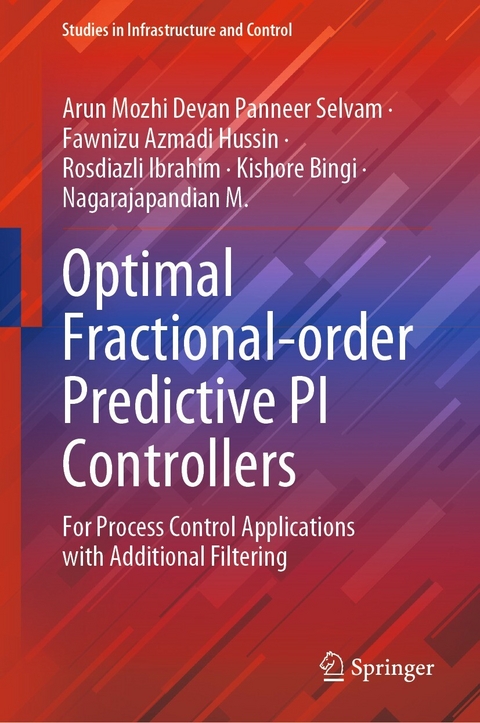
This book presents the study to design, develop, and implement improved PI control techniques using dead-time compensation, structure enhancements, learning functions and fractional ordering parameters. Two fractional-order PI controllers are proposed and designed: fractional-order predictive PI and hybrid iterative learning based fractional-order predictive PI controller. Furthermore, the proposed fractional-order control strategies and filters are simulated over first- and second-order benchmark process models and further validated using the real-time experimentation of the pilot pressure process plant.
In this book, five chapters are structured with a proper sequential flow of details to provide a better understanding for the readers. A general introduction to the controllers, filters and optimization techniques is presented in Chapter 1. Reviews of the PI controllers family and their modifications are shown in the initial part of Chapter 2, followed by the development of the proposed fractional-order predictive PI (FOPPI) controller with dead-time compensation ability. In the first part of chapter 3, a review of the PI based iterative learning controllers, modified structures of the ILC and their modifications are presented. Then, the design of the proposed hybrid iterative learning controller-based fractional-order predictive PI controller based on the current cyclic feedback structure is presented. Lastly, the results and discussion of the proposed controller on benchmark process models and the real-time experimentation of the pilot pressure process plant are given. Chapter 4 presents the development of the proposed filtering techniques and their performance comparison with the conventional methods. Chapter 5 proposes the improvement of the existing sine cosine algorithm (SCA) and arithmetic optimization algorithm (AOA) to form a novel arithmetic-trigonometric optimization algorithm (ATOA) to accelerate the rate of convergence in lesser iterations with mitigation towards getting caught in the same local position. The performance analysis of the optimization algorithm will be carried out on benchmark test functions and the real-time pressure process plant.
This book presents the study to design, develop, and implement improved PI control techniques using dead-time compensation, structure enhancements, learning functions and fractional ordering parameters. Two fractional-order PI controllers are proposed and designed: fractional-order predictive PI and hybrid iterative learning based fractional-order predictive PI controller. Furthermore, the proposed fractional-order control strategies and filters are simulated over first- and second-order benchmark process models and further validated using the real-time experimentation of the pilot pressure process plant. In this book, five chapters are structured with a proper sequential flow of details to provide a better understanding for the readers. A general introduction to the controllers, filters and optimization techniques is presented in Chapter 1. Reviews of the PI controllers family and their modifications are shown in the initial part of Chapter 2, followed by the development of the proposed fractional-order predictive PI (FOPPI) controller with dead-time compensation ability. In the first part of chapter 3, a review of the PI based iterative learning controllers, modified structures of the ILC and their modifications are presented. Then, the design of the proposed hybrid iterative learning controller-based fractional-order predictive PI controller based on the current cyclic feedback structure is presented. Lastly, the results and discussion of the proposed controller on benchmark process models and the real-time experimentation of the pilot pressure process plant are given. Chapter 4 presents the development of the proposed filtering techniques and their performance comparison with the conventional methods. Chapter 5 proposes the improvement of the existing sine cosine algorithm (SCA) and arithmetic optimization algorithm (AOA) to form a novel arithmetic-trigonometric optimization algorithm (ATOA) to accelerate the rate of convergence in lesser iterations with mitigation towards getting caught in the same local position. The performance analysis of the optimization algorithm will be carried out on benchmark test functions and the real-time pressure process plant.
| Erscheint lt. Verlag | 1.11.2022 |
|---|---|
| Reihe/Serie | Studies in Infrastructure and Control | Studies in Infrastructure and Control |
| Zusatzinfo | XVIII, 146 p. 63 illus., 57 illus. in color. |
| Sprache | englisch |
| Themenwelt | Mathematik / Informatik ► Informatik ► Programmiersprachen / -werkzeuge |
| Informatik ► Theorie / Studium ► Algorithmen | |
| Mathematik / Informatik ► Mathematik ► Analysis | |
| Mathematik / Informatik ► Mathematik ► Angewandte Mathematik | |
| Mathematik / Informatik ► Mathematik ► Finanz- / Wirtschaftsmathematik | |
| Naturwissenschaften | |
| Technik ► Elektrotechnik / Energietechnik | |
| Schlagworte | Benchmark Functions • Dead-time Compensation • Dead-time Processes • filtering • Fractional-order Controller • Fractional-order PI Controller • Optimization • PID Controller • Predictive Controller • Process Control • Process Modelling • Trigonometric Functions |
| ISBN-10 | 981-19-6517-X / 981196517X |
| ISBN-13 | 978-981-19-6517-3 / 9789811965173 |
| Informationen gemäß Produktsicherheitsverordnung (GPSR) | |
| Haben Sie eine Frage zum Produkt? |
 PDF (Wasserzeichen)
DRM: Digitales Wasserzeichen
Dieses eBook enthält ein digitales Wasserzeichen und ist damit für Sie personalisiert. Bei einer missbräuchlichen Weitergabe des eBooks an Dritte ist eine Rückverfolgung an die Quelle möglich.
Dateiformat: PDF (Portable Document Format)
Mit einem festen Seitenlayout eignet sich die PDF besonders für Fachbücher mit Spalten, Tabellen und Abbildungen. Eine PDF kann auf fast allen Geräten angezeigt werden, ist aber für kleine Displays (Smartphone, eReader) nur eingeschränkt geeignet.
Systemvoraussetzungen:
PC/Mac: Mit einem PC oder Mac können Sie dieses eBook lesen. Sie benötigen dafür einen PDF-Viewer - z.B. den Adobe Reader oder Adobe Digital Editions.
eReader: Dieses eBook kann mit (fast) allen eBook-Readern gelesen werden. Mit dem amazon-Kindle ist es aber nicht kompatibel.
Smartphone/Tablet: Egal ob Apple oder Android, dieses eBook können Sie lesen. Sie benötigen dafür einen PDF-Viewer - z.B. die kostenlose Adobe Digital Editions-App.
Buying eBooks from abroad
For tax law reasons we can sell eBooks just within Germany and Switzerland. Regrettably we cannot fulfill eBook-orders from other countries.
aus dem Bereich